TL;DR
- Clear Street upgraded Circle to Buy, raising price target from $92 to $136.
- Trump backs CLARITY Act, removing key regulatory barriers for institutional stablecoin use.
- Stablecoin utility now expands beyond trading into payments, lending, and cross-border transfers.
Clear Street upgraded Circle (CRCL) from Hold to Buy, raising its price target from $92 to $136. The firm identified multiple structural drivers supporting continued USDC expansion, the stablecoin issued by Circle. Circle shares have recovered ground after collapsing 81% from its $264 peak recorded in June 2025, hitting bottom near $50 in February 2026 before rebounding over 100%.
Recovery context reflects sentiment shift on stablecoins. While the entire crypto market declined 44% since October 2025, USDC maintained stability and grew in market capitalization. Clear Street identifies five factors supporting demand: asset tokenization, decentralized prediction markets, geopolitical pressures, artificial intelligence system integration, and regulatory developments in the United States.

Tokenization generates the first driver. Financial institutions convert traditional assets into digital representations on blockchains, frequently using USDC as the settlement asset. Decentralized prediction markets constitute the second factor: platforms like Polymarket require stablecoins for trading operations and position closure.
As participation grows, USDC balances on those platforms multiply. Geopolitical uncertainty in the Middle East adds a third factor: users seek digital financial tools during tension periods. Artificial intelligence systems represent the fourth driver: automated infrastructure requires stablecoins as programmable money for autonomous payments and settlements.
U.S. Regulation Could Accelerate Institutional Stablecoin Adoption
The fifth driver originates from Washington. Donald Trump expressed public support for the CLARITY Act, legislation designed to clarify stablecoin regulatory status in the United States. Greater regulatory clarity reduces friction for institutional adoption. Banks and payment platforms hesitate adopting stablecoins while legal uncertainty persists. Favorable legislation would remove those barriers entirely.
CryptoQuant reports nearly 593,000 daily active addresses interacting with ERC-20 stablecoins, a dramatic increase compared to previous years. Stablecoin usage has evolved from simple trading pairs into integral blockchain finance infrastructure: payments, liquidity provision, decentralized lending, cross-border transfers.
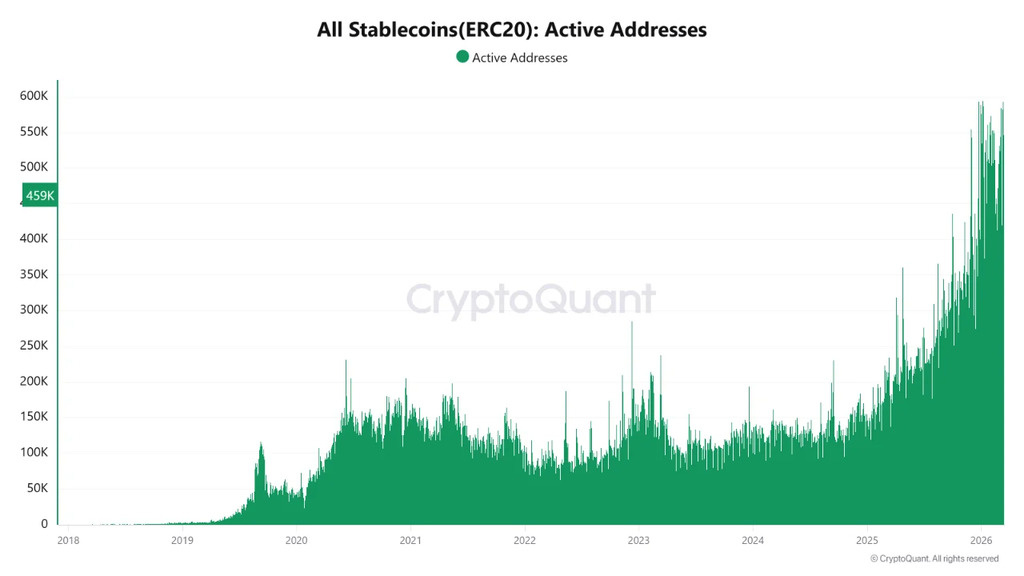
Global adoption accelerates particularly in markets with inflation or weak local currencies. Nigeria demonstrates clear pattern: users employ USDT and USDC to preserve value and execute peer-to-peer transfers without intermediaries.
India and the Philippines show similar trend: remote workers use stablecoins to send remittances home faster and cheaper than traditional banking systems. In developed markets like the United States, stablecoins enable rapid capital movement between crypto platforms and tactical positioning.
CRCL approaches $115 from $50, yet remains distant from historical highs. Clear Street projects additional upside toward $136 if catalysts materialize on expected timeline. The question for investors centers on whether USDC genuinely becomes global financial infrastructure or momentum dissipates.
On-chain evidence and real use cases in specific jurisdictions suggest authentic expansion beyond temporary speculation. Stablecoin adoption continues accelerating across payment settlement, AI integration, and cross-border remittances, positioning Circle for sustained growth if regulatory frameworks provide clarity supporting institutional participation.