TL;DR
- Stable blockchain will switch its native gas token to USDT0 on February 4.
- The upgrade aims to simplify payments and accounting by using a single stablecoin.
- It removes complexity for businesses by eliminating volatile gas tokens from operations.
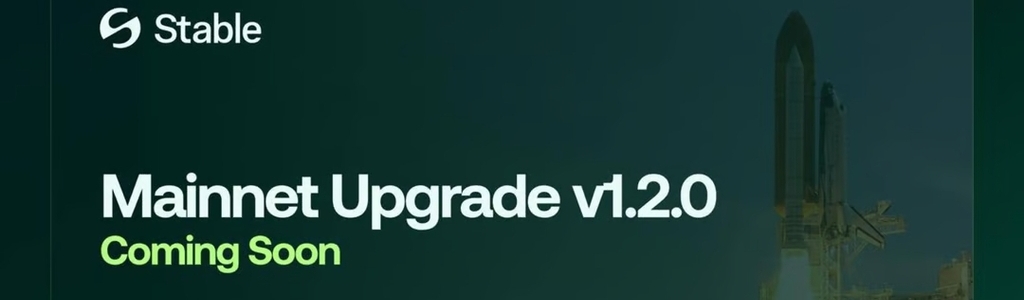
Stable, a Tether-backed Layer 1 blockchain, prepares a core protocol change scheduled for February 4, when the network switches its native gas token from gUSDT to USDT0 through the v1.2.0 mainnet upgrade. The decision arrives less than two months after mainnet launch and reflects an accelerated development cycle aimed at operational clarity rather than cosmetic change.
By placing USDT0 at the center of fee payment and settlement, Stable aligns transaction costs and value transfer under a single dollar-pegged unit, removing structural friction present in many existing chains.
Since debut on December 8, the network has attracted more than $780 million in on-chain value, supported by integrations and partnerships with firms such as Anchorage Digital, PayPal Ventures, Oobit, and Orbital. Activity growth followed a simple premise: payment infrastructure benefits from predictability, and stablecoins provide a familiar accounting base for businesses that manage cash flows daily.
Stable’s design rejects exposure to volatile native gas assets. All transactions settle in USDT, which reduces treasury complexity for payment processors and financial institutions.
In practical terms, accounting teams see fewer reconciliation steps, and developers handle fewer edge cases in transaction execution. The upgrade formalizes such logic by retiring gUSDT entirely in favor of USDT0 as native gas.
The v1.2.0 release does more than change a token label
The upgrade introduces a protocol-level on-chain signal for undelegation completion, allowing applications and indexers to track staking lifecycles directly from chain data. Developers gain deterministic visibility without polling endpoints or inferring state from secondary signals.
Stable also resolves Solidity compatibility issues reported during early deployment phases and adds API-managed gas waivers, enabling controlled zero-gas transaction flows for approved use cases.

The network relies on StableBFT consensus, delivering sub-second block finality while maintaining full EVM compatibility. Fee structures remain low for high-volume users, a factor that matters more than novelty when enterprises evaluate infrastructure.
Teams need to confirm support for USDT0-based gas handling across signing, fee estimation, and transaction submission. Indexers also require updates to listen for the new undelegation completion signal.
The company previously announced StablePay, a wallet designed for everyday use, with free peer-to-peer transfers at the wallet level. The roadmap targets broader adoption without relying on speculative incentives. Growth depends on usage volume and reliability, not hype cycles.
Competition continues to form around institutional stablecoin payments. Circle’s Arc, Stripe’s Tempo, and Plasma, a USDT-focused chain backed by Bitfinex and Framework Ventures, all pursue similar markets. Stable differentiates through early production focus and unified settlement design.