


Crypto market cycles can move quickly, and attention often shifts between large-cap networks and newer token projects. Recently, two names discussed by market participants have been Solana (SOL) and BullZilla ($BZIL). This article summarizes publicly available claims and commentary about both assets.
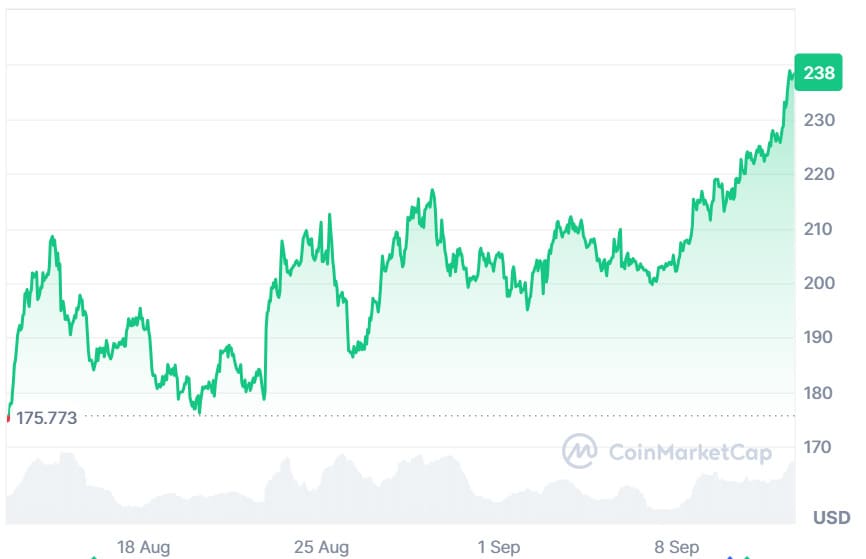
Some market commentary has included price targets for SOL around $300, although such targets are speculative and depend on broader market conditions. Separately, BullZilla has published updates about its early-stage token sale, including planned price adjustments. These are project-reported details and should be treated as unverified.
Solana price discussion: $300 as a frequently cited level
Solana has traded above the $225 area for the first time since February, amid discussions about institutional participation and exchange-traded product demand. Market narratives and fundamentals can influence sentiment, but outcomes are uncertain and prices can be volatile.
Institutional activity and ETF-related headlines
According to widely reported market coverage, on September 9th Forward Industries committed $1.65 billion to a Solana-focused treasury strategy. Separately, the REX-Osprey SOL + Staking ETF reported $3.4 million in inflows, bringing reported holdings to nearly $200 million. These figures are reported by third parties and can change over time.
Several issuers, including Grayscale, VanEck, Fidelity, and Bitwise, have been associated with efforts to launch spot Solana ETFs. Commentary about potential regulatory outcomes should be treated as uncertain. Some analysts have suggested that approval could affect market liquidity and sentiment, but there is no guarantee of a sustained price move.
Technical structure
From a technical-analysis perspective, some traders have focused on the $200 level and the $224.92 area as a retest zone. Commonly cited indicators include:
- MACD: described by some market commentators as bullish with a widening histogram.
- RSI: reported around 64 in some chart snapshots, which some traders interpret as neither extremely overbought nor oversold.
- Resistance: levels frequently referenced in commentary include $225, then $260 and $300.
Technical signals are interpretive and can fail, particularly during periods of high volatility or news-driven trading.
Ecosystem changes and community activity
Outside institutional activity, Solana’s ecosystem has also been referenced in retail-focused narratives. For example, a meme-token project, Wall Street Pepe, has announced a migration from Ethereum to Solana and reported token burns during the process. Such project-reported figures are not independently verified here.
Overall, Solana continues to be discussed as a major network with active development and periodic demand shifts. However, comparisons across assets should account for differences in maturity, liquidity, and risk.
BullZilla token sale: project-reported pricing and mechanics
While Solana is traded in public markets, BullZilla ($BZIL) has been promoted by its team through an early-stage token sale. Project materials state that the token was priced at $0.00004575 during a “Stage 2C” period and that a higher price point of $0.00005241 was scheduled next. These are claims published by the project and may change.
“Roar Burn” and supply-related claims
BullZilla’s materials describe a “Roar Burn Mechanism,” which the project says is intended to permanently remove tokens at certain milestones and record those actions on-chain. Supply changes can affect supply/demand dynamics, but they do not guarantee a particular market outcome.
The project also describes community events referred to as “Roar Surges.” These features are presented as part of the project’s narrative and marketing.
“Roarblood Vault” and staking-related features
BullZilla’s materials also reference a “Roarblood Vault” intended to support marketing incentives, including referral bonuses described as 10%. Referral programs are promotional by design and can introduce additional risks, including potential conflicts of interest.
The project further describes a “HODL Furnace” staking feature and advertises staking rewards “up to 70% APY.” Any such rates are project-reported, may be subject to conditions (including vesting), and are not guaranteed.
Token-sale snapshot (project-reported)
- Stage: 2nd (Dead Wallets Don’t Lie), Phase 2C
- Current Price: $0.00004575
- Next Price: $0.00005241
- Raised: $360,000+
- Holders: 1,239+
These figures are presented in project communications and should not be interpreted as evidence of future market demand or performance.
Illustrative valuation examples
Some token projects circulate illustrative valuation examples based on assumed future prices. These scenarios are inherently speculative, depend on market liquidity and adoption, and are not reliable indicators of future results.
Conclusion
In September 2025, Solana-related coverage has centered on ETF developments, institutional positioning, and technical price levels that some traders watch, including $300. Separately, BullZilla has promoted an early-stage token sale with a staged pricing model and several branded tokenomics features, as described in its own materials.
Readers should treat all forward-looking statements and price targets as uncertain, and should independently verify project-reported claims.
For More Information:
Follow BZIL on X (Formerly Twitter)
Frequently Asked Questions
Why is Solana often discussed as a major crypto asset?
Commentary often points to institutional interest, potential exchange-traded product developments, and a large ecosystem of applications. None of these factors guarantees any specific price outcome.
What does BullZilla say differentiates its token sale from other meme tokens?
Project materials describe a staged pricing model, a “Roar Burn Mechanism,” and marketing incentives via the “Roarblood Vault.” These are project claims and should be evaluated independently.
When is the next BullZilla token-sale price change scheduled?
The project has stated that the token-sale price would move from $0.00004575 to $0.00005241 at its next stage. Schedules and prices can change.
How does the “Roar Burn” feature work, according to the project?
The project says it burns tokens on-chain at certain milestones, reducing supply. Supply changes may influence market dynamics, but they do not guarantee price appreciation.
Are ROI projections for early-stage tokens reliable?
No. ROI projections depend on assumptions about future prices, liquidity, and adoption, and outcomes can vary widely—including loss of capital.
Can Solana and BullZilla generate very large returns?
Returns in crypto markets are uncertain. Large gains are possible in some market conditions, but so are significant drawdowns. Any specific return multiple should be treated as speculative.
Glossary of Terms
- Roar Burn Mechanism: BullZilla’s described deflationary feature that the project says burns tokens on-chain at chapter milestones.
- Roarblood Vault: A project-described treasury mechanism used for community and referral incentives.
- HODL Furnace: BullZilla’s described staking model, which the project advertises as offering rewards up to 70% APY (not guaranteed).
- ETF (Exchange-Traded Fund): A regulated investment vehicle that can track an asset such as Solana.
- MACD (Moving Average Convergence Divergence): A trend-following indicator used in technical analysis.
- RSI (Relative Strength Index): A metric used in technical analysis to gauge momentum and overbought/oversold conditions.
- Liquidity: The ease of buying or selling an asset without significantly impacting its price.
- Scarcity: A reduction in supply, which may influence supply/demand dynamics but does not guarantee price changes.
- Early-stage token sale: A fundraising and distribution period before broader secondary-market trading.
- Diamond Claws: A term used in BullZilla’s materials to refer to long-term holders.
This article is for informational purposes only and does not constitute financial or investment advice. This outlet is not affiliated with the project mentioned.

