

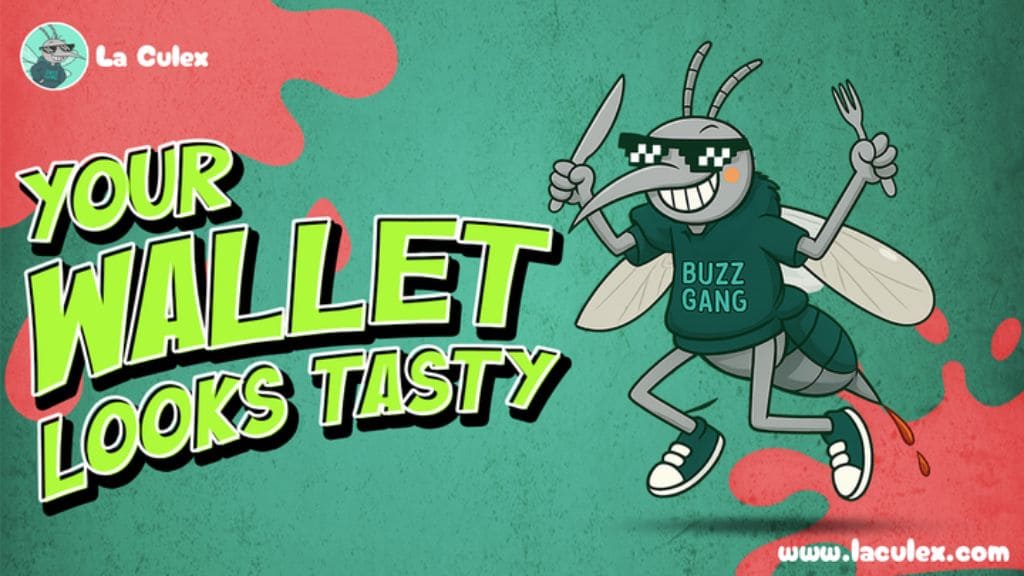
Timing the crypto market is often compared to trying to catch a mosquito in the dark: it can be difficult to do consistently. That metaphor is also used in La Culex ($CULEX) project materials; the project uses a mosquito-themed brand and meme-style marketing. This article reviews seven tokens and networks that are frequently discussed by market participants: La Culex, Solana, Chainlink, Toncoin, Injective, XRP, and Dogecoin.
According to the project’s public materials, the La Culex token sale uses a staged structure in which the token price changes on a schedule or when certain thresholds are reached. While staged sales can affect short-term pricing within the sale itself, they do not indicate future market performance after any potential listing. The sections below summarize the stated positioning and use cases of each project, along with commonly cited considerations and risks.
1. La Culex: A Staged Token Sale With Scheduled Price Changes
La Culex is presented as a meme-themed project. In project materials, the current stage is described as “Bug Spray Dip,” with a token sale price of $0.00002274 at the time of writing. The project also reports figures such as funds raised, token holders, and tokens sold; these figures are self-reported and may change over time.

The project describes planned stage-to-stage price changes during the token sale. Any references to potential future listing prices or returns should be treated as speculative and uncertain, and token sale pricing should not be interpreted as an indicator of market value once trading begins (if it does).
2. Solana: High-Throughput Network for Consumer and DeFi Activity
Solana is a smart-contract network designed for high throughput and relatively low transaction fees. It is used across several categories including payments, gaming, trading tools, NFT activity, and consumer-facing applications.
Network usage can vary with market conditions and application demand. Like other major platforms, Solana’s ecosystem depends on developer activity, user adoption, and network reliability.
Solana is a more established network than early-stage token-sale projects. Its risk profile and maturity are therefore different from new token launches.
3. Chainlink: Oracle Infrastructure for Smart Contracts
Chainlink is primarily known for providing oracles that deliver off-chain data (such as pricing data, rates, and event triggers) to blockchains so smart contracts can reference external information.
The project has also discussed work related to institutional integrations and real-world asset tokenization. These initiatives depend on adoption by partners and market participants and may evolve over time.
Compared with meme-themed token launches, Chainlink is generally positioned as infrastructure that underpins multiple applications and networks.
4. Toncoin: Consumer Distribution Through Messaging Platforms
Toncoin (TON) is associated with an ecosystem that emphasizes bringing wallets, mini-apps, and payments into messaging-platform-style user experiences.
If consumer distribution and app integrations expand, network usage could increase. However, outcomes may be influenced by product execution, competition, and external factors such as regulatory scrutiny.
5. Injective: On-Chain Trading and DeFi Markets
Injective focuses on trading-oriented DeFi applications, including spot and derivatives-style markets, with an emphasis on speed and user experience.
As with other trading-focused platforms, risks can include market volatility, smart-contract vulnerabilities, liquidity constraints, and the broader regulatory environment for derivatives-like products.
Its niche is typically framed around providing tools for active traders who want on-chain custody while using exchange-like functionality.
6. XRP: Cross-Border Value Transfer Use Case
XRP is commonly discussed in the context of cross-border value transfer and settlement. Proponents argue it can reduce friction in international transfers compared with some legacy systems.
XRP has also been associated with legal and regulatory developments over time, which may affect market perception and participation depending on jurisdiction.
Within this list, XRP is often framed as a longer-standing asset with a defined narrative around payments and settlement rather than early-stage fundraising.
7. Dogecoin: Meme-Origin Asset With Broad Public Awareness
Dogecoin began as a joke and became a widely recognized meme-origin token. It has been used for tipping and small payments and continues to benefit from brand familiarity and public attention.
That visibility can influence short-term interest, but it does not remove the risks common to crypto assets, including volatility and shifting market sentiment.
Conclusion
The altcoin market includes established networks and long-running assets, including Solana for high-throughput applications, Chainlink for oracle infrastructure, Toncoin for consumer distribution themes, Injective for trading-focused DeFi, XRP for cross-border settlement narratives, and Dogecoin for cultural recognition.
La Culex differs from the others in this list because it is described as being in a staged token-sale period. Token sales are generally considered high risk: schedules, stage prices, and marketing claims are not the same as verified fundamentals, and trading outcomes (if a token later becomes tradable) are uncertain.
For More Information:
Project website (for reference): Visit the Official CULEX Website
Social (for reference): Follow CULEX ON X (Formerly Twitter)
This article is for informational purposes only and does not constitute financial or investment advice. This outlet is not affiliated with the project mentioned.

