

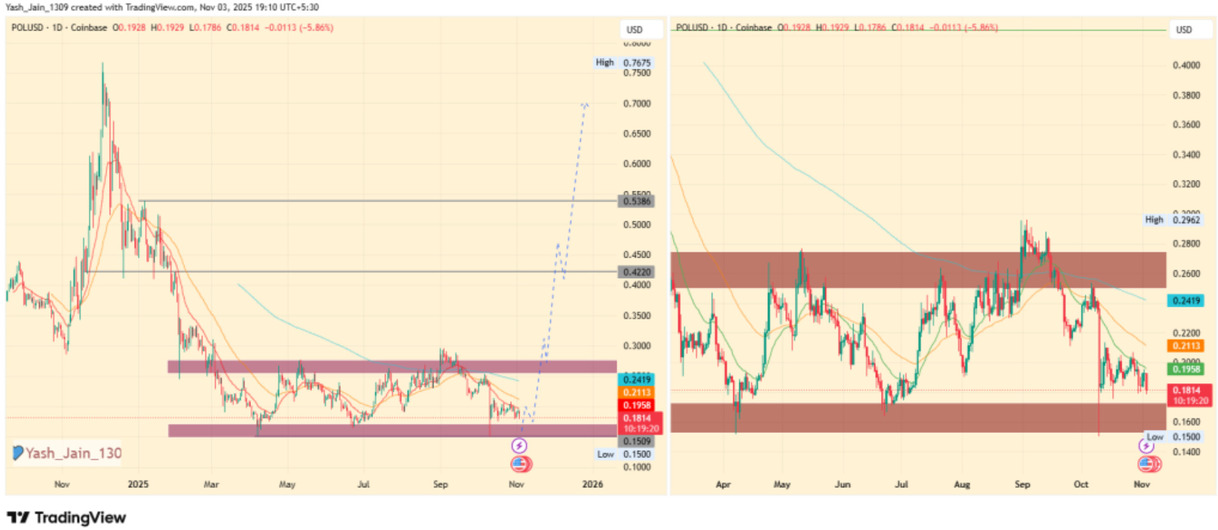
Like most other cryptocurrencies, Polygon has seen a price decline over the past month. POL tokens have fallen around 30%, dropping to as low as $0.1668. The token has faced weaker sentiment since early February, though some market participants point to signs of stabilisation.
Polygon is often discussed for relatively low transaction costs and higher throughput, but it has lost ground to other widely followed networks over the past year. Some supporters argue that broader adoption and new partnerships could improve usage over time, though outcomes remain uncertain.
Separately, several early-stage token projects including Bitcoin Hyper, Maxi Doge, and Pepenode have recently attracted attention online. The following sections summarise project claims and publicly available information; they are not recommendations.
Polygon partnership coverage highlights cross-border payments use case
Polygon had a weak year in price terms, but POL has been discussed more frequently again in recent weeks. Some market commentary has pointed to the possibility of a trend reversal; however, forecasts are speculative and not guarantees of future performance. One example cited in coverage is that POL could gain up to 500% over the next year.
Supporters link these views to reported adoption efforts, new partnerships, and a cross-border payments initiative aimed at reducing fees and improving transaction speed in certain markets.
According to partner announcements, Polygon signed a multi-year deal to accept low-cost stablecoin payments for services such as Uber and Audiomack, and for payments across more than 30 African countries. Cross-border payments can carry meaningful fees depending on corridors and providers; Polygon’s role in this arrangement will depend on real-world rollout and user adoption.
Project materials describe fast transfers and lower costs relative to some legacy rails. They also reference a payment app called Send App, which is expected to roll out later this year; any impact on network activity or token demand is uncertain.
Whether Polygon returns to higher market-cap rankings will depend on broader market conditions, competition among networks, and sustained usage beyond announcements.
Below is a neutral overview of three early-stage projects that have been promoted alongside Polygon in recent commentary: Bitcoin Hyper, Maxi Doge, and Pepenode.
Bitcoin Hyper — Layer-2 concept presented as a way to speed up BTC transfers
Bitcoin Hyper is an early-stage crypto project that, according to its website, aims to build a Bitcoin Layer 2 system to support faster transactions and lower fees. The project says it plans to use the Solana Virtual Machine as part of its design. As with any new network or scaling proposal, feasibility, security trade-offs, and adoption are not yet proven in the market.
Maxi Doge — meme-coin project marketing leveraged trading features
Maxi Doge is a meme-coin themed project that describes token “utility” and a trading-related product in its marketing materials. The project also references leveraged trading, which can amplify both gains and losses and may not be suitable for all participants. Specific features, risk controls, and product availability should be assessed from primary documentation.
Pepenode — game-based project describing a “mine-to-earn” mechanic

Pepenode is a meme-coin project that presents a gamified approach to earning tokens through virtual “mining.” Its materials describe purchasing in-game items (“meme nodes”) that can be combined to create a virtual server, with tokens used for upgrades. The economic model, token distribution, and sustainability of in-game rewards can vary widely across such projects and may change over time.
Context for readers
Polygon’s cross-border payments partnership has contributed to renewed discussion about the network, but any price recovery for POL remains uncertain and depends on broader market and adoption factors.
Early-stage token sales and newly launched tokens can carry elevated risks, including limited operating history, changing tokenomics, and liquidity constraints. Readers may wish to review primary project documentation and independent sources when assessing such claims.
This article is for informational purposes only and does not constitute financial or investment advice. This outlet is not affiliated with the project mentioned.

