


Polygon (MATIC) is one of several scaling solutions used within Ethereum’s ecosystem. At the time of writing, it is trading at $0.282, and some market commentators have discussed scenarios in which it could revisit higher levels during a future market uptrend. Separately, market discussion in 2025 has also focused on Ozak AI (OZ), an early-stage project running a token sale that the project lists at $0.01 per token and says has raised more than $3 million. Any price targets circulated online for either asset are speculative and may not materialize.
Polygon: Scaling Ethereum’s Ecosystem
Polygon is a scaling network that can be used to reduce transaction costs and improve throughput for certain Ethereum-based applications. It has been adopted across areas such as DeFi, NFTs, and Web3 gaming, alongside other scaling approaches, and continues to be used by developers and organizations looking for additional capacity while relying on Ethereum for settlement and security assumptions.
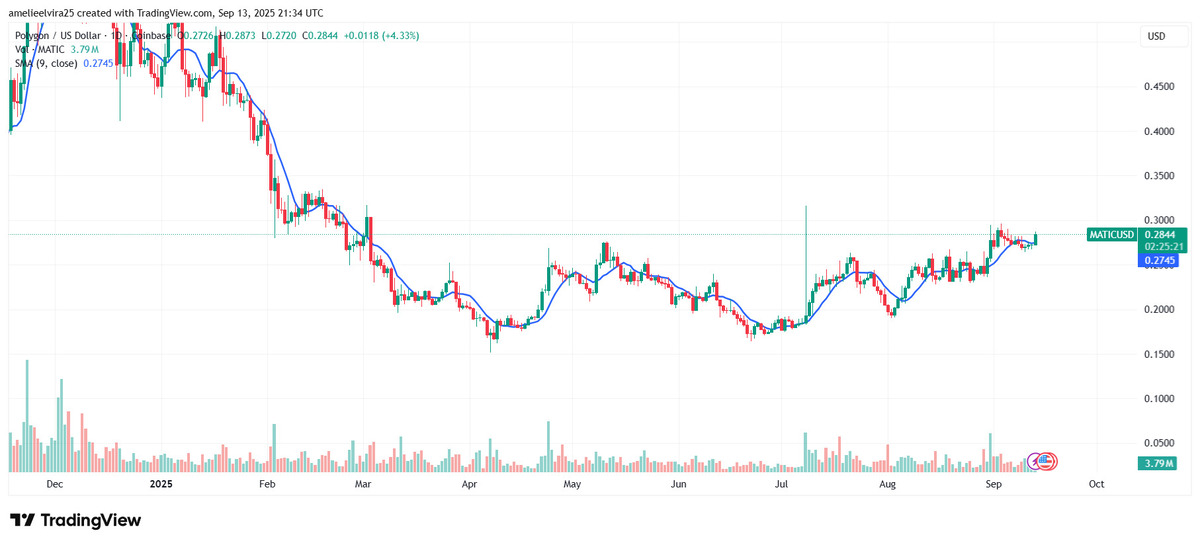
At $0.282, some technical analysts point to nearby areas of interest around $0.30, $0.35, and $0.40, and potential support levels around $0.27, $0.25, and $0.22. These levels are not guarantees of future movement and can fail under changing market conditions.
Polygon: price scenarios and risk context
If MATIC were to move from $0.282 to $5, it would represent a substantial increase. However, price targets of that kind depend on broader market conditions, liquidity, and project-specific developments, and outcomes can differ materially from any forecast. As with all cryptoassets, volatility and drawdowns are possible.
Ozak AI: token sale details and market risks
Ozak AI (OZ) is an early-stage project that is conducting a token sale. The project lists the token at $0.01 and says it has raised more than $3 million, and it describes the initiative as combining blockchain infrastructure with AI-related tooling. As with other early-stage token offerings, information may be limited and the risks of loss can be high.
Online discussions sometimes include specific future price targets for OZ. Such figures are not verifiable predictions and may be influenced by marketing or speculation. Token prices can be highly volatile, and early-stage tokens can lose significant value or fail to develop an active market.
What the project says it is building
In its published materials, Ozak AI says it aims to integrate AI features into decentralized systems, with potential use cases in areas such as DeFi, gaming, and enterprise applications. Whether those plans are delivered depends on execution, funding, adoption, and broader market conditions.
Comparisons between early-stage tokens and established networks can be misleading because they differ significantly in maturity, liquidity, and risk profile.
For Polygon, traders who follow technical analysis may continue to watch areas such as $0.30, $0.35, and $0.40 (potential resistance) and $0.27, $0.25, and $0.22 (potential support). For Ozak AI, key considerations typically include the quality of publicly available documentation, the transparency of the token distribution, and the liquidity and listing status after any token sale concludes.
About Ozak AI
Ozak AI describes itself as a blockchain-based crypto project focused on predictive AI and data analytics tools for financial markets. The project says it uses machine learning and community-driven mechanisms to generate market insights, but readers should treat performance and accuracy claims cautiously and review primary documentation.
Project links (for reference)
Website: https://ozak.ai/
Telegram: https://t.me/OzakAGI
Twitter: https://x.com/ozakagi
This outlet is not affiliated with the project mentioned. This article is for informational purposes only and does not constitute financial or investment advice.

