

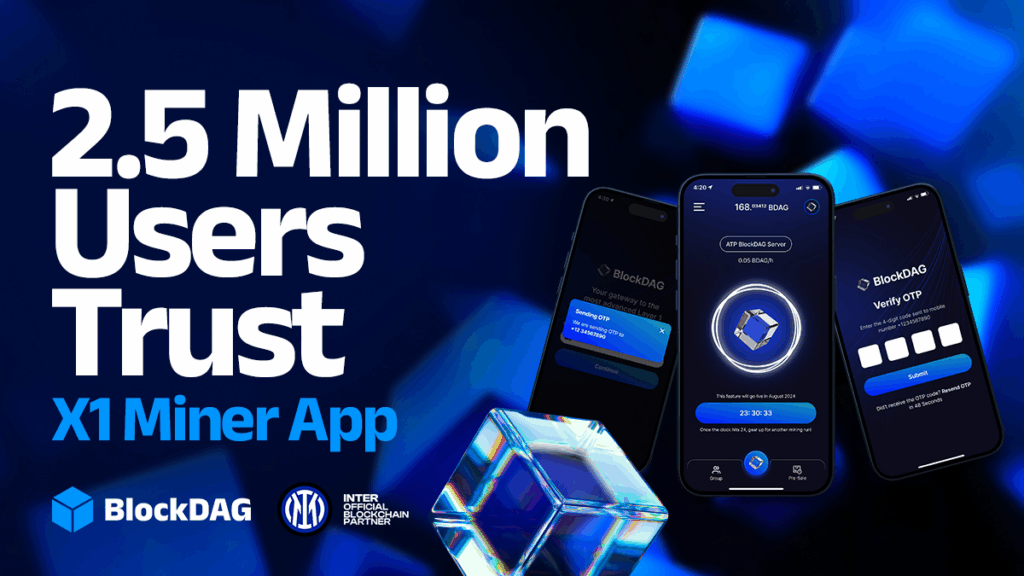
When comparing crypto assets for 2025, market participants often look at Layer-1 and scaling networks with established usage. Polygon (POL) has been used widely for Ethereum scaling and EVM compatibility, while SUI has attracted attention for its smart contract design. Some discussions also include tokens that are not yet broadly traded on major exchanges, where projects may offer incentives intended to encourage early development ahead of wider availability.
One project in that category is BlockDAG (BDAG). According to the project’s materials, it is running a developer grant program totaling $50,000 USDT and lists Wave 1 bounties of $5,000. The same materials describe a current token-sale price of $0.005 (Batch 32) and state that more than $435 million has been raised to date. These figures have not been independently verified.
Polygon: Steady Outlook with Moderate Headroom
Polygon remains active in the Ethereum scaling space, and its migration to the POL token model has been presented as a structural update for the network. Some third-party forecasts for 2025 reference a potential range such as $0.90 to $1.20, typically tied to adoption assumptions and DeFi activity; forecasts are speculative and can be wrong. As a more established network with broad awareness, Polygon’s token price may be influenced by a wide set of factors beyond technology, including overall market conditions.

Polygon continues to attract developers and liquidity across different applications. As with any cryptoasset, its risk profile and potential outcomes can differ materially from earlier-stage projects, and comparisons based solely on token price levels can be misleading.
SUI: Strong Fundamentals, But Mid-Stage Saturation
SUI has gained traction with smart contract developers for its object-based programming model, which aims to support composability and performance compared with traditional account-based structures. Despite the technical appeal, its price movement has remained within a moderate range relative to some other Layer-1 assets, and longer-dated forecasts are uncertain. While views on the January 2024 to November 2025 period vary, SUI’s longer-term trajectory will depend on sustained user growth, developer adoption, and broader market conditions.
Its valuation may track changes in user and developer activity, but outcomes are not guaranteed. Unlike BlockDAG’s described grant and bounty approach, SUI’s incentives and ecosystem programs are structured differently, and direct comparisons may not be meaningful.
BlockDAG: Builder-Led Launch
BlockDAG says its approach prioritizes ecosystem development before broader exchange availability. Through its buildathon, “The Amazing Chain Race,” the project describes offering $50,000 USDT in grants and $5,000 in Wave 1 bounties, aimed at encouraging development of tools such as wallets, explorers, AI agents, and DeFi applications. The project also describes a token sale currently labeled Batch 32 at $0.005. These are project-reported details and have not been independently verified.
The project states it has raised more than $435 million and that 4.2 billion tokens remain available in the sale before an expected end date in February 2026. It also says $86 million has been allocated to institutional buyers. Additionally, the team claims 20 exchange listings are confirmed and that “Keynote 4” is scheduled for November 26, when additional roadmap information may be shared. Independent confirmation of these statements may not be available. BDAG is not yet widely traded on major exchanges, which can add uncertainty for market participants.
Unlike more established tokens that are already broadly listed, the project’s stated plan is to build developer participation and initial applications ahead of wider trading. Whether this results in meaningful network usage remains uncertain and depends on execution, competition, and market conditions.
The project has also said it has moved away from referral-style marketing incentives and is emphasizing infrastructure delivery and ecosystem development. Any token-sale participation carries risk, including the possibility of loss and limited liquidity.
BlockDAG’s Early-Stage Utility Focus
Polygon and SUI are more mature networks with broader public trading histories, while BlockDAG is described by its team as earlier-stage and focused on developer incentives. As with any cryptoasset, projected outcomes are uncertain, and readers should treat forward-looking statements, fundraising totals, and listing plans as claims unless independently verified.
With its developer activation program and token-sale details, BlockDAG is one of several projects being discussed alongside established networks. Readers should consider the higher uncertainty that can accompany early-stage tokens and evaluate primary sources carefully.

Project website (for reference): https://blockdag.network
Telegram (for reference): https://t.me/blockDAGnetworkOfficial
This article contains information about a cryptocurrency token sale. This outlet is not affiliated with the project mentioned. This article is for informational purposes only and does not constitute financial or investment advice.

