TLDR:
- The A7A5 token added $90 billion to its supply, outperforming the growth of Tether and Circle.
- The asset is utilized by Russian companies for cross-border payments and accessing DeFi liquidity.
- The ruble ranks as one of the best-performing currencies due to capital controls and crude oil exports.
The meteoric rise of A7A5 has been widely reported in recent months. Recent on-chain data indicates that this ruble-backed stablecoin has become the fastest-growing asset of its kind in the market over the past year.
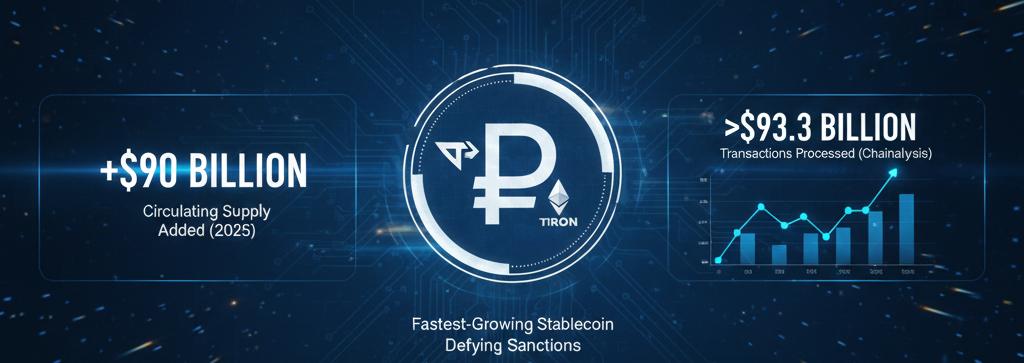
Launched in January 2025 by A7 LLC, the token has so far managed to inject approximately $90 billion into its circulating supply—a figure that far exceeds the annual expansion of giants like USDT (Tether) and USDC (Circle).
This phenomenon is occurring despite strict prohibitions imposed by the European Union on operations with assets linked to the ruble. The ruble-backed stablecoin operates primarily on the Tron and Ethereum networks, providing users and companies under banking restrictions with an effective way to conduct international payments and access decentralized finance (DeFi) protocols.
The Role of the Digital Ruble and Russia’s International Payment Strategy
The success of A7A5 is no coincidence; it is the result of a legal framework designed for economic resilience. In August 2024, President Vladimir Putin enacted laws legalizing the use of digital assets for global payments, seeking to reduce the chronic dependence on the U.S. dollar.
Currently, the Central Bank of the Russian Federation is working to fully integrate the digital ruble into the budget system by September of this year.
The impact on the real economy has been notable. Data from Chainalysis indicates that A7A5 has processed over $93.3 billion in transactions in less than a year.
Meanwhile, the traditional Russian currency shows surprising strength, appreciating against the dollar due to high interest rates, capital controls, and the massive conversion of oil export revenues.
In summary, the ruble-backed stablecoin A7A5 has consolidated itself as a fundamental pillar for the nation’s foreign trade, demonstrating how blockchain technology can be used to bypass traditional financial blocks and reconfigure capital flows on a global scale.