

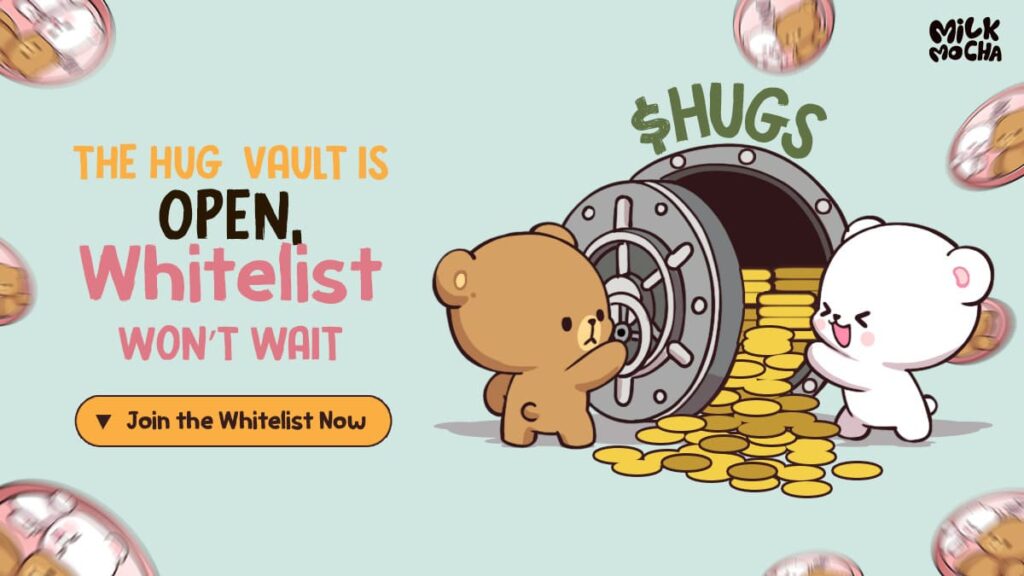
Milk & Mocha are widely recognized characters known for their playful branding. A crypto project using the theme has introduced the $HUGS token and says it aims to build a utility-focused ecosystem around the token. The project reports that an allowlist (whitelist) signup is currently open. It also states that participation is intended to be broadly accessible and that, according to its materials, it does not require identity verification (KYC) for signup.
The project also describes features such as staking, NFTs, mini-games, and a charity component. As with any early-stage token launch, the details, timelines, and outcomes are subject to change, and market risks remain significant.
The Whitelist Buzz
According to the project, interest in the $HUGS allowlist has been increasing as fans and crypto traders look to follow the launch. The team positions the signup process as broadly available, stating that it is not limited by regional restrictions and that signup can be completed with an email address.
The project further states that certain incentives may be tied to purchase volume during the token sale. Any such perks are project-described marketing incentives and are not a guarantee of value or performance. The team also says there is no stated maximum allocation per wallet, although participation terms can vary by launch and may be updated.
In addition, the team says that any unsold tokens would be permanently burned, which it frames as a supply-management mechanism. Readers should treat these mechanics as claims from the project until independently verified.
Mini-Games and Ecosystem Loop
The project says it plans to support mini-games that use $HUGS for in-game actions such as entering tournaments or unlocking features. In the proposed model, tokens would circulate among players, prize pools, and token burns, with the intention of creating ongoing in-app demand.
Project materials describe a loop in which players use $HUGS, winners receive rewards from a prize pool, and a portion of tokens used in gameplay may be burned. The team also says a portion may be allocated to development and seasonal updates. As with any game-linked token design, actual usage depends on adoption, execution, and market conditions.
The team argues that gaming can help attract users beyond short-term speculation and that Milk & Mochas existing audience could support engagement. However, community size or brand recognition does not ensure sustained token demand.
Overall, the concept combines meme branding with utility features, but prospective participants should evaluate whether the product is live, what has been audited or tested, and what risks apply.
Staking Rewards and Considerations
Alongside gaming, the project describes a staking feature for $HUGS. Its materials advertise a 50% APY with rewards calculated daily and claimable under the rules set by the platform. Staking terms, reward rates, and eligibility can change, and staking involves risk, including smart-contract risk, liquidity constraints, and token price volatility.
The team also suggests that staking could reduce circulating supply by moving tokens into staking pools, which it says may influence market dynamics. Any such effects are uncertain and depend on broader trading activity, participation levels, and the tokens overall liquidity.
The project further mentions gamified elements such as leaderboards and NFT badges for certain staking activity. Readers should distinguish between engagement features and claims about financial outcomes, and review the underlying terms before relying on advertised rates.
NFTs, Merch, and Charity Impact
The $HUGS ecosystem described by the team also includes NFTs linked to the Milk & Mocha theme. According to project materials, these NFTs may be upgradable through token burning and could provide access to certain events, mini-games, or discounts, depending on how the platform is implemented.
On the commerce side, the project states that an official merchandise store would accept $HUGS for purchases, and that some items or benefits could be restricted to token holders. Availability, pricing, and access conditions would depend on the stores rules and the projects execution.
The team also says a portion of ecosystem revenue would be directed to charitable causes, with recipients selected through community governance. As with other project-led charity initiatives, readers may want to look for transparency reports, on-chain records (where applicable), and clear governance documentation.
Taken together, the project presents $HUGS as a token intended to link fan engagement with digital products and community initiatives. Whether these features materialize and are used at scale remains uncertain.
Key claims the project highlights for 2025
In summary, the $HUGS project highlights an open allowlist signup model and describes incentives tied to participation in its token sale. It also positions the absence of KYC at signup as an accessibility feature, although users should still consider legal and compliance requirements in their jurisdiction.
The teams broader roadmap includes a staking program (advertised at 50% APY in project materials), a mini-game economy, NFTs, merchandise integration, and a community-directed charity pool. These are plans and claims that should be assessed against available documentation, audits, and delivered products.
As with any early-stage token launch, readers should be cautious about marketing language, review primary sources, and consider the possibility of total loss.
This article is for informational purposes only and does not constitute financial or investment advice. This outlet is not affiliated with the project mentioned.

