Every blockchain transaction consumes network resources, but the fee system depends on the blockchain being used. Ethereum and other EVM-compatible networks use gas to price computational work, while Bitcoin bases fees largely on transaction size and fee rates. Solana combines a base transaction fee with optional priority pricing.
Understanding these differences can help users avoid unnecessary costs. A transaction that is inexpensive on one network may become significantly more expensive on another, particularly when smart contracts, bridges or periods of heavy demand are involved.
How Crypto Gas Fees Work Across Major Networks
On Ethereum, transaction costs are determined by the amount of gas required and the effective gas price. Since EIP-1559, introduced with the London upgrade, Ethereum transactions generally include a base fee and a priority fee. The base fee is burned, while the priority fee is paid to validators.
A simple way to estimate the cost is gas used multiplied by the effective gas price. A basic ETH transfer typically requires 21,000 gas, while token transfers, decentralized exchange swaps and DeFi interactions can consume considerably more.
Gas prices are measured in gwei, a denomination of ETH. One gwei equals one-billionth of an ETH. The dollar value of the fee also changes with ETH’s market price.
Bitcoin does not use gas. Its transaction fees depend largely on virtual transaction size and the prevailing fee rate, commonly expressed in satoshis per virtual byte. The amount of BTC being transferred does not directly determine the fee. A transaction with many inputs can require more blockspace even when the transferred amount is relatively small.
Solana uses a different structure, with a base fee per signature and an optional prioritization fee linked to compute-unit settings. Meanwhile, networks such as BNB Smart Chain and Avalanche C-Chain use EVM-compatible gas models.

Ways To Reduce Crypto Transaction Costs
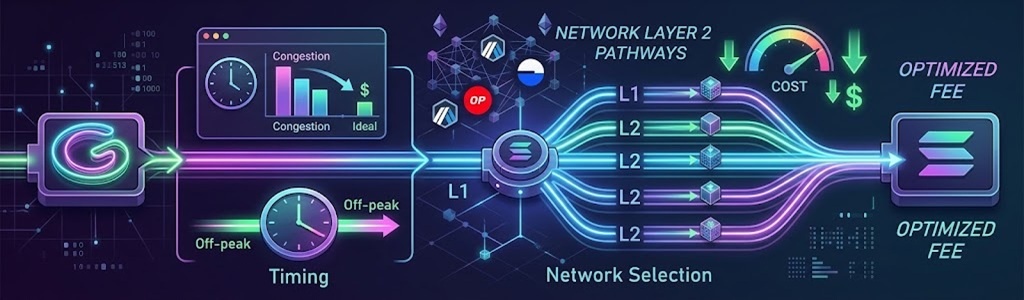
Users have several practical options for lowering fees without unnecessarily increasing risk. The first is timing. When demand for blockspace falls, fee pressure can decline, although there is no universal low-fee period because crypto markets operate continuously.
Ethereum users can also consider Layer 2 networks such as Base, Arbitrum and OP Mainnet. These networks can reduce execution costs, although the total expense may include both Layer 2 execution and Ethereum data costs.
Another strategy is avoiding unnecessary transactions. Repeated token approvals, failed smart-contract interactions and unnecessary bridging can add costs quickly. Wallet fee estimates should also be reviewed before confirming a transaction.
Bitcoin users can consider UTXO management, including consolidating smaller outputs when fee conditions make it economical. Solana users and developers can avoid unnecessarily high compute-unit limits or priority settings when immediate confirmation is not required.
It is also important to distinguish network fees from exchange withdrawal fees. A centralized exchange may charge its own withdrawal amount, which does not necessarily equal the fee paid directly to the blockchain.
Finally, users should not confuse slippage with gas. Slippage controls the acceptable price movement during a trade, while gas pays for blockchain execution. Increasing slippage does not reduce transaction fees.
Crypto networks continue to develop scaling solutions, fee sponsorship and transaction batching. These changes may make blockchain applications easier to use, but the underlying network resources still carry an economic cost.
For users, the most effective approach is to compare the complete transaction cost, verify the network and choose the simplest safe route for each transaction.