


TL;DR:
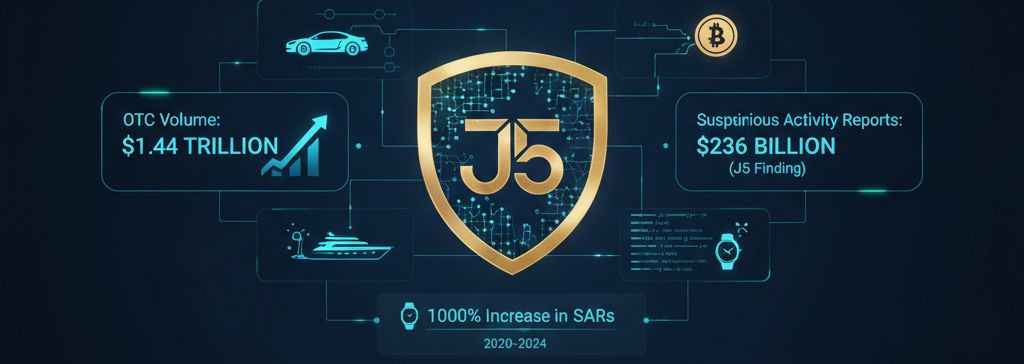
- The J5 group warns that daily volume on OTC desks ($1.44 trillion) vastly exceeds that of traditional exchanges.
- Crypto payment processors have seen a 1,000% increase in suspicious activity reports since 2020.
- International regulators aim to tighten oversight to prevent luxury goods from being used for money laundering.
The Joint Chiefs of Global Tax Enforcement (J5) has sounded the alarm on the link between OTC crypto desks and financial crime. Their latest report reveals that these direct trading platforms move massive volumes of capital outside the radar of authorities.
Specifically, it is estimated that the daily volume handled by these desks exceeds $1.44 trillion, a figure that surpasses many traditional exchanges. Consequently, the J5 asserts that the lack of real-time monitoring makes these tools the ideal vehicle for tax evasion.
Furthermore, the alliance—comprising Australia, Canada, the Netherlands, the U.S., and the UK—revealed a startling figure. At least $236 billion in suspicious activities linked to these private platforms has been reported.
The Risk of Payment Processors and Luxury Goods
The report also highlights that crypto-asset payment processors have seen a 1,000% spike in illicit transaction alerts. This is largely due to the ease of acquiring luxury goods, such as Rolls-Royce or Ferrari vehicles, using digital assets.
Although OTC crypto desks and financial crime are often associated due to their anonymity, some industry companies defend their compliance. Executives from platforms like OKX claim they apply strict KYC protocols and on-chain surveillance to act quickly and freeze suspicious funds.
In short, jurisdictions like Hong Kong are already implementing stricter regulatory regimes to pull these businesses out of “gray areas.” The goal is to ensure the crypto ecosystem ceases to be an additional layer for laundering capital into traditional finance.

