

Altcoins are often discussed for more than short-term market narratives. In 2025, many market participants look for projects that address specific use cases, attract users, and show ongoing development activity. However, outcomes can vary significantly across projects and market cycles.
When people ask which altcoins to monitor, they are often looking for a mix of narrative, technology, and adoption signals.
Below are four projects that frequently appear in those discussions, including Noomez, which describes a structured token sale model and participation mechanics in its project materials.
1. Noomez ($NNZ) – Token sale mechanics described by the project
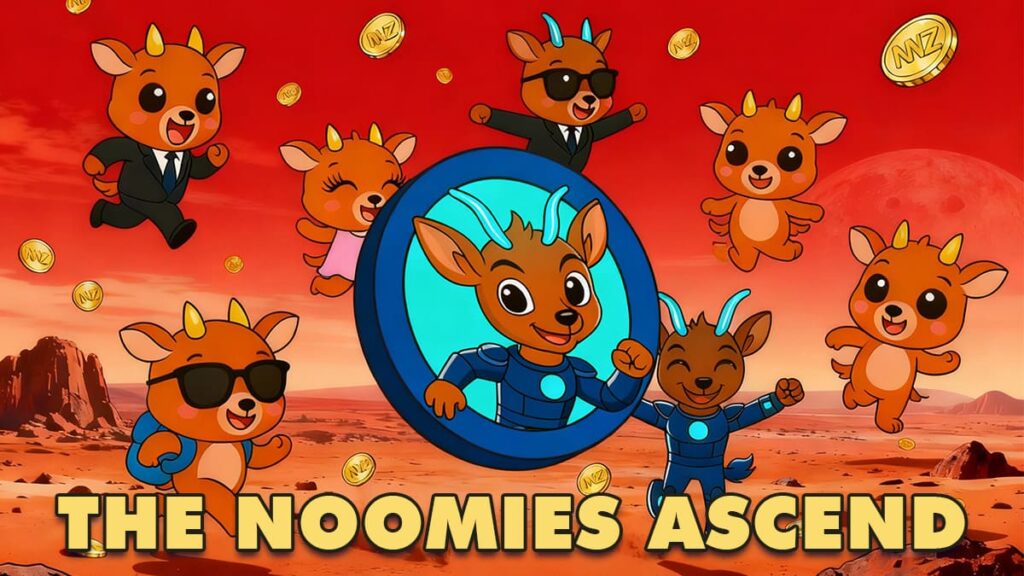
Noomez positions itself as a meme-themed token project with a staged token sale rather than an immediate exchange listing. According to the project, the staged format is intended to make token pricing and supply schedules easier to follow.
The project publishes stage-based pricing and other sale-related information in its materials. It also reports metrics such as:
- Holder Count: project-reported figure (may change)
- Total Raised: project-reported figure (may change)
Noomez describes a 28-stage model where each stage has a fixed price. The project also says unsold tokens are burned, and that later stages are priced higher than earlier stages.
The project also references marketing incentives (such as referral bonuses) and a staking program with variable yields. Any rewards, yields, or future performance are not guaranteed and may involve significant risk.
More broadly, Noomez says its goal is to make early-stage participation rules clearer than in some token sale formats by publishing stage mechanics and related terms in advance. Readers should rely on primary project documentation and independent verification where possible.
2. Chainlink (LINK) – Data feeds for smart contracts
Chainlink provides oracle services that deliver data to smart contracts, enabling decentralized applications to reference information that originates outside a blockchain.
Use cases can include price feeds and other external data sources. Because this role can support DeFi and other Web3 applications, LINK is often discussed as an infrastructure-focused cryptoasset rather than a purely narrative-driven token.
3. Render (RNDR) – Distributed GPU computing
Render focuses on GPU computing for tasks such as 3D rendering and certain AI workloads. The project describes a network where participants can provide available GPU capacity and others can pay to use it.
This model is intended to create a marketplace for rendering and compute services, with potential relevance to industries such as media production, gaming, and AI. Participation and compensation, where applicable, depend on network rules and market demand.
4. Stellar (XLM) – Cross-border payments infrastructure
Stellar is designed for fast, lower-cost transfers of value across borders. It has been used in payment and remittance-oriented contexts, including efforts aimed at improving access to financial services.
The network is built to support interactions among entities such as payment providers, institutions, and individuals. Like other cryptoassets, XLM carries market and regulatory risks, and price outcomes are uncertain.
How market participants research altcoin projects
Comparing projects typically involves more than social media activity. Common research steps include:
- Reviewing whitepapers and technical documentation
- Tracking on-chain metrics such as holder counts and liquidity (where applicable)
- Following announcements and checking whether integrations are independently verifiable
- Assessing token supply mechanics, vesting schedules, and inflation assumptions
Chainlink, Render, and Stellar are commonly cited for specific infrastructure or payments-related use cases. Noomez is discussed in a different context, with the project emphasizing staged token sale mechanics and related participation terms.
These summaries are a starting point for independent research, not a recommendation to buy or sell any asset.
For More Information:
Twitter: Follow Noomez ON X (Formerly Twitter)
This article is for informational purposes only and does not constitute financial or investment advice. This outlet is not affiliated with the project mentioned. This article contains information about a cryptocurrency token sale. As with any activity in the crypto ecosystem, readers should do their own research and consider the risks involved.

