


Discussion around Ethereum trading near $4,500 has increased attention across crypto markets. At the same time, some market participants are also watching early-stage token sales, including BullZilla ($BZIL), which is promoted online as a meme-coin project with staking and community-driven branding. Any such offerings involve significant risk, and outcomes are uncertain.
BullZilla’s materials describe a meme-coin themed around a narrative “lore” and tokenomics features, including staking and a multi-part story format. Ethereum, by contrast, is an established smart-contract network used across DeFi and Web3 applications. The two assets differ substantially in market maturity, risk profile, and the availability of independent data.
BullZilla Overview: Project-Described Features and Token-Sale Details
According to the project’s website, BullZilla is conducting a staged token sale. The project describes itself as being in “Stage 7” and reports figures such as funds raised, the number of holders, and tokens sold; these claims are not independently verified in this article. The project also references possible future exchange listings, but any listing timing, price, or market performance is uncertain and not guaranteed.

The project describes a pricing schedule in which the token price can change based on milestones or time intervals. Such structures are commonly used in token sales and do not, by themselves, indicate future market demand or performance.
BullZilla also describes branding elements such as a 24-chapter storyline tied to project milestones, and a “burn” mechanism that it says may reduce token supply over time. The project advertises staking rewards and referral incentives; the terms, sustainability, and outcomes of these programs depend on implementation and market conditions and may change.
The project further states that liquidity will be locked for a limited period after launch. Liquidity locks, if implemented, can reduce certain risks but do not eliminate them; common areas for independent review include smart-contract audits, token distribution, vesting, liquidity arrangements, and governance controls.
Ethereum ($ETH): Smart Contracts and Network Activity
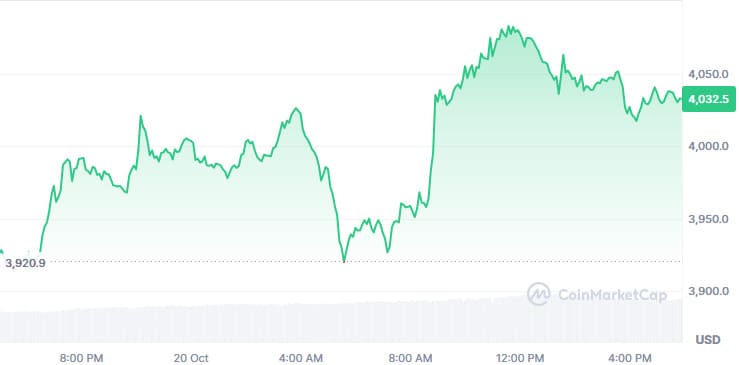
At the time of writing, Ethereum was quoted at $4,039.79 with a market capitalization near $487 billion and 24-hour trading volume above $39 billion. The article cites a 24-hour price increase of 4.64% and a one-year change of 52.63%. Crypto markets can be volatile, and short-term performance can change quickly.
The article also cites Ethereum’s historical price range, including an all-time high of $4,953.73 in August 2025 and an early low near $0.42 in 2015. Separate market commentary referenced here suggests ETH could trade around the $4,500–$5,200 range over the next 6–12 months, influenced by factors such as Layer-2 adoption and staking participation; such estimates are speculative and may not materialize. Staking yields also vary over time and depend on network conditions and validator participation.
Ethereum remains a widely used base layer for decentralized applications, including DeFi, NFTs, and token issuance. However, it also faces ongoing technical, competitive, and regulatory risks that may affect usage and market pricing.
Conclusion
Ethereum and BullZilla represent very different parts of the crypto market: one is a long-running smart-contract network with broad ecosystem usage, while the other is a newly marketed meme-coin project conducting a token sale. Readers should treat project-reported figures and token-sale marketing claims with caution and consider the elevated risks associated with early-stage tokens, including liquidity, smart-contract, and market-manipulation risks.
Project links (for reference):
Follow BZIL on X (Formerly Twitter)
Frequently Asked Questions About Early-Stage Token Sales
How can readers evaluate early-stage meme token sales?
Common review steps include checking whether contract addresses are published, whether audits are available, how tokens are allocated and vested, how liquidity is handled, and whether key risks are clearly disclosed. Independent verification is important, as project materials may be incomplete or promotional.
What does BullZilla say differentiates its token sale?
Project materials emphasize a narrative theme, a burn mechanism, staking terms, and referral incentives. These features are not proof of future performance, and readers should review the underlying contracts and terms to understand how they work in practice.
What is Ethereum’s price outlook for 2025?
Price outlooks vary widely. The estimates cited in this article (including $4,500 to $5,200 over the next year) are speculative and depend on market conditions, adoption trends, and broader macro and regulatory factors.
Is BullZilla a safe investment?
Safety cannot be assumed for any newly issued token. Early-stage crypto assets can be subject to smart-contract bugs, liquidity issues, rapid price swings, and limited disclosure. Readers should independently verify claims and consider whether they can afford to lose any funds used.
Can meme coins deliver returns?
Returns can be positive or negative, and losses are possible. Meme coins are typically highly volatile and can be influenced by sentiment, concentrated holdings, and changing liquidity conditions.
Glossary of Key Terms
- Deflationary: A mechanism intended to reduce total token supply over time.
- Token sale: An early fundraising phase where a project offers tokens to participants.
- Layer-2: Off-chain solution intended to enhance Ethereum’s transaction speed and cost.
- ROI: Return on Investment.
- Smart Contract: Automated code enforcing blockchain transactions.
This article is for informational purposes only and does not constitute financial or investment advice. This outlet is not affiliated with the project mentioned. As with any initiative within the crypto ecosystem, readers are encouraged to do their own research and consider the risks involved.

