


Crypto markets in November 2025 continue to focus on major assets such as Ethereum, which has been trading above $4,000 and approaching widely watched resistance levels. Market participants are also monitoring newer projects that are experimenting with gaming-style mechanics and token-based incentives.
One example is PepeNode, which the project describes as a mining-themed, gamified experience where users optimize virtual setups. As with any new token-related initiative, the associated risks, disclosures, and participation terms are important to review independently.
ETH Price Gains Steam Ahead of Resistance
Currently, Ethereum trades at $4,023, up by 4.16% in the past week (at the time of writing). The price also represents a 53.94% rise on an annual level. Despite recent volatility, Ethereum’s ability to maintain higher lows is often interpreted by traders as a sign of strengthening sentiment, though outcomes remain uncertain.
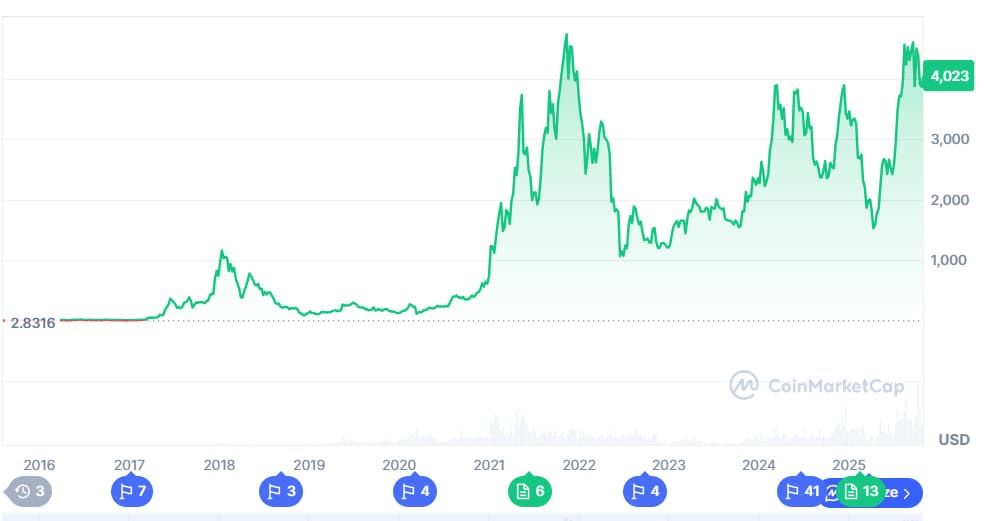
Some market commentary frames $4,115 as an important level to watch. If price moves above it, analysts may look to areas around $4,298 and $4,550 as potential resistance levels based on historical Fibonacci levels, although such levels are not predictive. Conversely, a pullback from current levels could see traders watch zones around $3,712 or $3,510, where prior demand has been observed.
PepeNode: Project Overview
PepeNode is a mine-to-earn crypto project that presents mining as a strategy game. According to project materials, users build and optimize virtual mining setups and receive token rewards based on in-game activity, rather than operating physical hardware.

The project’s public communications reference rewards that may include various meme-themed tokens (for example, $PEPE and $FARTCOIN). The mechanics, eligibility, and reward rates depend on the project’s rules and may change over time.

The project also publishes a token allocation breakdown, stating that its total token supply is divided between:
- Infrastructure: 15%
- Protocol development: 35%
- Growth and listings: 7.5%
- Node rewards: 7.5%
- Economics and treasury: 35%
According to project documentation, PepeNode includes a referral program where participants may receive 2% of rewards attributed to referred users.
The project also describes a burn mechanism, stating that for each node purchase or upgrade, 70% of the tokens used are burned. While token burns can reduce circulating supply, the effect on price and long-term value is uncertain and depends on many factors, including demand, liquidity, and broader market conditions.
The team has stated that Coinsult audited $PEPENODE’s smart contract. Audits can identify some issues, but they do not eliminate risk or guarantee security.
Inside $PEPENODE’s Token Sale
According to the project, $PEPENODE began a token sale in August and has raised over $1.9 million to date. The sale is described as being split into stages with changing prices. At the time of writing, the project lists $PEPENODE at $0.0011227, up by 12.27% from an initial listed price of $0.001. The project states that payment methods include ETH, USDT, BNB, or debit/credit cards.
The project also advertises staking, stating that over 1.2 billion tokens (68% of its token-sale allocations) have been contributed to the staking pool. It lists a dynamic APY that it reports as 650% at the time of writing; such figures can change and do not represent guaranteed returns.
The team has said it intends to provide liquidity for $PEPENODE on Uniswap after the token generation event (TGE). Timelines, listings, and liquidity conditions can change.
Conclusion
Ethereum’s move above $4,000 has put focus on nearby resistance levels that traders and analysts commonly monitor. Separately, newer projects such as PepeNode are experimenting with game-based participation models and token incentives, though details and risk profiles differ significantly from large, established networks.
Readers should treat project-reported figures, timelines, and reward estimates as unverified until independently confirmed, and consider the risks typically associated with early-stage tokens and staking programs.
Website (project): https://pepenode.io/
This article is for informational purposes only and does not constitute financial or investment advice. This outlet is not affiliated with the project mentioned.

