TL;DR
- Ethereum’s validator entry queue has extended to ~25 days, while exit times are now rapid (~14 minutes), creating a significant asymmetry.
- The unpredictable queue is contrasted with Cardano’s fixed, 10-day staking activation period, which offers more predictability for institutional planning.
- Liquidity managers are implementing new rules, like maximum wait thresholds and staggered entries, to mitigate the timing risk.
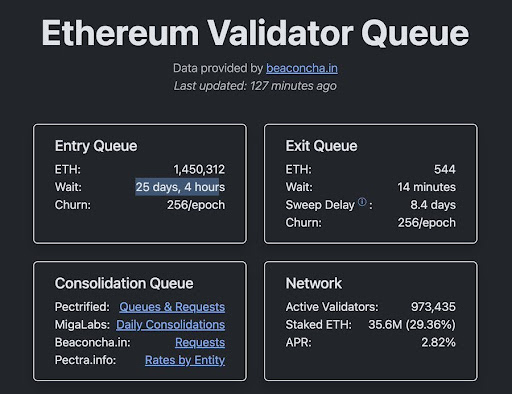
Ethereum enters 2026 with a crowd at the door. The validator queue stretches to ~25 days 4 hours, up from ~7.55 days only weeks ago, while the exit queue contracts to ~14 minutes after peaking near 44.25 days earlier. Participants report longer waits to activate new validators and near-instant exits, a split that reshapes how desks plan liquidity, target yield, and time ETH deployment.
Traders and treasury teams adjust playbooks. Long entry lines require advance purchases and tighter calendars; near-instant exits encourage faster rotation when reward rates compress or risk rises. As more coins lock into validation, ETH supply available for spot and derivatives trading shrinks, and books reflect the change through spreads, basis, and depth during volatility bursts.
Entry delays, exit speed, and supply friction
Teams now monitor three gauges: 1) the pace of new entrants in the queue, 2) yield differentials versus liquid staking and restaking routes, 3) the elasticity of exits during price shocks. A queue near a month adds measurable friction to supply re-entry and lifts the premium on forward planning. Quick exits, by contrast, support rapid de-risking and amplify short-term swings when headlines hit.

Analyst Dave highlights the asymmetry as a core problem for predictability: weeks to enter, minutes to leave. The pattern turns staking behavior highly state-dependent. If participation surges, new capital waits on the sideline; if rewards dip or price breaks lower, unlocked balances can revert to liquid markets without delay.
Comparisons with Cardano underline the value of deterministic mechanics
Cardano staking avoids entry queues; delegation posts on-chain immediately, and changes follow a fixed activation lag of two epochs (~10 days). Predictable timing helps treasuries budget exposure, set windows for rebalance, and evaluate net yield without hidden timing costs. No dynamic queues, no sudden shifts, fewer surprises.
The Ethereum staking entry queue is now showing an estimated wait of ~25 days and 4 hours just to enter.
Not long ago, this was around 7.55 days. That means the entry wait has grown to over 3× longer in a relatively short period.
At the same time, the exit queue is reporting… pic.twitter.com/2KIitBCBkj
— Dave (@ItsDave_ADA) January 7, 2026
Desks set maximum wait thresholds for new validators and postpone activation once delays exceed policy limits. Teams ladder entries over multiple days to reduce calendar risk, measure on-balance volume and exchange inflows/outflows to track pressure on spot supply, and compare effective APR after queue time versus alternatives that keep units liquid.
Ethereum staking now imposes a real timing cost on fresh capital and a rapid escape hatch for capital already inside. Predictability becomes an asset in its own right. Cardano offers one template; policy rules and queue-aware sizing offer another. either way, planning sits at the center of a cleaner, more explicit staking thesis.