


Ethereum has posted recent gains. ETH has increased by over 9% in the past seven days and by more than 4.05% in the past 24 hours. The token is trading for $4.389, according to the linked price tracker, though short-term price moves can change quickly.
Some long-range forecasts have suggested ETH could reach $75,000 by 2030, but such figures are speculative and depend on assumptions about adoption and market size. Separately, Pepenode is a newer crypto project that is being marketed via an early-stage token sale; the sections below describe the project’s stated features for context.
Ethereum price scenarios – what a $75K target would imply
Ethereum price forecasts vary widely depending on methodology and assumptions. Some more conservative projections cited across the market place ETH in the $8,000 to $12,000 range by 2030, but any long-term estimate remains uncertain.
More optimistic projections have cited figures as high as $75,000. Based on current supply, that would imply a market capitalization on the order of several trillion dollars. Compared with the current overall crypto market capitalization (roughly a few trillion dollars), a $75,000 ETH scenario would require substantial market expansion over time, and it is far from certain.
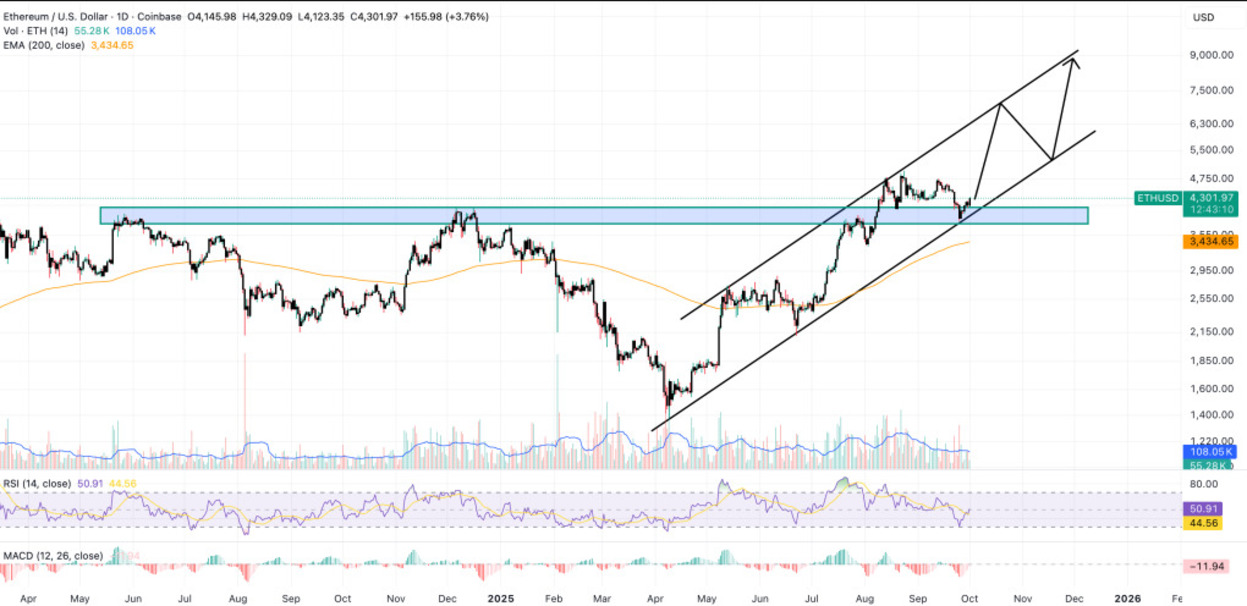
A higher valuation would likely require large growth in network usage and the broader on-chain economy, as well as sustained capital inflows. These conditions are possible but not guaranteed, and the path could include significant volatility and regulatory or technological risks.
Because Ethereum is already one of the largest cryptoassets by market capitalization, forecasts that assume very large multiples should be treated as highly uncertain. Smaller, early-stage tokens can move more sharply in either direction, but they also tend to carry higher risk and a higher failure rate.
Pepenode – game-based token project (project description)

Pepenode is a meme-coin-branded project that, according to its materials, is building a blockchain game in which users create and manage a virtual mining operation. The project describes this as a “Mine-to-Earn” model in which gameplay is tied to earning the native $PEPENODE token.
Project materials describe the purchase of “meme nodes” as part of the in-game mechanics. These items are presented as affecting in-game mining speed and other attributes.
The project also states that earned $PEPENODE tokens can be used in-game to buy additional nodes or upgrade existing ones. As with many token-based game ecosystems, how these mechanics perform in practice depends on adoption, tokenomics, and broader market conditions.
$PEPENODE token sale and staking claims (project-reported)

According to Pepenode’s own communications, its token sale began roughly six weeks ago and has raised more than $1.5 million to date. These figures have not been independently verified in this article.
The project also advertises a staking yield figure (APY) that it says is currently above 825%. Such rates can change, may depend on assumptions about emissions and participation, and are not a guarantee of results. Readers should treat marketing claims about yields with caution.
Key risks and uncertainty
Long-term ETH price targets, including $75,000 by 2030, are speculative and depend on a wide set of uncertain factors. Likewise, early-stage token-sale projects can involve material risks, including smart-contract risk, liquidity risk, token distribution risk, and the possibility that a product does not ship as described.
Website (for reference): https://pepenode.io/
Telegram (as provided): https://t.me/pepe_node
This article is for informational purposes only and does not constitute financial or investment advice. This outlet is not affiliated with the project mentioned. As with any activity involving cryptoassets, readers should do their own research and consider the risks.

