

In the crypto market, traders often monitor short-term price movements across multiple assets. Two names currently drawing attention are BullZilla and Ethereum. While Ethereum continues to feature prominently in market coverage due to its volatility and large ecosystem, BullZilla is being discussed in connection with an ongoing token sale that the project says has attracted early participants. This article summarizes commentary around Ethereum’s near-term price action and outlines what BullZilla describes about its token sale and related features.
Ethereum price outlook: consolidation and volatility
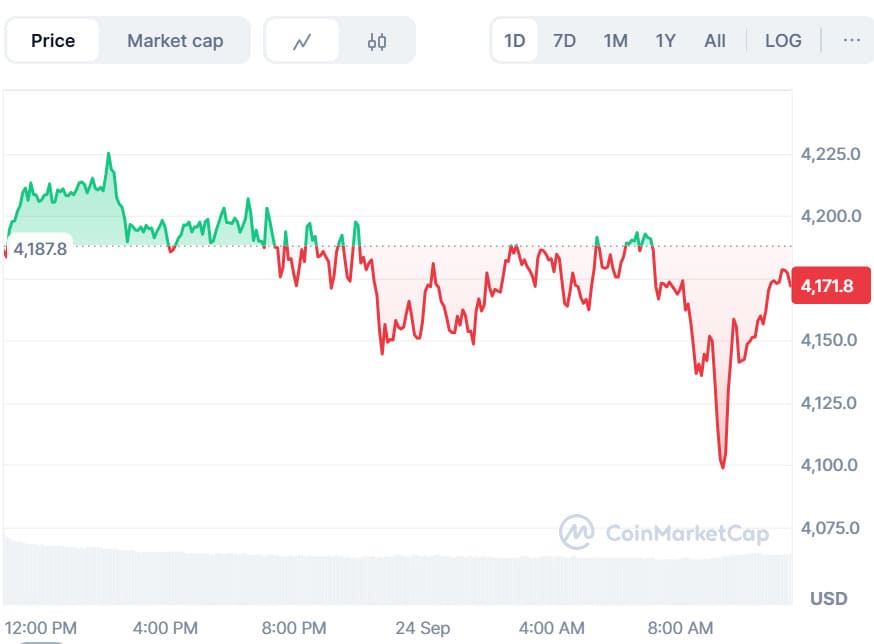
Ethereum remains a major smart-contract network used across DeFi and other on-chain activity, but its recent trading has shown the typical volatility of a large crypto asset. ETH was described as moving from around $4,700 to $4,100 in a sharp pullback before entering a consolidation range. How that range resolves is uncertain and can change quickly with broader market conditions.
Ethereum’s current outlook
- Consolidation phase: Some market participants are watching whether current support levels hold and whether volatility compresses.
- Potential scenarios: Some analysts have referenced a move back toward $5,000 as one possible outcome if buying interest returns, but this is speculative and not guaranteed.
- Risks ahead: If selling pressure resumes, ETH could move lower; macro conditions and crypto-market sentiment can amplify swings.
Separately, some commentary links Ethereum’s medium-term narrative to activity in newer projects. For example, Remittix (RTX) has been mentioned in connection with a token sale; the project reports nearly 40,000 holders and $26.3M raised, and it frames its product around the remittance market (figures and comparisons are project-reported and should be independently verified). References like these are typically used to contextualize Ethereum’s role as a benchmark network rather than to indicate a direct relationship.
Ethereum’s ecosystem remains large relative to most alternatives, but it also carries market risk, technical risk, and regulatory uncertainty that can affect short-term price behavior.
BullZilla: overview of the project’s token sale
BullZilla is being discussed primarily in connection with an early-stage token sale. Project materials describe staged participation and a whitelist process, alongside staking and other utility claims. These are project-described features and may change over time.
Features described by the project
- Whitelist process: The project describes a priority-access mechanism for some participants during the token sale.
- Tokenomics: BullZilla states it aims to balance liquidity and community incentives; details should be reviewed in primary documentation.
- Security claims: The project references smart-contract audits; readers should verify audit scope, date, and findings from original sources.
- Community activity: Social engagement is cited by the project as a driver of interest, though this does not indicate future performance.
As with any early-stage token sale, key considerations typically include smart-contract risk, liquidity risk, token distribution, and limited disclosure compared with established assets.
Conclusion
Ethereum and BullZilla are discussed for different reasons: Ethereum as a large, liquid network asset with well-known catalysts and risks, and BullZilla as an early-stage project promoting a token sale and associated participation features. Any comparison between a major asset and a new token involves differences in scale, maturity, disclosure, and risk profile.

For more information (project links for reference)
Follow BZIL on X (Formerly Twitter)
Frequently Asked Questions
What does the BullZilla project say it is offering?
Project materials describe an early-stage token sale, a whitelist-based access process, and planned tokenomics. Details and terms should be confirmed using primary sources.
How is Ethereum different from an early-stage token sale?
Ethereum is an established, widely traded network asset with an extensive ecosystem, while early-stage token sales generally involve higher uncertainty, lower liquidity, and less operating history.
Why is Remittix mentioned in discussions about Ethereum?
Some market commentary references newer projects such as Remittix to contextualize the broader smart-contract and payments landscape. Any fundraising figures or product claims should be treated as project-reported unless independently verified.
How should readers think about risk in early-stage tokens?
Early-stage tokens can involve smart-contract risk, liquidity risk, market manipulation risk, and limited disclosures. Readers typically review documentation, audits, and token distribution details, and consider whether they can bear potential losses.
What price levels are traders watching for Ethereum?
Some analysts and traders reference round-number levels such as $5,000 as a point of interest, but price targets are speculative and can change with market conditions.
Glossary
- Whitelist entry: Priority-access system described by some projects for token-sale participation.
- Token sale: Early-stage fundraising in which a project offers tokens under specified terms.
- DeFi (Decentralized Finance): Blockchain-based financial ecosystem.
- Demand zone: Chart region where buying pressure has historically appeared.
- Tokenomics: The economics of a cryptocurrency’s supply, demand, and distribution.
- Liquidity: Ease of buying or selling an asset without significant price changes.
- Staking: Locking tokens to secure a network and potentially earn rewards, subject to protocol and market risk.
- Fiat conversion: Exchanging crypto into traditional currencies.
- Volatility: Frequency and scale of price fluctuations.
- CertiK verification: A security review label sometimes used to reference a CertiK audit; readers should confirm the underlying report.
This article is for informational purposes only and does not constitute financial or investment advice. This outlet is not affiliated with the project mentioned. As with any initiative within the crypto ecosystem, readers should do their own research and carefully consider the risks involved.

