


Market participants continue to monitor Ethereum’s ongoing upgrades and broader sentiment across crypto assets. Alongside large-cap networks, some early-stage meme and utility projects are also drawing attention, though their risk profiles and maturity differ significantly from established protocols.
One project being discussed in that context is BullZilla ($BZIL). According to the project’s materials, it uses a time-based pricing model and smart-contract features, and it also references a referral program and a staking product that advertises up to 70% APY. These are project-reported claims and are not independently verified in this article.
BullZilla overview (project-reported)
Ethereum ($ETH): A Major Smart-Contract Network Amid Shifting Market Conditions
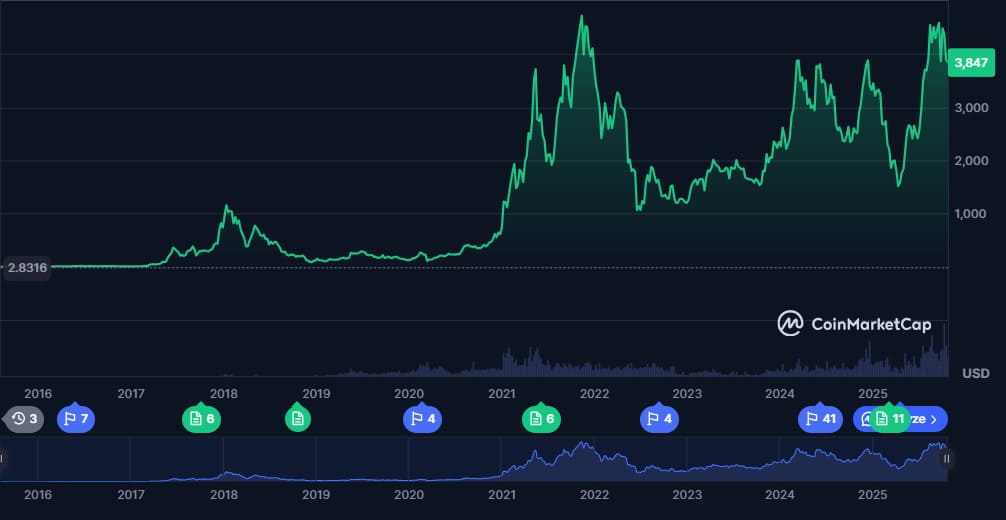
Ethereum remains a major platform for decentralized finance and smart contracts. At the time of writing, it was priced around $3,851.70, with the article citing a market cap of about $464.9 and roughly $36.5B in daily trading volume. Short-term price changes can be volatile and do not indicate future performance.
On the technical side, the Fusaka upgrade has been discussed as part of Ethereum’s scalability roadmap. It includes EIP-7825, which raises the block gas limit to 60 million and caps per-transaction gas at 16.78 million units, aiming to support throughput while reducing spam risk. Parallel transaction execution has also been referenced for a later timeframe, though timelines and outcomes can change.
Frequently Asked Questions About Ethereum
What’s Ethereum’s price outlook for 2025?
Some analysts publish price ranges for Ethereum based on factors such as ETF flows, staking activity, and network upgrades. These forecasts are speculative and can change quickly as market conditions evolve.
Why do market participants still follow Ethereum alongside newer coins?
Ethereum has an established developer ecosystem and deep liquidity compared with many newer projects. That said, different assets carry different risks, and comparisons do not imply similar outcomes.
BullZilla ($BZIL): Tokenomics and Features Described by the Project
BullZilla ($BZIL) is being promoted by its team as an early-stage token sale with a time-based pricing approach. The project states it is in “Stage 7” and “Phase 4,” and reports a token price of $0.00018573, with over $960,000 raised, 31+ billion tokens sold, and 3,200+ holders. It also describes automatic price increases tied to time intervals or fundraising milestones; any future listing, liquidity, or pricing outcomes are uncertain.
The project also describes a token burn mechanism tied to milestones and a referral incentive it calls the “Roarblood Vault.” It further promotes staking through a product labeled the “HODL Furnace,” with an advertised rate “up to 70% APY.” Such rates, if offered, may change and may involve additional smart-contract and market risks.
BullZilla token-sale pricing mechanics (project-reported)
BullZilla’s materials describe an automated pricing schedule in which the token price increases at set intervals and/or when fundraising thresholds are met. While the project also references future price targets and return scenarios in its marketing, those projections are speculative and should not be treated as guarantees of results.
Frequently Asked Questions About BullZilla
What does the project say distinguishes BullZilla?
The project highlights an auto-scaling pricing model, time-based scarcity messaging, and Ethereum-based smart contracts. Readers should treat these points as project claims and review primary sources and risks independently.
How does the project describe BullZilla’s staking system?
BullZilla describes a staking feature with an advertised APY. Staking outcomes can vary based on program terms, token price changes, smart-contract security, and liquidity conditions.
Does the project provide return estimates?
Project marketing materials reference hypothetical ROI figures tied to specific price targets. Such estimates are promotional and uncertain, and real-world outcomes may differ materially.
Additional details are described in the project’s own materials.
Conclusion
Ethereum remains a widely used smart-contract network, and its roadmap continues to be a focus for developers and markets. BullZilla is an early-stage token sale that promotes a staged pricing model, staking, and token burns; these details are based on project-reported materials and should be approached with appropriate caution.
This article is for informational purposes only and does not constitute financial or investment advice. This outlet is not affiliated with the project mentioned.
For More Information:
Follow BZIL on X (Formerly Twitter)
This article is for informational purposes only and does not constitute financial or investment advice. This outlet is not affiliated with the project mentioned. Crypto assets are volatile, and participating in token sales or staking can involve significant risks, including the risk of loss.

