


Ethereum headlines this week point to three notable developments. Developers confirmed the Fusaka testnet upgrade activation for October 1, which could inform future mainnet scalability work. Separately, co-founder Jeffrey Wilcke moved about $6M worth of ETH, prompting market discussion, while on-chain data indicated large-scale accumulation activity totaling roughly $1.6B in Ether. In addition, REX-Osprey announced an Ethereum ETF structure in the U.S. that includes staking-related features, a development that may affect how some institutions access ETH exposure.
These institutional and technical developments have coincided with ongoing retail interest in higher-risk, meme-themed crypto projects, including BullZilla (BZIL), illustrating the contrast between infrastructure-led innovation and speculative activity.
Fusaka Testnet Upgrade: October 1 Activation
At the 221st Ethereum ACDE meeting, developers confirmed that Fusaka’s first public testnet upgrade will go live on October 1. While four client teams are still finalizing their versions, the upgrade is part of Ethereum’s scaling roadmap.
Developers discussed raising the default block gas limit to 60 million gas, which would increase throughput under certain conditions. Meanwhile, the EthPandaOps team plans to launch a Holesky shadow fork to stress-test the upgrade.
As with any testnet change, timelines and parameters may still evolve as client implementations are finalized and testing continues.
Ethereum Co-Founder Moves $6M ETH, While Large Holders Accumulate
Ethereum co-founder Jeffrey Wilcke transferred 1,500 ETH (≈$6M) to Kraken, prompting speculation about whether the move could be related to a sale. Transfers to exchanges can be interpreted by market participants in different ways, and the on-chain data alone does not confirm intent.
Separately, blockchain-tracking accounts reported large-wallet accumulation activity over a short period:
- At least 15 wallets accumulated over 406,000 ETH (≈$1.6B) in about two days, according to reported tracking data.
- The reported purchases involved major venues and service providers, including Kraken, Galaxy Digital, BitGo, and FalconX.
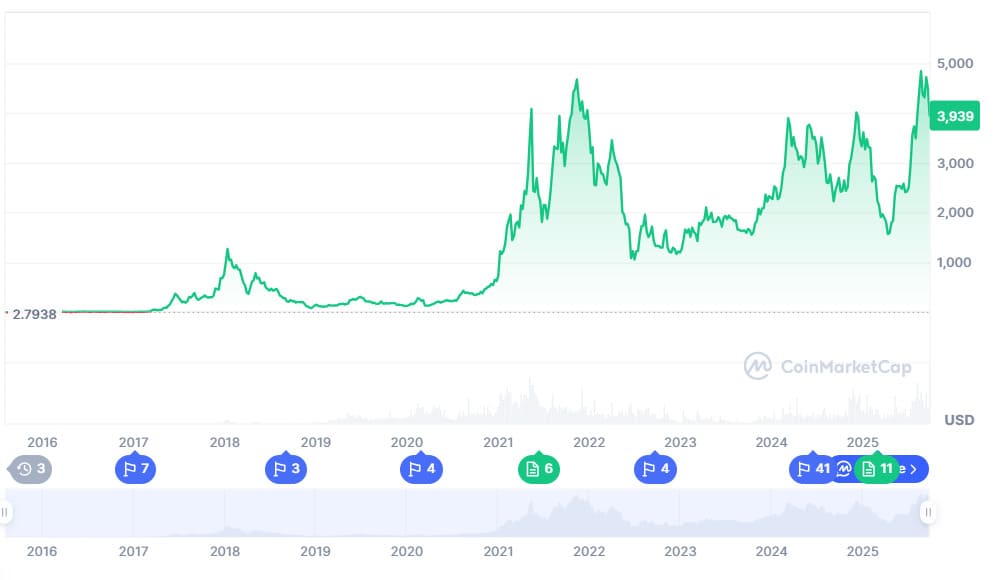
ETH’s price moved below $4,000 during the period referenced. Interpreting large-wallet activity as a directional signal is inherently uncertain, and such activity can reflect a range of strategies.
Ethereum ETF Staking: New Structure, Open Questions
REX-Osprey announced an Ethereum ETF structure in the U.S. that incorporates staking-related features. If adopted broadly, such products could change how some market participants access staking exposure through regulated vehicles, though the operational and regulatory details remain central to how these products function in practice.
Why It Matters:
- Institutional access: The structure is designed to package ETH exposure alongside staking mechanics, according to the issuer’s materials.
- Market impact is uncertain: Any effect on demand or circulating supply would depend on product uptake, staking implementation, and broader market conditions.
- Different from spot-only exposure: Staking-linked designs can introduce additional layers of operational, custody, and risk considerations compared with price-only products.
Regulatory interpretation, disclosures, and implementation details will likely shape whether and how staking-related ETF structures expand.
BullZilla Token Sale: Example of Retail Speculation
Alongside institutional-focused developments, some retail activity continues to center on meme-themed tokens and early-stage fundraising events. BullZilla (BZIL) is one such project running a token sale, based on information published by the project. These offerings can carry elevated risks, including limited transparency, high volatility, and uncertain liquidity.
Conclusion: Multiple Narratives Around Ethereum
This week’s updates reflect several parallel narratives: protocol testing tied to Ethereum’s scaling work, on-chain activity involving large holders, and product experimentation in regulated markets. At the same time, meme-token fundraising remains a prominent feature of the broader crypto landscape, though it tends to be driven by different risk and participation dynamics.
This article is for informational purposes only and does not constitute financial or investment advice.
This outlet is not affiliated with the project mentioned.
This article references a token sale. This outlet is not associated with the project mentioned. This content is for informational purposes only and does not constitute financial or investment advice.
Frequently Asked Questions
What is the Fusaka testnet upgrade?
It is an upcoming Ethereum testnet upgrade scheduled for October 1, which includes discussion of raising the block gas limit to 60M gas as part of testing and scaling work.
Why did Jeffrey Wilcke move ETH to Kraken?
He transferred about $6M worth of ETH; on-chain transfers to exchanges can be interpreted in multiple ways and do not confirm a sale on their own.
How much ETH did whales buy recently?
Tracking reports cited accumulation activity totaling about 406,000 ETH (roughly $1.6B) over a short period, though such figures depend on the methods used to label wallets and flows.
What is Ethereum ETF staking?
It generally refers to ETF structures that seek to provide ETH exposure while incorporating staking-related mechanics, subject to disclosures, implementation choices, and applicable regulation.
Why is ETF staking significant?
If such products are broadly adopted, they could offer an additional regulated route to access staking-linked exposure; the market impact remains uncertain.
How does BullZilla differ from Ethereum ETFs?
BullZilla is described by the project as a meme-themed token sale, while ETFs are regulated investment products traded on exchanges; the risk profile and disclosure framework differ substantially.
What risks face Ethereum ETF staking?
Regulatory interpretation, disclosure requirements, operational setup (including custody and staking mechanics), and execution risks.
Glossary
- Fusaka Upgrade: Ethereum testnet upgrade referenced in developer discussions.
- Gas Limit: Maximum computational effort per block on Ethereum.
- Shadow Fork: A test fork simulating Ethereum mainnet conditions.
- Whale: A term often used for an entity controlling large cryptocurrency holdings.
- Proof-of-Stake (PoS): Ethereum’s consensus mechanism where validators stake ETH.
- Staking Rewards: Rewards earned by validators participating in PoS transaction validation.
- ETF (Exchange-Traded Fund): A fund traded on exchanges like stocks.
- SEC: U.S. Securities and Exchange Commission.

