The second quarter of 2026 set an uncomfortable record for decentralized finance. DefiLlama logged close to 70 exploits and roughly 746 million dollars stolen, the highest incident count ever recorded in a single quarter.
The figure doubles the prior frequency record, though it stays far below historical peaks in volume. The pattern shifted: many small attacks replaced a handful of mega-heists.
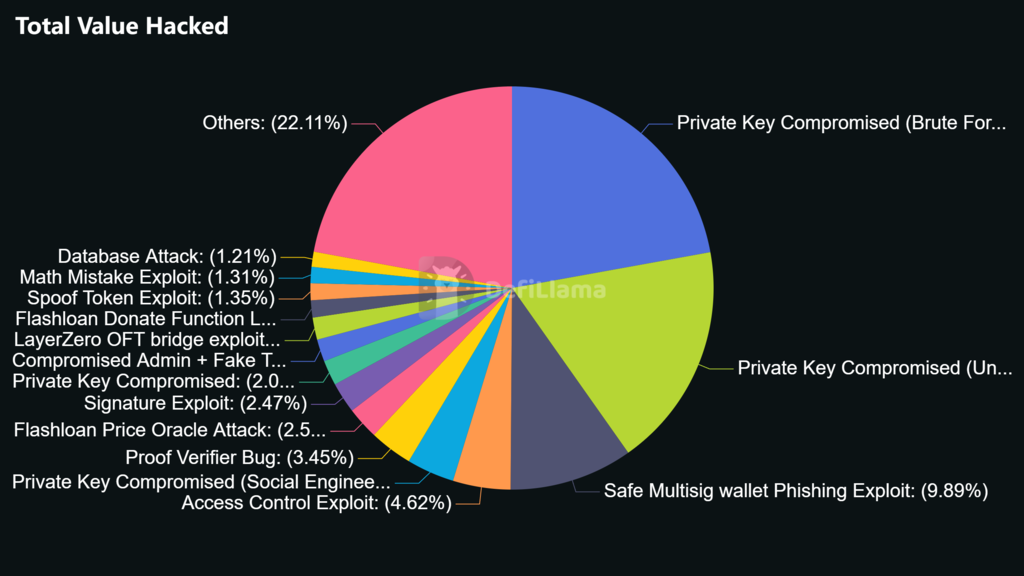
Cross-chain bridge exploits concentrated the largest damage, near 351 million dollars. The obvious conclusion points to hardening bridge code. The reading, however, points the wrong way.
Data dismantling the technical narrative
The two blows defining the quarter did not originate in a contract flaw. The Drift Protocol exploit drained about 285 million dollars through a social engineering campaign attributed to the Lazarus group.
The KelpDAO attack siphoned close to 293 million via the LayerZero OFT bridge, through message spoofing and compromised signers. A single incident explained more than 38% of all value stolen across the quarter.
Both cases share a decisive trait: the smart contracts ran as written. The failure occurred in the human and operational layer.
The parametric cover and audit industry emerged to measure smart-contract risk. The product evaluates lines of code, not the operational discipline of a team.
The loss distribution exposes the mismatch. Admin credential theft and price manipulation added up to 37% of quarterly damage. Compromise of private keys contributed another 5.66%.
Vulnerable code loses relative weight against human error. The defense, nonetheless, stays concentrated where the attacker barely enters anymore.
Why bridges concentrate operational damage
A bridge custodies value and depends on a signer set and a message verification process. Security rests, therefore, on trust assumptions run by people.
Correlated risk worsens the problem. A single fault in validation or in one signer hits every user at once. Traditional insurance spreads independent risks; a bridge concentrates them.
The outcome fits the data. Bridges lead monthly losses because they concentrate the weakest point: the trust model, not the contract syntax.
Self-insurance as a symptom
Facing the gap, the dominant answer shifts the burden onto the user. Common advice asks people to assume user self-insurance and rehearse a first-hour response plan.
The recommendation carries defensive logic. It also reveals an analytical surrender: a systemic, operational risk gets framed as an individual education problem.
The numbers deny any optimism. In May, only about 9.4 million of 68.3 million stolen returned to owners, a fund recovery rate near 14%.
Direct damage fails to capture the scale. After the hacks, close to 14 billion dollars left decentralized finance, according to figures cited by the financial press.
The ratio speaks clearly. Capital flight multiplied the stolen value by nearly 19. Total value locked fell from a peak near 170 billion to around 130 billion in June.
Confidence, rather than the stolen balance, sets the true cost. Misallocated defense feeds the exodus directly.
What would change the diagnosis
Correcting course demands raising operational security to the front line. Distributed signer custody, hardware-backed keys, and social-engineering resistance now weigh more than one additional code audit.
Coverage must follow the same path. Useful insurance would price governance failure and key management, not only the programming error.
Audits also need a wider focus, control over admin pathways and anomaly monitoring protect more than a one-time review of contract logic.
The DeFi insurance gap exists and persists. The cause, however, runs deeper than the difficulty of insuring bridges.
The sector fortifies the contract while the attacker walks in through the operator. The attack surface moved toward people, and the defense still refuses to accept it.
As long as insurance, audits, and playbooks aim at the code, the gap stays open. The problem is not missing coverage, but a misreading of the risk.