
TLDR:
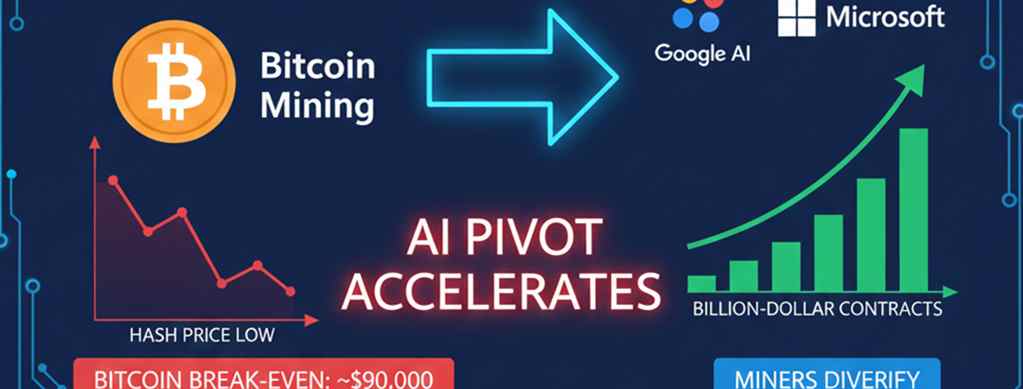
- Bitcoin’s hash price dropped to a historic low, leaving most public miners unprofitable (breakeven point at ~$90,000).
- Growing unprofitability, exacerbated by the 2024 halving, accelerates the Bitcoin Miners Pivot to AI.
- Major miners like Core Scientific and Terawulf are already generating multi-million dollar revenue from high-performance computing services for giants like Google and Microsoft.
The crypto downturn has pushed a large number of Bitcoin miners to the brink of unprofitability, forcing operators to scale back the power of the energy-intensive machines that keep the blockchain running.
According to Hashrate Index, a key measure of mining revenue known as the hash price recently touched a record low. This level is now below the median mining cost (including overhead and financial expenses) for most publicly traded miners, with a breakeven price that has climbed 20% to around $90,000 per Bitcoin. As a result of this economic pressure, the network’s hashrate saw a drop of almost 8%, as miners underclock their machines to save power.
Artificial Intelligence as an Escape Route for Bitcoin Miners
The bleak outlook for traditional mining, intensified by the April 2024 halving which reduced rewards, has validated the strategic shift of many operators. The Bitcoin Miners Pivot to AI and to hybrid models built around High-Performance Computing (HPC) has accelerated, turning the shares of these companies into some of the best market performers this year.
While mining remains their largest revenue stream, major companies like Core Scientific and Terawulf already derive 21% and 14% of their revenue from HPC, respectively. This shift is due to the fact that the demand for computing capacity for Artificial Intelligence (AI) applications offers a much larger and more lucrative market pie in the long term, unlike the finite and decreasing reward from Bitcoin.
The decoupling between the stock prices of miners and the price of Bitcoin has deepened; investors are primarily focused on the AI business, with little interest in Bitcoin mining operations.
Large miners have transformed their facilities into data centers for AI, signing multi-million dollar contracts with hyperscalers like Google and Microsoft. This trend has led some major players, such as Bitfarms Ltd., to announce plans to completely wind down their Bitcoin mining business in the coming years.
In summary, analysts predict that the pivot to AI will continue, and companies with weaker balance sheets and high debt will struggle the most in such a depressed hash price environment.