


The crypto market appears more selective as some participants look for projects with clearer mechanics and verifiable on-chain activity rather than broad marketing claims. This has increased attention on early-stage token sales with transparent distribution methods.
Mutuum Finance positions itself around DeFi lending. Maxi Doge is presented primarily as a meme-themed token, while MAGACOIN Finance uses political branding that may appeal to some audiences and deter others.
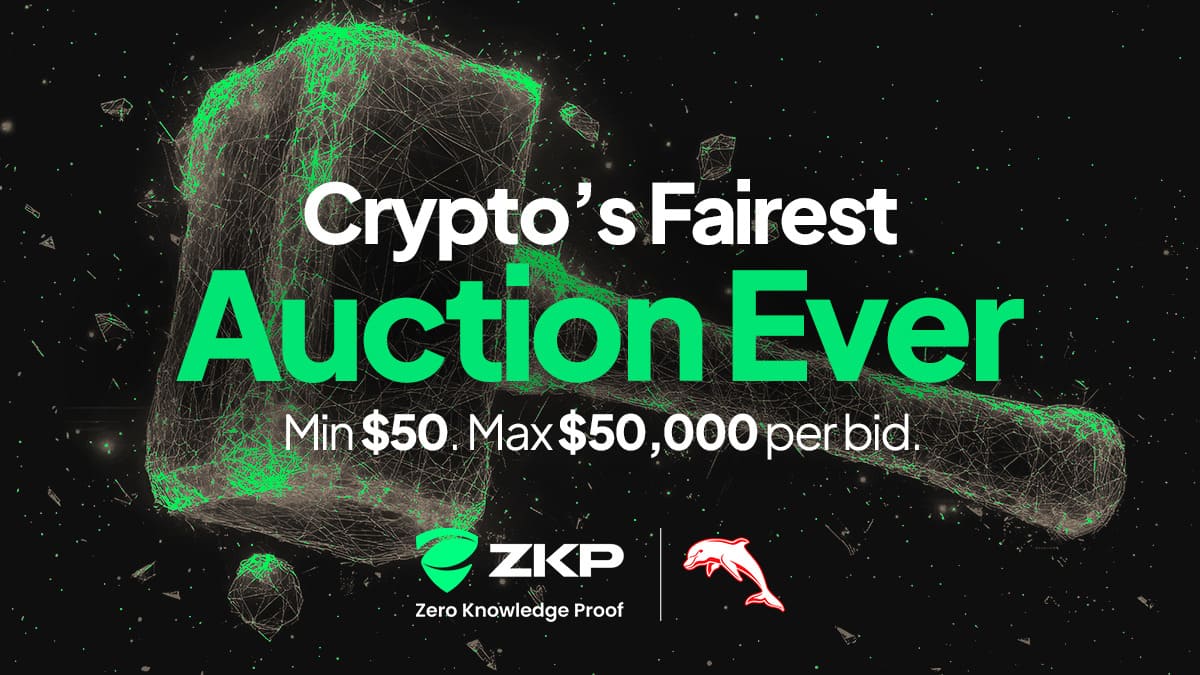
Meanwhile, Zero Knowledge Proof (ZKP) describes a model based on daily token-sale auctions that distribute 200 million coins every 24 hours. According to the project, allocations are proportional, recorded on-chain, and capped at $50,000 per wallet per day. The projects below illustrate different approaches that are currently being discussed in the market.
1. Zero Knowledge Proof (ZKP): Daily token-sale auction model
Zero Knowledge Proof (ZKP) describes a 24-hour token-sale auction window rather than a fixed-price model. According to the project, participants can contribute using ETH, USDC, USDT, BNB, or 20+ other assets. At the end of each window, 200 million ZKP coins are distributed based on each contributor’s share of the total pool. For example, if a user contributes 10% of the day’s total, they receive 10% of the tokens.
The project says the outcome of each day’s auction sets a reference price used for Proof Pods, described as validators for AI compute tasks. It also states that a $50,000 daily wallet cap is intended to limit oversized contributions.
Across the full token-sale period, the project states that 90 billion ZKP coins will be distributed, representing 35% of a 257 billion total supply. The project also says tokens become visible in a dashboard after each window closes. Activity is described as on-chain, which the project says is intended to reduce off-chain or discretionary steps.

Based on project materials, Zero Knowledge Proof (ZKP) emphasizes proportional allocation, an on-chain record of contributions, and the daily wallet cap.
2. Mutuum Finance: DeFi lending in a competitive category
Mutuum Finance offers decentralized lending and staking pools. This is a crowded segment, with many established protocols offering similar services. Based on publicly available descriptions, Mutuum Finance appears to rely on familiar DeFi mechanics rather than clearly differentiated features.

The project highlights APY rates that may change with market conditions. As with any DeFi lending product, outcomes can vary and depend on broader market factors, smart-contract risk, and liquidity conditions. Readers comparing early-stage token sales may want to evaluate whether the project’s features and planned use cases are sufficiently distinct for their risk tolerance.
3. Maxi Doge: Meme-focused token positioning
Maxi Doge has been promoted primarily through meme-driven social media marketing. Meme tokens can attract attention quickly, but long-term relevance often depends on factors such as sustained community engagement, utility, and transparent tokenomics. Public information about Maxi Doge emphasizes branding more than product features.
Trading activity may continue regardless of whether a project has an active development roadmap. Readers assessing early-stage tokens may wish to distinguish between short-term attention and longer-term delivery of stated plans.
4. MAGACOIN Finance: Political branding and audience fit
MAGACOIN Finance uses political themes as a core branding element, which can narrow the potential audience. Political or culture-led narratives may generate attention, but they can also increase volatility and reduce appeal to participants who prefer technology- or product-led projects.
Available descriptions emphasize narrative more than unique technical features. Tokens built around a single theme may face challenges if broader online attention shifts. Readers should review any available documentation, token distribution details, and disclosed risks before considering participation in any token sale.
Key Takeaways
Mutuum Finance is positioned around DeFi lending and staking pools in a competitive market. Maxi Doge is largely meme-driven, with limited publicly described utility. MAGACOIN Finance uses political branding that may be polarizing. In contrast, Zero Knowledge Proof (ZKP) describes a daily token-sale auction with a $50,000 per-wallet cap, and it states that each 24-hour window distributes 200 million coins based on proportional contributions.

According to the project, contributions and allocations are handled on-chain, and tokens are distributed after each window closes. Readers comparing token-sale structures can use these details as a starting point for further verification via primary sources such as the project website and any available documentation.
This article contains information about a cryptocurrency token sale. This outlet is not affiliated with the project mentioned. This article is for informational purposes only and does not constitute financial or investment advice.

