


TL;DR
- Crypto spot trading hit $18.6 trillion in 2025, with 9% growth.
- Binance dominated, handling 41% of spot and half of futures volume.
- Stablecoin reserves are highly concentrated, with 72% held on Binance.
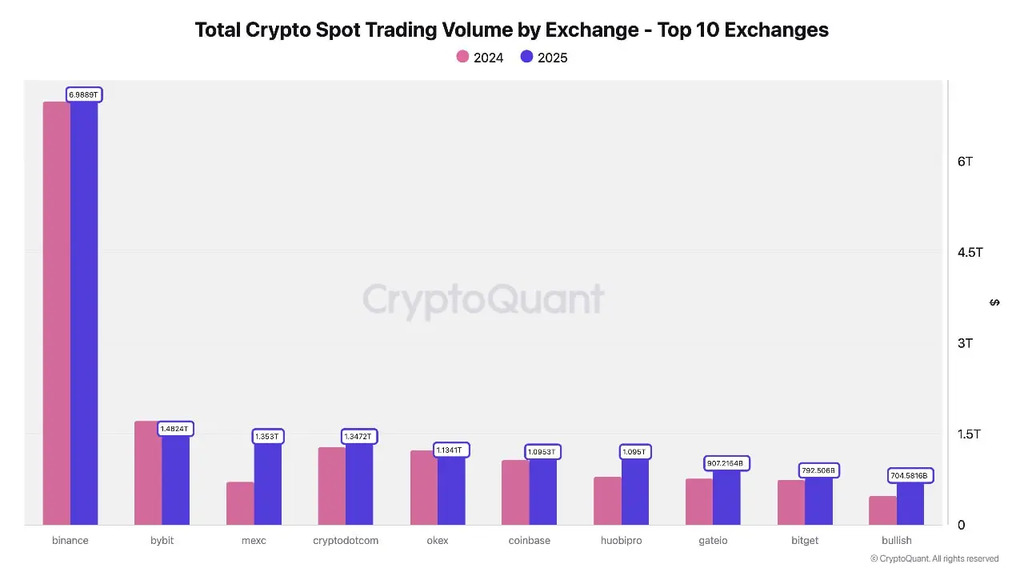
Cryptocurrency exchanges recorded record trading volumes in 2025. Centralized and decentralized platforms combined for $18.6 trillion in spot transactions, per blockchain analytics firm CryptoQuant. Annual growth slowed to 9%, a sharp drop from 2024’s 154% surge. Perpetual futures markets remained robust, climbing 29% to $61.7 trillion—a $13.8 trillion jump from the prior year.
Binance dominated Bitcoin perpetual trading with $25.4 trillion, nearly half the total volume among the top ten exchanges. OKX, Bybit, and Bitget formed a secondary tier, collectively processing 11–19% of trades. Hyperliquid contributed $2.2 trillion, or 3.7% of the market.
Binance reported $7 trillion in spot volume, capturing 41% of the top ten exchanges’ activity. Its influence extended across ETH, XRP, BNB, TRX, and SOL markets. Rivals like Bybit, MEXC, and Crypto.com trailed significantly, each handling $1.3–1.5 trillion.
ETH gained 1.68% annually but slumped 23% in Q4. BNB rose 37% for the year before retreating 23% in the final quarter. TRON climbed 36% yearly but dipped 6% in Q4. XRP and Solana closed with losses of 15% and 19.37%, respectively, after Q4 drops of 17.53% and 30.16%.
Stablecoin reserves concentrate in few hands
Stablecoin holdings revealed extreme centralization. Binance held $47.6 billion in USDT and USDC reserves—72% of the top ten exchanges’ combined total. OKX and MEXC followed with $9.3 billion and $2.2 billion. Bybit, Kraken, and Coinbase held smaller shares: $1.8 billion (2.8%), $1.78 billion (2.7%), and $1.1 billion (1.7%).
Binance’s stablecoin reserves peaked at $51 billion in November 2025 before settling at $49 billion year-end. This marked a 51% increase from December 2024’s $31.7 billion.

Total reserve data underscored industry consolidation. Binance controlled $117 billion in BTC, ETH, USDT, and USDC—31.8% of all exchange-held assets. Coinbase ranked second with $81 billion (22.1%), trailed by Bitfinex ($44.4 billion, 12.1%). OKX and Upbit held roughly $23 billion and $20 billion each.
Trading activity expands, yet liquidity pools shrink into fewer entities. Binance and Coinbase alone command over half of custodied crypto assets. This concentration invites regulatory scrutiny while smaller platforms struggle to attract users prioritizing liquidity and perceived safety.
CryptoQuant’s data highlights systemic vulnerabilities
Dominant exchanges face mounting pressure to comply with evolving rules, particularly around reserve transparency. Meanwhile, perpetual futures outpace spot markets, signaling trader preference for leveraged positions. Stablecoins, critical for liquidity, remain tethered to Binance’s operational health.
Can decentralized finance mature without replicating traditional finance’s centralization pitfalls? Will regulators push for reserve diversification? Users currently favor convenience over idealism, trusting giants despite recurring breach risks.
One pattern holds: scale attracts both capital and consequences. Binance’s growth mirrors its regulatory battles. Coinbase’s reserve share grows alongside its compliance costs. Smaller players survive by niche specialization but lack volume clout.

