TLDR:
- Seven Chinese financial associations classify RWAs as “risky” and prohibited business models.
- The new regulations group tokenization with stablecoins and crypto mining under a total ban.
- Regulators prioritize financial control over technological benefits, eliminating any possibility of pilot testing.
On Monday, the regulatory landscape in Asia took a drastic turn. Seven of the continent’s most influential financial associations issued a joint statement, ending any ambiguity: Real-World Asset tokenization in China is no longer considered a technological innovation awaiting clarity, but rather an illicit financial activity.
Among the signatories are the China Banking Association and the Securities Association of China, which now categorize RWAs within the same risk bracket as stablecoins and digital asset mining.

Financial Risks Over Technological Innovation
The statement highlights that Real-World Asset tokenization in China carries multiple dangers, including asset fraud, operational failures, and excessive speculation. Authorities made it clear that no activity of this nature has the approval of regulatory bodies.
This action does not seek to optimize the sector through gradual supervision; instead, it excludes it entirely from the legal framework, removing terms like “prudential development” or “technical pilots” from its official vocabulary.
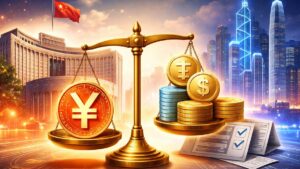
While Beijing closes its doors, the contrast with the West intensifies. In the United States, the implementation of the GENIUS Act aims to establish a framework for payment stablecoins, although industry experts warn that internal debate could weaken the dollar’s position against the advancement of the digital yuan.
China, for its part, prefers to consolidate its CBDC, even allowing interest payments on digital yuan wallets while eradicating any decentralized competition.
In summary, the ban on Real-World Asset tokenization in China reaffirms the government’s intention to maintain absolute control over capital flows.
The message is forceful: the technological benefits of Web3 do not outweigh, in Beijing’s eyes, the systemic risks that these assets represent to its financial sovereignty.