

How often does a meme coin token sale draw significant early interest in a short period? In September 2025, BullZilla ($BZIL) reported raising more than $500,000 in early token-sale rounds. The project describes a structure where pricing stages change every 48 hours or when a funding threshold is reached. This article summarizes project-reported details and related market developments; the figures and mechanics described below are not independently verified.
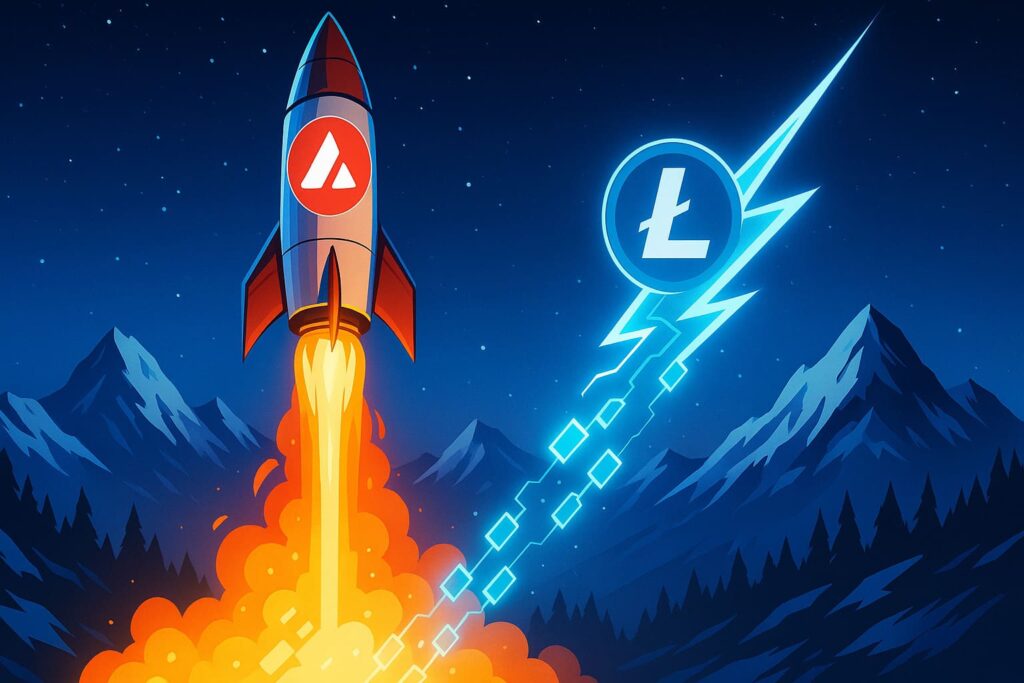
Meanwhile, Avalanche (AVAX) and Litecoin (LTC) have also been in focus due to ETF-related developments and ecosystem updates. Avalanche has been associated with ETF filings and stablecoin-related integrations, while Litecoin faces an ETF decision that market participants are watching. These topics are separate from BullZilla and carry different risk profiles and market dynamics.
BullZilla ($BZIL) and the Project’s “Progressive Price Engine”
BullZilla describes a token-sale mechanic it calls the “Progressive Price Engine.” According to the project, the token price increases on a schedule (every 48 hours) or when a stated funding threshold is reached. Such mechanics do not remove market risk, and any future token pricing is uncertain.
Token-sale figures (project-reported)
According to the project’s published materials at the time of writing, the current stage lists $BZIL at $0.00007908, with more than $570,000 raised, more than 1,900 holders, and 28 billion tokens sold. Any projections about future “listing” prices, returns, or outcomes are speculative and should not be treated as predictions.
| Project-reported token sale snapshot | Value |
| Stage | 3rd (404: Whale Signal Detected) |
| Phase | 4th |
| Price per Token | $0.00007908 |
| Raised | $580,000+ |
| Holders | 1,900+ |
| Tokens Sold | 28B+ |
| Returns / “ROI” claims | Not independently verifiable; future performance is uncertain. |
The project also publishes examples that model hypothetical outcomes using a stated “listing price.” These examples depend on assumptions that may not occur (including whether a listing happens, on what venue, at what price, and with what liquidity), so they should be treated as marketing scenarios rather than reliable forecasts.
Token features described by the project
BullZilla’s materials also describe features such as token burns (“Roar Burns”), a staking program (with an advertised APY), and a referral program. As with any token-related program, these features may change over time, may be subject to eligibility rules, and do not guarantee outcomes for participants.
Participation overview (as described by the project)
The Bull Zilla website describes a typical token-sale participation flow. The steps below are a high-level summary of the project’s description and are not a recommendation to participate.
- Wallet setup: The project references third-party wallets (e.g., Metamask, Trust Wallet, Coinbase Wallet) for access.
- Funding asset: The project lists supported payment assets (such as ETH, USDT, USDC, or BNB) and notes that network fees may apply.
- Connection step: The project indicates that a wallet connection/approval is required on its site interface.
- Order entry: The project describes entering an amount and confirming a transaction in the connected wallet.
- Confirmation: The project states that allocations can be tracked through its dashboard.
Readers should be aware that token sales can involve smart-contract risk, custody risk, counterparty risk, and regulatory risk, and token pricing after any sale period is uncertain.
Avalanche (AVAX): Institutional activity and stablecoin-related developments
Avalanche was reported trading near $32 at the time of writing. Some market commentary has discussed potential price ranges if broader momentum continues, but such scenarios are speculative. Separately, Avalanche’s ecosystem has been linked in public reporting to stablecoin-related integrations and cross-chain infrastructure developments.
Institutional interest has also been discussed in connection with ETF-related filings involving AVAX. As with other digital-asset products, timelines and outcomes can depend on regulators, market structure, and evolving risk disclosures. Readers should also consider token-supply and ecosystem-related risks when evaluating any network.
Litecoin (LTC): ETF decision timeline and integrations
Litecoin was reported trading in the $105–$115 range at the time of writing, with attention on a pending ETF-related decision that has reportedly been delayed into October. Any market impact—positive or negative—remains uncertain.
Separately, Litecoin has been associated in public reporting with integrations that aim to support payments and transfers, including references to Telegram Wallet. As with Avalanche, broader market conditions and liquidity can strongly influence LTC’s price behavior.
Conclusion: September developments and what to watch
September 2025 included multiple narratives across crypto markets: Avalanche-related ecosystem updates and ETF discussions, Litecoin’s ETF timeline and integration news, and BullZilla’s project-reported progress in its token sale. These developments are not directly comparable, and each carries distinct risks.
BullZilla’s materials emphasize its staged pricing structure and other token mechanics. However, any claims about future token prices, exchange listings, or returns remain uncertain and should be treated as speculative.

For More Information:
Follow BZIL on X (Formerly Twitter)
Frequently Asked Questions about the BullZilla token sale
What makes BullZilla different from other meme coins?
According to the project, BullZilla uses a staged token-sale structure (“Progressive Price Engine”) in which the token price changes over time or when a funding threshold is met.
How much could I earn if I invest now?
Potential returns are uncertain. Token prices can be volatile, and any examples shared by projects about future values depend on assumptions that may not occur. Consider the risks and review primary sources before making decisions.
Why is Avalanche (AVAX) gaining attention?
AVAX has been discussed in connection with ecosystem updates and ETF-related filings, alongside stablecoin-related integration news reported publicly.
What is Litecoin’s biggest catalyst right now?
Market attention has focused on the timing and outcome of an ETF-related decision, which has reportedly been delayed into October.
Is this financial advice?
No. This article is for informational purposes only and does not constitute financial or investment advice.
Glossary of Terms
- Progressive Price Engine: BullZilla’s stated token-sale mechanic that changes token price by time or capital raised.
- Roar Burn: A token burn described by the project at the end of certain stages, which would reduce supply if executed.
- APY: Annual Percentage Yield, a measure commonly used for staking or yield programs.
- ETF: Exchange-Traded Fund, a regulated investment vehicle that tracks an underlying asset or basket of assets.
- Stablecoin: A cryptocurrency designed to track a reference asset (often a fiat currency), though mechanisms and risks vary.
Summary
This article reviews project-reported details about BullZilla ($BZIL) and its token sale, including its staged pricing mechanic and other features described in its materials. It also summarizes publicly discussed developments involving Avalanche (AVAX) and Litecoin (LTC), including ETF-related timelines and ecosystem updates. Any forward-looking price scenarios or return estimates should be treated as speculative and uncertain.
This outlet is not affiliated with the project mentioned. This article is for informational purposes only and does not constitute financial or investment advice.

