TLDR
- The Binance token retreats 1.5% after failing to consolidate above the psychological $870 level.
- Bitcoin’s drop toward the $87,000 range has dragged the market down, forcing traders to adopt defensive stances.
- Despite the volatility, the network continues to expand with the integration of BNB into prediction markets like Kalshi.
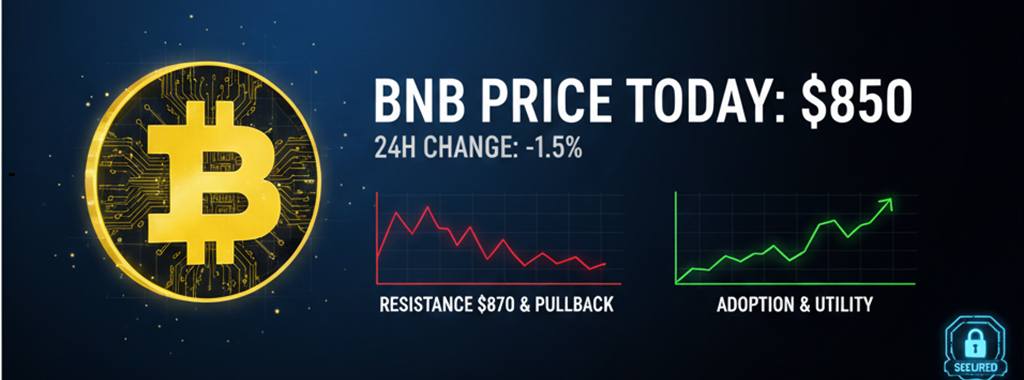
This Tuesday, the BNB price today in December reflects the uncertainty gripping the cryptocurrency market. Following a brief rally that took the asset to its recent high of $870, selling pressure intensified, causing a pullback that placed the token around the $850 mark.
This activity is not isolated; rather, it coincides with a generalized correction led by Bitcoin, which, notably, lost its $90,000 support earlier this week. In this context, experts observe that recent volume spikes do not indicate an influx of fresh capital, but rather a defensive repositioning by large investors.
Instead of seeking aggressive gains, traders appear to be protecting their capital against the macroeconomic volatility that characterizes the end of the year. This dynamic typically precedes prolonged consolidation phases, where the market awaits clearer signals before defining a direction.
Support and Resistance: Key Levels for BNB
In this “wait and see” scenario, the BNB price today in December is trapped in a tight range between $850 and $870. Breaking the $870 barrier with sustained volume could revive bullish projections aiming for $900 before 2025 comes to a close.
However, the recent failure to maintain higher levels suggests that sellers still control the resistance zone. On the downside, investors should keep a close eye on the $820 support. A drop below this point would confirm a short-term bearish structure, potentially leading to deeper losses and an even more conservative market posture.
Despite these technical challenges, the BNB Chain ecosystem continues to reach adoption milestones, such as the recent integration into the Kalshi platform, reinforcing the narrative of real network utility in the face of price fluctuations.