

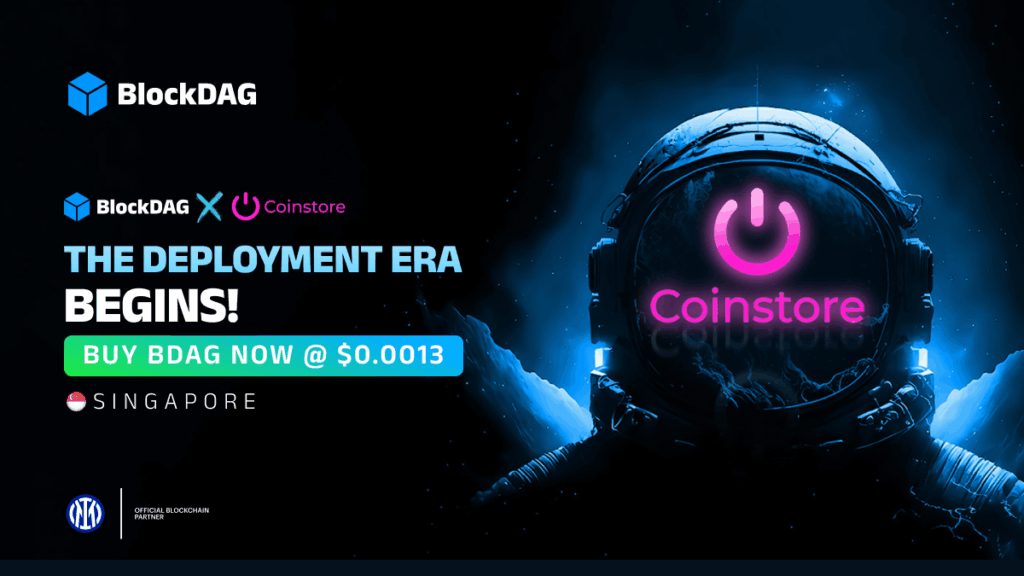
Interest in crypto markets remains high in 2025. With Bitcoin and Ethereum relatively steady, attention has also moved to a range of altcoins and early-stage token sales. Rather than focusing on hype, it can help to look at adoption signals, disclosed technical plans, and the risks that come with newer networks and token distribution schedules. BlockDAG has drawn attention following a large, project-reported token sale ahead of launch.
At the same time, Hedera (HBAR), Sui (SUI), and Pi Network (PI) continue to navigate technical considerations, supply events, and changing market sentiment. Below is a summary of recent talking points for each project, alongside common caveats for readers evaluating high-volatility assets.
BlockDAG (BDAG): Project-reported token sale activity
BlockDAG has been promoted by the project as having raised more than $405 million in a token sale, as part of what it describes as a broader fundraising roadmap. Project materials also reference a sale price of $0.0013 for a “Deployment Event.” Any price targets or post-launch performance expectations are speculative and may not reflect future market conditions.
The project has also reported adoption-related figures for its ecosystem, including usage of the X1 Mobile Miner app, active miners across multiple countries, and a growing number of token holders. These metrics are difficult to independently verify without on-chain and third-party auditing, and readers should treat them as project-reported. On the technical side, BlockDAG describes its design as a hybrid DAG + Proof-of-Work model and has stated throughput goals that may change as the network develops.

The team has said that hundreds of dApps and thousands of developers are involved in building on the ecosystem. Readers can review the project’s own materials here for reference: BlockDAG (BDAG). As with any early-stage network and fundraising event, key considerations include code maturity, security review status, token distribution, and the availability of verifiable on-chain data after launch.
Hedera (HBAR): Market levels and near-term volatility
HBAR has recently traded around $0.220 after declines over the past week. Price moves around the $0.214 area may influence near-term direction; a sustained break below it could increase the likelihood of a move toward the $0.19–$0.20 range, though outcomes are uncertain in fast-moving markets. HBAR has continued to show notable liquidity, with daily volumes in the hundreds of millions of dollars. Hedera’s enterprise-focused positioning and corporate partnerships are often cited as longer-term strengths, but they do not eliminate short-term price risk.
Compared with newer projects that are currently drawing more retail attention, HBAR is often discussed more for its enterprise-related activity than for rapid price moves.
Sui (SUI): Stability meets supply and tokenomics questions
SUI has recently traded around $3.34–$3.38. Market discussion has also referenced reported purchases by SUI Group Holdings, including claims of acquiring 20 million coins and holding a larger total position. If accurate, such activity can affect sentiment, but it does not remove the risk from future supply unlocks, which can add selling pressure depending on broader conditions.
On-chain activity on Sui, including DeFi and gaming usage, is frequently cited by analysts as a supportive signal, but volatility remains a key feature of the asset. Tokenomics, unlock schedules, and liquidity conditions are central factors for understanding the risk profile.
Pi Network (PI): Limited price response after an update
PI has recently traded around $0.344–$0.347, with limited follow-through after the release of Protocol Version 23 on Stellar v23, according to the project. The update was described as improving KYC decentralization and validator security. Even with upgrades, market pricing can remain muted, especially when liquidity is thin. Technical commentary has also raised the possibility of a “death cross,” which, if it plays out alongside weak demand, could put additional pressure on price levels such as $0.32.
Some market commentary includes speculative projections for late 2025 under bullish conditions. These ranges are not guarantees and should be treated as opinion-based scenarios rather than forecasts. Developer activity, community participation, and verifiable network usage are among the factors that can influence longer-term narratives.
Conclusion
Evaluating crypto assets in 2025 involves weighing disclosed adoption claims, fundraising information, technology plans, token distribution, and market liquidity—alongside the possibility of sharp drawdowns. BlockDAG has attracted attention largely because of project-reported token sale fundraising and stated ecosystem goals, while HBAR, SUI, and PI each present different mixes of network development progress and market-related risks.

Readers who want to compare these projects should focus on independently verifiable data where available (for example, on-chain activity after launch, audited code, and transparent token supply information), and interpret any forward-looking statements as uncertain. top crypto to buy now.
This article contains information about a cryptocurrency token sale. This outlet is not affiliated with the project mentioned. This article is for informational purposes only and does not constitute financial or investment advice.

