

As crypto markets head into 2025, some market participants are re-evaluating portfolios and paying attention to projects with established ecosystems and active development. Binance Coin, Ethereum, Solana, and BlockDAG are frequently cited in market commentary for different reasons.
Each has distinct characteristics: BNB’s connection to the Binance ecosystem, Ethereum’s large developer base, Solana’s focus on high-throughput applications, and BlockDAG’s alternative architecture. BlockDAG has also been associated with an ongoing token sale, with the project describing a per-token price of $0.0015 in “Batch 31.”
According to project materials, BlockDAG has raised $430 million and sold 27 billion tokens. More broadly, these four names are often discussed as examples of different approaches to liquidity, network design, and adoption in digital assets.
BlockDAG (BDAG): Project overview
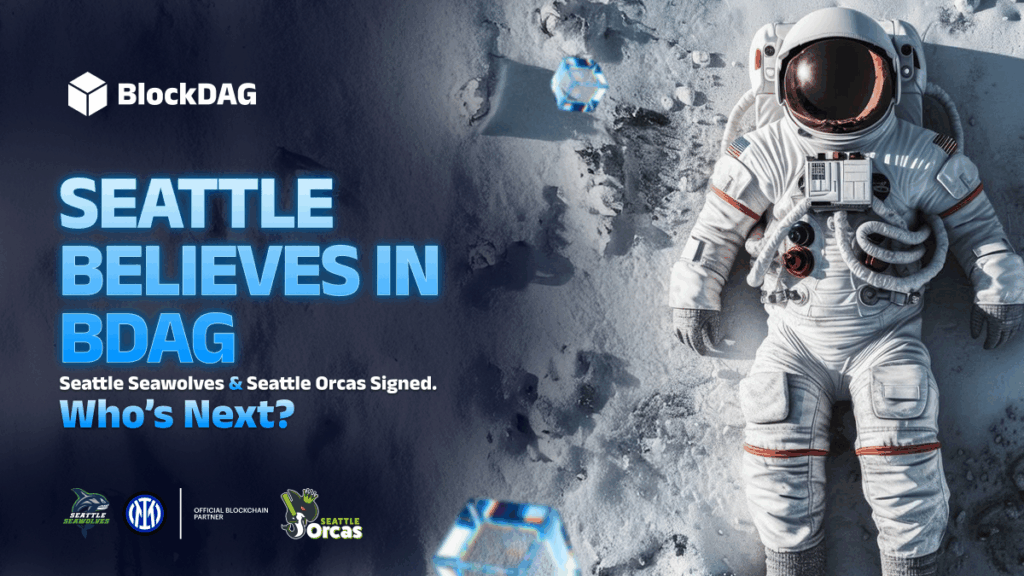
BlockDAG (BDAG) is described by the project as a Layer-1 network using a hybrid DAG + Proof-of-Work approach. The project states that its token sale price is $0.0015 per token and that it has raised over $430 million, with 27 billion tokens sold and 312,000+ holders.
The project also reports that its “Awakening Testnet” has reached 1,400 TPS, and that its X1 mobile miner app has 3 million users. BlockDAG has additionally highlighted a sponsorship arrangement with the BWT Alpine F1 Team.
Some third-party commentary has discussed possible future valuations and exchange listings for BDAG, but these scenarios are speculative and outcomes are uncertain.

Binance Coin (BNB): Ecosystem-linked asset
BNB remains a widely followed cryptoasset linked to activity across the Binance ecosystem. At the time referenced in this text, it was described as trading around $1,127 with about $2.5 billion in daily volume, alongside a $1,120–$1,130 trading range.
Some analysts have pointed to comparatively modest short-term performance versus broader market averages. Supporters of BNB often cite its use cases across exchange-related services and other products, though its price can still be affected by market conditions and company- and regulatory-related developments.
BNB is often discussed as a utility-focused token within exchange-linked assets. Any expectations about “catalysts,” resistance levels, or future price movement should be treated as uncertain, especially in highly volatile markets.
Ethereum (ETH): Large smart-contract ecosystem
Ethereum (ETH) continues to be a central smart-contract platform, with activity spanning decentralized finance and tokenized assets. It was described here as trading in the $3,900–$4,000 range; some technical analysts interpret chart formations such as symmetrical triangles as possible indicators of changing momentum, though such patterns are not predictive.
Network upgrades, including EIP-4844, have been discussed as steps aimed at improving scalability. References to derivatives open interest and institutional participation can vary significantly over time and should be interpreted cautiously.
Ethereum’s market role is often tied to its developer activity and long-running application ecosystem, but its price can still be sensitive to macro conditions, regulatory changes, and technology risks.
Solana (SOL): High-throughput network
Solana (SOL) is frequently discussed for its throughput and lower-fee design, and has attracted interest from both retail and institutional market participants. It was described here as trading around $199 with a market capitalization above $109 billion, alongside mention of a 250,000 SOL OTC transaction and discussions of a potential spot Solana ETF in Hong Kong.
Claims about transaction capacity (often presented as “tens of thousands of transactions per second”) are typically based on project reporting and can depend on methodology and network conditions. As with other Layer-1 networks, activity across DeFi and NFTs can shift quickly and may not indicate future demand.
Conclusion
Comparisons among BNB, Ethereum, Solana, and BlockDAG often reflect different priorities: established liquidity and utility, developer ecosystems, network performance, and early-stage fundraising narratives. For readers looking for primary information about BlockDAG, the project website is available for reference here: BlockDAG’s.

This article is for informational purposes only and does not constitute financial or investment advice. This outlet is not affiliated with the project mentioned.

