The Bitcoin mining industry faces a business model transformation that data quantifies with precision. The electrical cost of production sits around $48,694 per BTC, while the realized price remains near $54,000. The gap represents a gross margin of 9.9%, insufficient to absorb operating costs, capital expenditure, and maintenance expenses in low-efficiency fleets.
The hashprice holds near $29 per PH/s per day, and transaction fees contribute roughly 1% of total miner revenue. With the 2028 halving that will cut the block subsidy from 3.125 BTC to 1.5625 BTC, operators without clear structural advantages will accumulate severe margin pressure in the next cycle.
The relevant question is not whether Bitcoin mining will remain profitable. The question is which operating model defines profitability in an environment where the protocol’s subsidy decreases by design every four years and the hashprice operates at historically compressed levels.
The “Buy-Mine-Sell” Model No Longer Functions as a Standalone Strategy
During the 2017 and 2020-2021 cycles, mining logic operated effectively under a simple structure: deploy ASICs, secure cheap electricity, and capture BTC price appreciation. The upward price volatility offset operational inefficiencies that, in a 9.9% margin environment, would destroy any operator’s profitability.
The current cycle tolerates no inefficiency. With the hashprice at low levels and transaction fees contributing marginally to total revenue, the block subsidy represents practically the sole income source for the average operator.

Depending on a variable the protocol cuts every four years, without building parallel structural advantages, turns the classic mining model into a speculative bet on the asset’s price, not an operational business with independent fundamentals.
Michael Jerlis, CEO of EMCD, articulates the break with the previous model directly: the reward alone no longer covers the bill. Miners must now squeeze the margin per kilowatt-hour, not per petahash.
Firmware and Software Optimization Become Financial Variables in Bitcoin Mining
The mining industry historically undervalued software as a source of competitive advantage. Hardware defined the strategic position; software fulfilled auxiliary functions. The 2026 numbers invert that hierarchy.
Factory firmware can leave up to 25% of chip capacity unused, while the machine consumes 100% of contracted power. For an operator running 1,000 next-generation ASICs, recovering that 25% of efficiency without increasing electricity consumption equates to adding 250 machines to output without additional CAPEX or energy bills. At $29 hashprice, no rational operator ignores that available margin.
Voltage and frequency optimization, autotuning, fan curve management, and adaptive operating profiles no longer represent optional improvements. At current hashprice levels, operators who implement them separate profitable sites from ones that accumulate sustained operating losses.
Curtailment adds an additional value dimension. Operators who participate in demand response programs earn direct revenue from grid operators or reduce their net electricity cost during peak tariff periods. ASIC fleets carry a technical advantage for curtailment: they can cut load within seconds without interrupting an industrial production process.
Heat reuse adds a third value source from the same electricity input. Sites that redirect the heat from ASICs into greenhouses, district heating systems, industrial drying processes, or buildings reduce their net energy cost and build a parallel revenue stream from the same watts. Regulatory and reputational pressure on the energy footprint of mining accelerates heat reuse adoption beyond the pilot project stage.
Energy Defines Competitive Position Before the First Block
The competitiveness analysis in Bitcoin mining no longer starts from hardware. It starts from the energy access structure.
Operators with access to stranded energy, curtailed renewable generation, flexible load contracts, or behind-the-meter generation build an advantage that competitors cannot replicate by simply purchasing more ASICs. Energy cost determines the total cost per BTC produced, and the resulting number, not the hashrate, decides operator viability in a compressed hashprice environment.
Private operators with all-in costs between $50,000 and $64,000 per BTC produced maintain positive operating margins at current prices. Operators with costs above that range require BTC price appreciation to stay solvent, which turns their model into a speculative position on price, not a business with independent operational fundamentals.
Bradley Peak, Global Head of Sales at VNISH, states the principle with technical precision: Bitcoin mining operators build their margins long before they plug in the first ASIC.
The Split Between Public and Private Miners Deepens
Publicly listed miners face a structural pressure that private operators do not experience: the obligation to report quarterly metrics to capital markets that value hashrate growth as the primary indicator of business health.
The result produces a split between two distinct models. The first transforms mining infrastructure into the foundation of a high-performance computing (HPC) and artificial intelligence business. Sites with contracted electrical power, high-density cooling, and sufficient network connectivity meet the technical requirements of AI data centers. The differentiating asset is not the installed ASIC; it is the site, the contracted power, and the cooling infrastructure.
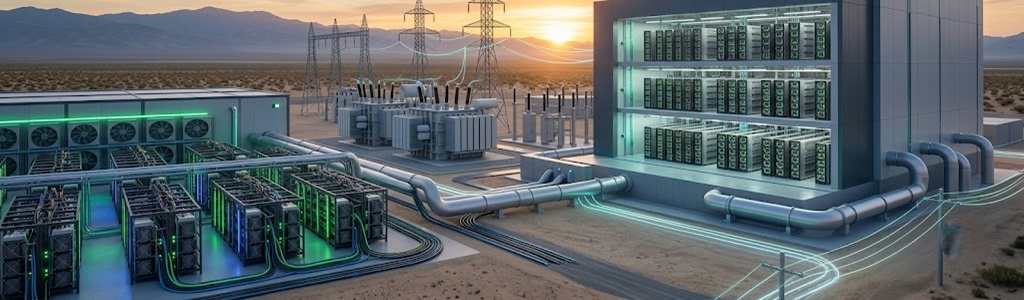
The second model maintains pure exposure to Bitcoin mining without diversification into HPC or flexible energy strategies. Without exceptional energy costs and modern hardware fleets, operators who sustain the traditional model accumulate risk ahead of the 2028 halving with few available mitigation paths.
Private operators with lean cost structures and competitive energy access retain the flexibility that public companies lost when they accepted capital market commitments. The ability to reallocate hardware, change pools, adjust firmware profiles, or pause operations without affecting a stock price generates a real operational advantage in margin-compression cycles.
Bitcoin Mining and Energy Markets Converge Structurally
The sector’s ten-year direction points toward the operational integration of Bitcoin mining within energy infrastructure. Miners will not compete solely with each other for hashrate; they will compete with other flexible industrial consumers for access to low-cost, high-availability, and scalable generation sources.
Fernando Lillo Aranda, CMO of Zoomex, frames the transition with technical precision: energy shifts from cost to strategy. Miners who adopt energy hedging, active treasury management, and hybrid revenue models — mining plus grid services plus HPC — will build businesses with structural resilience against BTC price volatility.
Michael Jerlis projects the long-term convergence: within ten years, rigs will share buildings with AI and HPC infrastructure, and the real asset of the business will be the contracted electrical power and the site location, not the installed ASIC model.
The Bitcoin mining industry converges toward a model where competitive advantage does not belong to whoever deploys the most hashrate, but to whoever manages the energy input with greater precision, optimizes software down to the chip level, and diversifies revenue sources from the same physical site. The 2028 halving accelerates the convergence and eliminates the possibility of deferring it.