Bitcoin’s 30-day implied volatility has declined to 36%, reaching a long-term support level last observed in May 2026, according to data cited by Crypto Economy. The asset has traded in a narrow range below $65,000 for seven consecutive sessions, with maximum daily price movement recorded at 1.18%. Price registered at $64,739.1 on August 6, reflecting a 0.8% gain over 24 hours.
The 30-day implied volatility index (BVIV), which measures expected market volatility in the Bitcoin options market, has declined from a June peak near 60%. This decline occurred despite recent market events including a multi-million-dollar Coldcard wallet hack, weak institutional demand, and regulatory uncertainty.

Low Volatility Environment Encourages Leveraged Positioning
Adam Haeems, Head of Asset Management at Tesseract Group, which manages $500 million in client assets, stated that low-volatility environments suppress trading costs, encouraging traders to build large directional bets and hedging positions. “When volatility is cheap, traders can build directional positions and hedges at relatively low cost,” Haeems said.
“If the market then moves through a level with concentrated positioning, dealer hedging can accelerate the move”.
“The practical implication is that low volatility should not be mistaken for low risk,” Haeems added. “It is a reason to be careful with leverage, particularly when trading volumes and market depth are subdued”.
Market Depth and Liquidity Conditions Present Structural Vulnerabilities
Bitcoin’s 2% order-book depth—the aggregate value of buy and sell orders within 2% of the market price—fell to approximately $35–$40 million by late June from around $70 million in early May. Aggregated 2% market depth has declined roughly 30% from its 2025 high, with Binance 1% depth falling from above $600 million in October 2025 to under $400 million, according to Kaiko data.
When market depth contracts, a limited number of large orders can produce significant price movements. Luke Deans, senior research associate at Bitwise, told CoinDesk that “thin participation and market illiquidity can create fragile conditions where relatively modest changes in supply or demand produce excessive price moves”.
Options Market Signals Divergent Sentiment
Paul Howard, Senior Director at market-making firm Wincent, observed that demand for put options has weakened while call options also lack buying interest. Glassnode characterizes this condition as “no one is paying for upside, and no one is paying for downside,” a pattern often observed near cycle bottoms.
Bitcoin options data from Deribit showed that 32,000 BTC options expired on August 7 with a put/call ratio of 0.26, a maximum pain point of $64,000, and a notional value of $2.06 billion. Calls still represent 60.7% of total open interest, indicating the broader options market remains call-biased even as recent trading has concentrated on bearish puts.
Deribit’s DVOL index, which tracks 30-day expected volatility, trades near 35, down from a peak of 90 recorded earlier this year. Deans noted that the compression extends across 30-, 60-, and 90-day trading intervals and from one-week to three-month options.
“The market is effectively crowding around the expectation that very little will happen,” he stated.
ETF Inflows and Macro Factors
U.S. spot Bitcoin ETFs recorded $626 million in net inflows over the first three trading days of August, according to SoSoValue and Farside Investors data. This three-day total surpassed the $172.43 million recorded over all of July. BlackRock’s IBIT accounted for $479 million of that total.
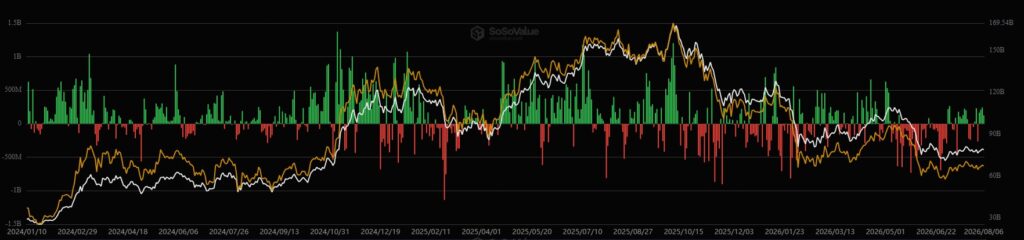
Howard identified positive regulatory developments, such as the Clarity Act, as a potential catalyst that could manifest as institutional ETF inflows. Primary downside risks include a potential breakdown in Hormuz Strait negotiations and inflationary shocks.
Bitcoin trades approximately 48.4% below its October record high, with 303 days elapsed since that peak. The asset has remained range-bound between $60,000 and $70,000, with analysts suggesting limited upside in the near term.