


Market attention often shifts between large-cap assets and higher-risk, community-driven tokens. While some traders watch the Bitcoin price trend, others look to meme-themed projects that can be more volatile. Bitcoin Cash, a long-running blockchain, continues to be used for payments and transfers, with activity influenced by broader crypto market conditions.
In the meme-token segment, projects such as BullZilla ($BZIL) describe mechanisms intended to reduce supply over time and encourage community engagement. Bitcoin Cash and newer meme-token projects represent different parts of the market, with meaningfully different risk profiles.
BullZilla ($BZIL): A meme-token project running a token sale
BullZilla ($BZIL) is a meme-token project that, according to its website, is conducting a staged token sale. The project states it has raised over $880,000, sold 31 billion tokens, and attracted 2,900+ holders. It also describes a pricing schedule in which the token price can change based on time and fundraising milestones.
The project also discusses a potential future listing price and various return scenarios. Such figures are speculative and should not be treated as forecasts; outcomes can differ significantly from project projections and marketing materials.
BullZilla describes a “Roar Burn Mechanism” that reduces supply over time, and a staking feature it calls the “HODL Furnace,” with yields the project advertises (these rates are not guaranteed and may change). As with many early-stage tokens, participation can involve significant risk, including illiquidity and the possibility of a complete loss.
The project frames its design as an alternative to longer-cycle supply reductions seen in major networks, while adding gamified elements intended to keep community members engaged.
Referral incentives described by the project
BullZilla also promotes a referral program it calls the “Roarblood Vault,” which, according to the project, offers token-based incentives tied to referred purchases and includes an unlocking period.
Referral programs are marketing incentives and may influence participation; readers should review the terms in full and consider the risks and potential conflicts created by referral rewards.
Bitcoin Cash ($BCH): A long-running network focused on payments
Bitcoin Cash was created from Bitcoin’s 2017 chain split, with a focus on scaling for payments and higher transaction throughput. With larger block sizes, the network is designed to process transactions at lower fees relative to some alternatives, though outcomes depend on network usage and broader market conditions.
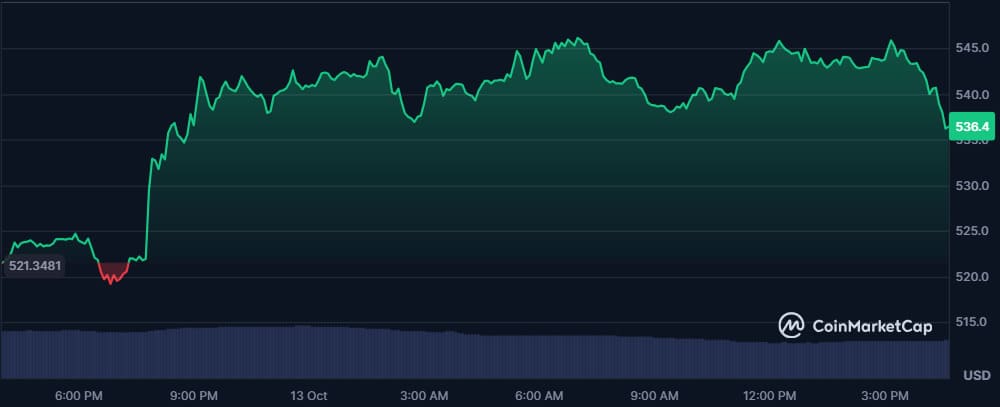
At the time of writing, publicly available market data showed Bitcoin Cash trading around $540.82, with a market capitalization of about $10.78 billion and daily trading volume near $397.83 million. The price was up 3.26% over 24 hours, while seven-day and one-month performance showed modest declines. Year-on-year, BCH was up about 66.19% from prior levels, after having fallen sharply in earlier market cycles.
Some market commentary has suggested BCH could move higher if broader market conditions remain supportive, but price targets are uncertain and depend on multiple variables, including liquidity, adoption, and overall risk appetite.
Conclusion
Bitcoin Cash and meme-token projects such as BullZilla reflect different approaches in crypto markets: established networks with ongoing use cases versus early-stage tokens that rely heavily on community narratives and project-defined mechanics. Any comparison should account for differences in scale, liquidity, and risk.
Project features such as token burns, staking yields, and referral incentives can affect token distribution and participant behavior, but they do not guarantee future performance. Readers should approach early-stage token sales cautiously and verify claims independently.
For More Information:
Frequently Asked Questions
How can you research a meme-token sale?
Check the project’s documentation and on-chain contract details, look for independent audits where available, and review whether key claims can be verified through publicly available data. Be cautious of unaudited contracts, aggressive marketing, and unclear terms.
What should readers keep in mind when evaluating early-stage token sales?
Early-stage token sales can carry elevated risks, including smart-contract vulnerabilities, limited liquidity, and rapid price swings. Claims about future listings or returns should be treated as speculative.
Do meme coins have a future?
Some meme tokens develop longer-term communities or add features such as staking or supply-reduction mechanics, but outcomes vary widely and many projects do not sustain activity over time.
What’s the impact of the bitcoin price on meme coins?
Broader market moves, including Bitcoin price volatility, can influence risk appetite across crypto markets. Meme tokens often see larger percentage moves during periods of heightened speculation, in both directions.
How do people assess the potential risks of a meme token?
Common checks include contract transparency, token distribution, lockups, audit status, liquidity arrangements, and whether project claims can be independently verified. High marketing intensity is not a substitute for fundamentals.
What factors do people consider when evaluating meme tokens?
Look for clear disclosures, transparent tokenomics, and verifiable information about the team and contracts, and avoid relying on short-term hype or guaranteed-outcome messaging.
Glossary
- APY: Annual percentage yield used to describe staking or yield programs; rates can change and are not guaranteed.
- Roar Burn: A token burn mechanism described by the BullZilla project.
- Token sale: A fundraising event in which a project sells tokens to participants before broader market trading.
- Roarblood Vault: A referral-based incentive program described by the BullZilla project.
- HODL Furnace: A staking feature described by the BullZilla project.
- Deflationary Tokenomics: A model designed to reduce token supply over time to increase scarcity; it does not guarantee price appreciation.
- Layer-1: Core blockchain architecture that processes transactions on its own network.
- Utility Token: A token intended to provide functional use within a specific ecosystem.
- Market Cap: Total value of a token’s circulating supply based on market price.
- Volatility: The speed and intensity of market price changes.
This article is for informational purposes only and does not constitute financial or investment advice. This outlet is not affiliated with the project mentioned.

