

Bitcoin and Ethereum prices can move sharply, and short-term volatility can make it difficult for traders to time market swings. In response, some market participants look at cloud mining services, which generally market the ability to rent computing power from data centers and receive payouts tied to mining activity. These products can also involve significant counterparty, operational, and regulatory risks.
With many providers operating globally, service quality and transparency can vary widely. The overview below discusses several commonly mentioned platforms and software providers, focusing on general features and risk considerations. Inclusion is for context and should not be read as an endorsement.
1. AIXA Miner – Company-described cloud mining service
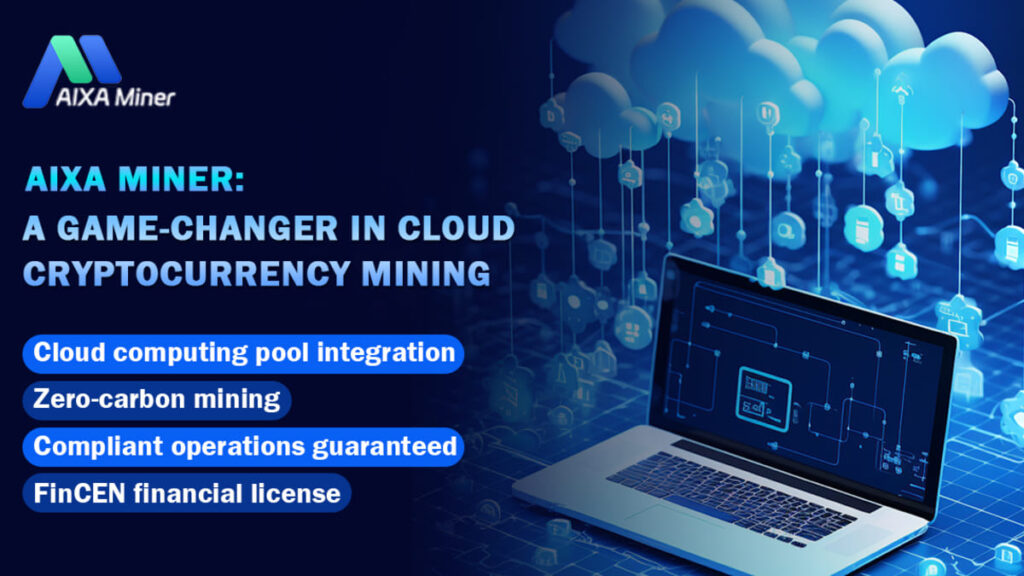
Established in 2020, AIXA Miner describes itself as a U.S.-based company and states that it is registered with FinCEN. The company also says it operates data centers in multiple locations and uses renewable energy sources.
Project materials describe contract-based mining options intended for different user profiles. Features mentioned by the project include:
- A streamlined account setup process.
- Multiple contract sizes, including low minimum tiers and higher-value tiers.
- Payout schedules described as daily (terms and conditions may apply).
- Marketing incentives such as referral and VIP-style programs, according to the company.
Highlighted AIXA Miner contract examples (as presented by the project)
The table below reflects contract names, amounts, and durations as shown in project materials. Payout figures and rates are not reproduced here and are not independently verified; users should review the full terms, fees, and risk disclosures directly with the provider.
| Contract Name | Contract Amount (USD) | Duration (Days) | Daily Earnings (USD) | Total Earnings (USD) | Daily Rate |
| LTC Free Experience Miner | $20 | 1Day | Not independently verified | Not independently verified | Not independently verified |
| DOGE Beginner Experience Miner | $100 | 2Day | Not independently verified | Not independently verified | Not independently verified |
| DOGE Miner DG Hydro 1 | $1100 | 10Days | Not independently verified | Not independently verified | Not independently verified |
| BTC Miner M60S++ | $7000 | 18Days | Not independently verified | Not independently verified | Not independently verified |
| BTC Miner M66S++ | $30,000 | 22Days | Not independently verified | Not independently verified | Not independently verified |
| BTC Miner ANTSPACE MD5 | $100000 | 26Days | Not independently verified | Not independently verified | Not independently verified |
| ANTSPACE MD5-Bonus $130000 | $650000 | 16Days | Not independently verified | Not independently verified | Not independently verified |
As with any third-party mining or payout service, users may want to evaluate custody arrangements, fee structures, contract terms, withdrawal conditions, and the provider’s regulatory and corporate disclosures before using it.
2. NiceHash – Hashpower marketplace model
NiceHash operates as a marketplace where users can buy or sell computing power. Outcomes for buyers and sellers can vary based on demand, pricing, and network conditions.
Pros of NiceHash:
- A liquid marketplace format for trading hash power.
- Support for multiple algorithms and assets (depending on the product used).
- More configurability for technically proficient users.
Cons:
- Results depend on market demand and pricing, which can change quickly.
- The learning curve may be challenging for beginners.
- There are no fixed or guaranteed daily outcomes.
Overall, NiceHash is structurally different from fixed-term contract offerings because it relies on a marketplace matching model; this can increase flexibility, but it can also make expected results harder to estimate.
3. Genesis Mining – Long-running cloud mining provider
Genesis Mining is a long-running provider in the cloud mining segment and is frequently referenced by early market participants.
Pros of Genesis Mining:
- Established brand recognition in the sector.
- A relatively simple product structure compared with some marketplaces.
- Public materials typically discuss energy and operational considerations.
Cons:
- Supported assets and contract availability may be limited depending on the period.
- Users may encounter waiting times for certain offerings.
- Some products may be temporarily unavailable.
As with similar services, availability, pricing, and the economics of mining can change quickly, affecting user outcomes.
4. BitFuFu – Large-scale mining offering
BitFuFu is often described as a large-scale mining operation and has been associated with major hardware supply chains in the industry. As with other cloud mining products, payouts and costs can be sensitive to network conditions.
Pros of BitFuFu:
- Large-scale infrastructure positioning.
- Products aimed at higher-volume users may be available.
- Fees and contract structures can vary by plan.
Cons:
- Results are influenced by network difficulty and other external variables.
- Minimum entry requirements may be higher for some plans.
- Customer support experiences reported by users can be mixed.
5. Hashshiny – Consumer-facing cloud mining app
Hashshiny is a cloud mining provider that emphasizes an app-based experience aimed at consumer users.
Pros of Hashshiny:
- Mobile-first interface designed for simpler onboarding.
- Lower entry points may be available depending on the product.
- Multiple assets may be offered (depending on availability).
Cons:
- Users may find limited transparency in financial reporting.
- Support response times can vary.
- Projected outcomes may differ from realized outcomes due to fees and market conditions.
6. MiningRigRentals – Peer-to-peer rig rental marketplace
MiningRigRentals offers a marketplace where users can rent mining rigs owned by third parties.
Pros of the service of MiningRigRentals:
- Choice of many mining algorithms.
- Options for short-term or longer-term rentals.
- A large pool of hardware providers.
Cons:
- Configuration may require technical knowledge.
- Results are variable and are not guaranteed.
- Service quality can depend on third-party providers.
7. Cudo Miner – Mining management software
Cudo Miner is primarily positioned as mining software intended to help users manage and optimize mining on their own hardware.
Pros of Cudo Miner
- Customizable settings aimed at users who want more control.
- GPU and CPU mining support (depending on hardware and configuration).
- Automated switching features may be available.
Cons
- Users typically need to own and maintain compatible hardware.
- Outcomes depend on device performance, network conditions, and operating costs.
- Electricity costs and hardware wear can materially affect results.
Summary – What to check before using cloud mining services
Cloud mining and hashpower products are not uniform: some are fixed-term contracts, others are marketplaces, and some are software tools. Across models, common issues include opaque fee structures, changing mining economics, custody and withdrawal risk, and the difficulty of verifying underlying operations.
If a provider publishes payout rates or revenue projections, they should be treated as marketing information unless independently verified, and they may change over time due to external factors such as network difficulty and asset prices.
Company Details
Company address: 5800 S Quebec St, Greenwood Village,
Company email: [email protected]
Official website: www.aixaminer.com
Keywords: Bitcoin mining
Cloud mining
Mining software
This article is for informational purposes only and does not constitute financial or investment advice. This outlet is not affiliated with the project mentioned. Crypto Economy is not affiliated with any of the platforms mentioned. Readers should conduct their own research and consider the risks before using any service.

