

The cryptocurrency market is entering a period where project fundamentals and early-stage token fundraising are drawing attention. Two names that are frequently discussed are BullZilla ($BZIL) and Binance Coin (BNB). They represent different types of crypto exposure: an early-stage token sale versus an established network token.
This article reviews BullZilla’s token sale as described by the project and discusses general scenarios that analysts commonly use when assessing Binance Coin. Any forward-looking statements about tokens are speculative and may not reflect actual outcomes.
BullZilla token sale: project-reported activity and features
BullZilla ($BZIL) is conducting a staged token sale (described by the project as “Stage 4B”). According to project materials cited in this piece, the token price at that stage is $0.00009241, with more than $670,000 raised, more than 2,000 holders, and more than 29 billion tokens sold. These figures are project-reported and were not independently verified for this article.
The project has also published projections that compare earlier and later token sale stages and a potential future listing price. Such projections are inherently uncertain and should not be treated as a forecast of future performance.
The Roarblood Vault: a project-described treasury mechanism
BullZilla describes its ecosystem as including a “Roarblood Vault,” presented as a community-focused treasury intended to support development and incentive programs. As with many early-stage tokens, these mechanisms depend on execution, market conditions, and smart-contract and operational risks.
The project also describes a referral feature with rewards tied to new participants and purchases. Referral-based incentives are a marketing mechanism and may encourage speculative participation; readers should review the terms and associated risks directly in project documentation.
After the token sale, the project states that the vault would continue to support its ecosystem and that staking may be available. The project references a staking product it calls the “HODL Furnace,” including an advertised APY; advertised yields are not guaranteed and can change, and actual outcomes depend on the protocol’s design, token emissions, and market prices.
Overall, BullZilla’s materials position the token as a meme-coin-style project with added incentive and treasury features. Whether those features translate into sustained usage is uncertain.
Staking in the HODL Furnace: how the project describes it
The project describes the HODL Furnace as a staking mechanism with a lockup/vesting component. In general, lockups can reduce immediate selling pressure, but they also reduce user liquidity and can increase risk if market conditions change.
As with any staking program, prospective participants should assess smart-contract risk, the source of rewards (for example, emissions versus fees), and the possibility of changes to terms.
Participating in the BullZilla token sale: general considerations
Project participation mechanics typically involve using a compatible wallet and paying network fees, and may require interacting with a token sale contract. Details can differ by project and may change over time. Readers should consult the project’s official documentation and consider security practices (such as verifying URLs and contract addresses) before taking any action.
The project also describes stage-based pricing adjustments. Changes in stage pricing are marketing design choices and do not indicate future market demand.
Binance Coin (BNB): overview and 2025 scenario discussion
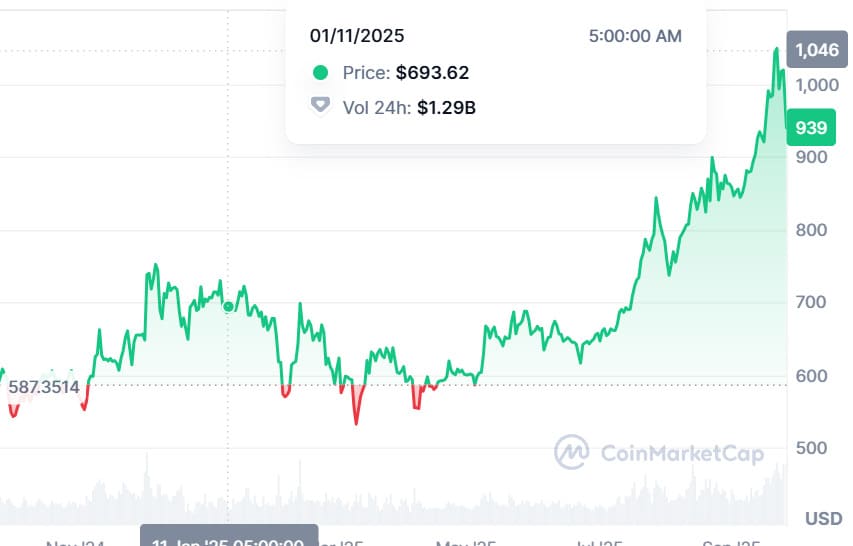
Binance Coin (BNB) is an established token associated with the Binance ecosystem and BNB Chain. The figures cited in this article (including price, market cap, and trading volume) are time-sensitive and can change quickly; readers should verify current data using independent market sources.
The utility of Binance Coin is commonly described as including exchange-related uses (such as fee programs) and applications across its broader ecosystem. Like other large-cap crypto assets, BNB can still experience significant volatility and is exposed to market, technology, and regulatory risks.
Looking ahead, discussions about BNB in 2025 often reference factors such as ecosystem adoption and token burn mechanisms. These factors may influence demand and supply dynamics, but they do not determine price outcomes.
Binance Coin price scenarios for 2025 (speculative)
Based on commonly used scenario analysis (not a prediction), potential outcomes for BNB in 2025 are sometimes framed as follows:
- Higher-growth scenario: If activity and adoption expand and broader market conditions are favorable, BNB could trade higher than recent levels, potentially approaching prior cycle highs.
- Range-bound scenario: If growth moderates, BNB may trade within a range for extended periods as the market digests macro and sector developments.
- Lower-growth scenario: If adverse regulatory developments, market stress, or ecosystem disruptions occur, BNB could trade lower than recent levels.
These scenarios are illustrative only. Crypto prices are difficult to forecast, and past performance is not indicative of future results.
Conclusion
BullZilla represents an early-stage token sale with project-described incentive features, while Binance Coin represents a more established crypto asset with broader existing usage. These categories carry different risk profiles, and comparisons between them should account for liquidity, maturity, and execution risk.
Readers considering any crypto asset may want to review primary documentation, understand custody and smart-contract risks, and consider how volatility could affect their financial situation.
For More Information:
Follow BZIL on X (Formerly Twitter)
FAQs
What makes BullZilla unique compared to other meme coins?
BullZilla’s materials describe a treasury mechanism (“Roarblood Vault”) and a staking product (“HODL Furnace”). Whether these features lead to sustained usage depends on execution and market conditions.
How much ROI can BullZilla deliver at listing?
The project publishes ROI-style projections tied to its token sale stages and a possible listing price, but such figures are not guaranteed and should be treated as marketing estimates rather than outcomes.
What drives Binance Coin’s long-term value?
Commonly cited factors include usage across the Binance ecosystem and supply changes via token burns. These factors may influence value but do not eliminate risk or ensure price appreciation.
How risky are early-stage token sales?
Early-stage token sales can carry heightened risk, including smart-contract vulnerabilities, limited liquidity, information asymmetry, and high volatility. Participants can lose some or all of their capital.
Do people diversify between early-stage tokens and established assets?
Some market participants choose to spread exposure across different types of assets, but diversification does not guarantee profits or protect against losses.
Glossary
- APY (Annual Percentage Yield): Annualized yield rate sometimes quoted for staking programs; it can change and is not guaranteed.
- ROI (Return on Investment): A way to express gains or losses relative to an initial amount; forward-looking ROI figures are speculative.
- Token sale: An early fundraising event in which a project sells tokens, sometimes before broader exchange trading.
- Token Burn: A mechanism that reduces token supply by removing tokens from circulation.
- Vault: A treasury system that may be used for incentives or project funding, depending on design.
This outlet is not affiliated with the project mentioned. This article is for informational purposes only and does not constitute financial or investment advice.

