

The crypto market has been active again, and four names are drawing attention for recent developments: BlockDAG, Polygon, Litecoin, and Stellar. These networks are at different stages and carry different risk profiles. This overview looks at reported fundraising and community activity for BlockDAG, scaling work at Polygon, Litecoin’s ongoing role as a payments-focused network, and Stellar’s cross-border payments focus.
Digital assets remain volatile and outcomes are uncertain. The projects below are being monitored by market participants because of ongoing development and adoption efforts, not because future price performance is assured.
1. BlockDAG: Reported $430M Raised and Binance AMA Scheduled
BlockDAG describes its design as combining Proof-of-Work security with DAG-based throughput, and says it is compatible with the Ethereum Virtual Machine (EVM) for smart-contract development and migration. The project reports throughput targets ranging from 2,000 to 15,000 TPS, though real-world performance can vary depending on network conditions and implementation details.
According to the project, BlockDAG (BDAG) has raised more than $430 million through a token sale. The team has also published figures it says reflect current distribution and user activity, including tokens sold, miners shipped, holders, and mobile-app users. These figures are project-reported and may change over time.
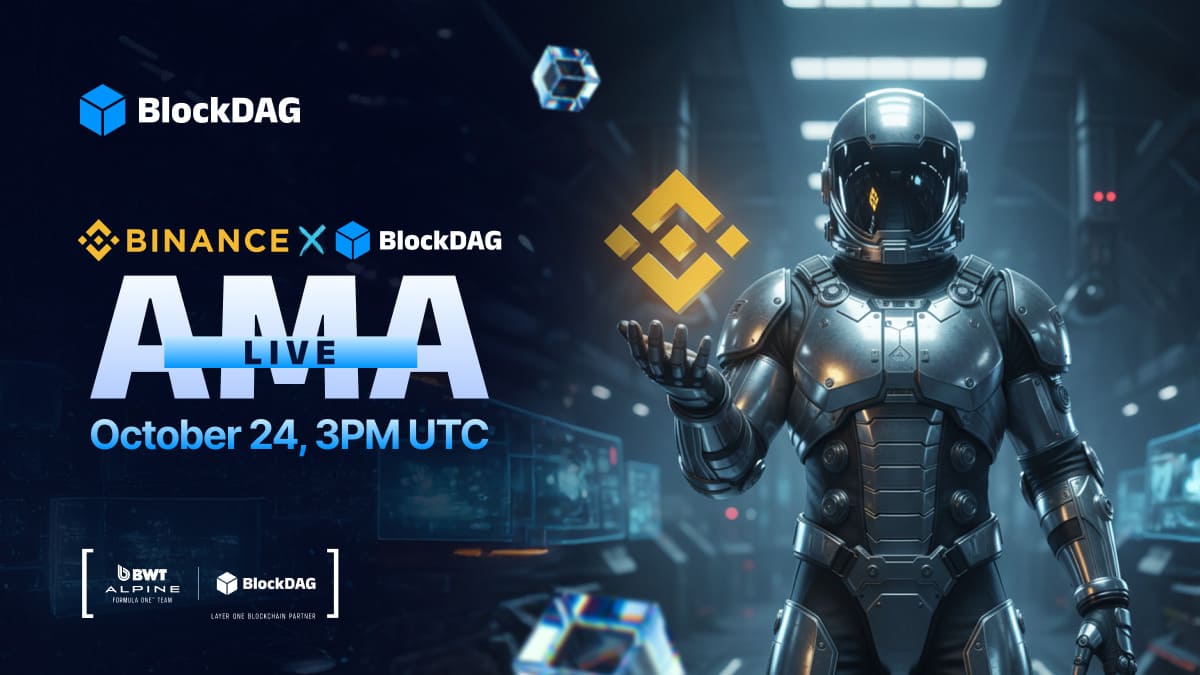
BlockDAG has also announced it will host a Binance AMA on Friday, October 24, at 3 PM UTC. The project says the session will cover product and roadmap updates and is positioned ahead of its upcoming “Keynote 4: The Launch Note” and “GENESIS DAY” communications.
The project says it is led by CEO Antony Turner and advised by Dr. Maurice Herlihy. It also states it has completed audits by CertiK and Halborn. BlockDAG further notes a partnership with the BWT Alpine Formula 1® Team. As with any early-stage token project, readers may wish to review primary documentation and independent reporting, and to treat forward-looking plans as uncertain.
2. Polygon: Scaling Updates and On-Chain Finance Experiments
Polygon has expanded beyond its early positioning as an Ethereum scaling network into a broader set of tools and chains. The token’s market price changes frequently; any quoted price is time-sensitive. Polygon has discussed the “Rio” upgrade, including validator-elected block producers and stateless validation, and has referenced throughput figures in the thousands of transactions per second depending on conditions.
Polygon has also been used for experiments in tokenized assets and stablecoins. For example, the launch of an ODDO BHF Euro-backed stablecoin has been cited as an illustration of traditional-finance interest in on-chain settlement. Polygon’s staking and validator economics can include rewards, but rates can fluctuate and are not guaranteed.

Overall, Polygon’s ongoing technical upgrades and cross-chain strategy are among the factors observers use to assess its longer-term relevance, though network usage and token performance can diverge.
3. Litecoin: A Long-Running Payments-Focused Network
Litecoin has operated for more than a decade and is often discussed as a payments-oriented network known for relatively fast and low-cost transfers. Its market price changes frequently, and any quoted price is time-sensitive. Litecoin uses a Proof-of-Work model and has maintained a conservative approach to protocol changes compared with newer platforms.
Market commentary sometimes highlights technical chart patterns or potential future products such as exchange-traded funds, but such discussions are speculative and do not indicate future performance. Any regulatory or product developments would depend on decisions by issuers and regulators.
Litecoin’s continued relevance is often tied to network uptime, liquidity, and its role as a straightforward transfer asset, rather than new features or marketing cycles.
4. Stellar: Cross-Border Payments and Financial Access
Stellar focuses on enabling payments and asset issuance, with an emphasis on cross-border transfers. As with other tokens, Stellar’s market price can move quickly and technical trading levels are not reliable indicators of future direction.
Stellar’s proponents point to lower-fee transfers and partnerships with banks, fintechs, and payment companies, including activity in emerging markets. The scale and durability of these integrations can vary by corridor, partner, and regulatory environment.
With ongoing developer activity and continued work on remittance and settlement use cases, Stellar remains part of the broader conversation about practical blockchain adoption, even as results differ across markets.
The Takeaway
Evaluating narratives such as “next crypto to explode” can be less useful than comparing verifiable indicators like development activity, network usage, security assumptions, and transparency around funding and governance. BlockDAG has highlighted its reported token-sale fundraising and a scheduled Binance AMA; Polygon continues to iterate on scaling and infrastructure; Litecoin remains a long-running payments network; and Stellar continues to focus on cross-border payment rails.

Each project reflects a different part of the sector’s evolution—scaling research, payments infrastructure, and attempts at broader adoption. None is without risk, and readers should treat project claims and forward-looking plans cautiously when forming their own views.
This article contains information about a cryptocurrency token sale. This outlet is not affiliated with the project mentioned. This article is for informational purposes only and does not constitute financial or investment advice.

