
Choosing the best crypto to buy for 2026 goes beyond chasing short-term attention. It increasingly requires examining real technology, active users, and use cases that can remain relevant beyond brief market cycles.
Below are four blockchain projects frequently cited in long-term crypto discussions for 2026. Each addresses a different structural challenge within blockchain infrastructure, offering distinct approaches that help explain why they continue to appear in discussions around the best crypto to buy for 2026.
1. Zero Knowledge Proof (ZKP)
Zero Knowledge Proof (ZKP) draws attention for combining privacy, data ownership, and AI-focused computation within a single network design. The project aims to function as a private data and AI marketplace, where users can contribute and monetize data or compute resources without exposing underlying information. Through zero-knowledge proofs, verification occurs without revealing raw inputs, a feature with potential relevance for sectors such as healthcare, finance, and AI model training.

ZKP is built on the Substrate framework and integrates zk-SNARK cryptography alongside a hybrid consensus model that combines Proof of Intelligence and Proof of Space. Rather than emphasizing energy-intensive mining, the system is designed to reward useful computation and storage contributions. Hardware devices known as Proof Pods are intended to support this model by generating cryptographic proofs with low power consumption. Entry-level reward estimates remain illustrative and depend on network conditions rather than guarantees.
The project is currently operating in a testnet phase. Core components such as EVM compatibility, encrypted IPFS storage, and early AI-related circuits are reported to be live. Token distribution follows a daily allocation model intended to limit concentration, while overall supply remains fixed. With a data marketplace planned for 2026 and a longer-term mainnet timeline extending into 2027–2028, ZKP is often cited as a candidate for those who believe privacy-preserving data infrastructure will play a larger role in the next cycle.
2. Polygon (POL)
Polygon (POL) continues to play a key role in Ethereum scaling by offering faster and lower-cost transactions while remaining compatible with Ethereum tooling. As of mid-January 2026, POL trades in the $0.14–$0.15 range following earlier gains and a broader market pullback. Despite price fluctuations, network usage remains active, supported by high transaction volumes and sustained developer engagement.
Polygon’s current roadmap emphasizes payments, stablecoins, and aggregated liquidity through initiatives such as Polygon 2.0 and AggLayer. The objective is to connect multiple chains while preserving shared liquidity and reducing fragmentation. For those evaluating the best crypto to buy for 2026, Polygon represents a balance between established adoption and continued infrastructure development closely tied to Ethereum’s long-term trajectory.
3. Cosmos (ATOM)
Cosmos (ATOM) is best known for its focus on interoperability through the Inter-Blockchain Communication (IBC) protocol, enabling independent blockchains to exchange data and value. In January 2026, ATOM trades near $2.50, significantly below prior highs but supported by a broad ecosystem. Approximately 60% of the circulating supply remains staked, suggesting ongoing long-term participation.
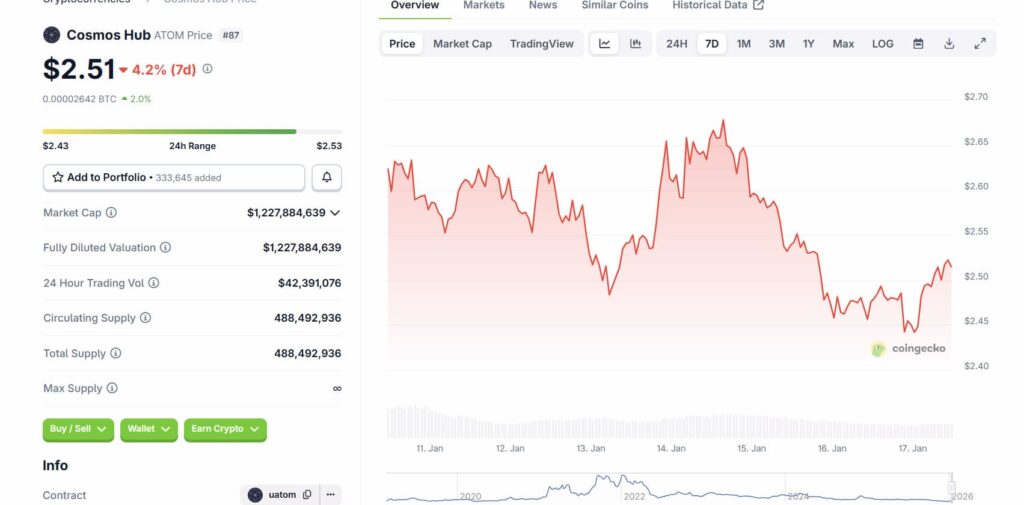
Source- CoinGecko
The Cosmos community continues to explore adjustments to token economics and governance aimed at strengthening value capture for ATOM holders. Upgrades to the Gaia hub focus on efficiency improvements and performance optimization. While some projects have migrated away over time, Cosmos remains a foundational framework used by many independent networks.
For those considering the best crypto to buy for 2026, ATOM is often viewed as a longer-horizon option, emphasizing infrastructure and interoperability rather than rapid speculative growth.
4. Arbitrum (ARB)
Arbitrum (ARB) is among the leading Ethereum Layer-2 solutions, designed to reduce congestion and transaction costs while inheriting Ethereum’s security. As of January 2026, ARB trades between $0.20 and $0.22, with recent price pressure linked to scheduled token unlocks that have introduced near-term supply.
Despite these headwinds, Arbitrum remains one of the most active Layer-2 networks by usage and protocol revenue. Developer activity, DeFi adoption, and ongoing upgrades — including ArbOS improvements — continue to support its long-term relevance. Incentive programs also play a role in maintaining liquidity and engagement.
Within discussions of the best crypto to buy for 2026, Arbitrum often appeals to those who believe Ethereum scaling solutions will remain central to broader blockchain adoption, even as short-term volatility persists.
Bottom Line
Identifying strong long-term crypto candidates for 2026 increasingly means looking beyond short-term price action and focusing on structural utility. Zero Knowledge Proof emphasizes privacy-preserving AI and data ownership, while Polygon, Cosmos, and Arbitrum provide established solutions for scalability and cross-chain communication.
Each project targets a different but interconnected aspect of blockchain infrastructure. Together, they illustrate how privacy, performance, and interoperability are shaping the next phase of the crypto ecosystem. For those willing to evaluate fundamentals rather than headlines, these four names help frame where longer-term development momentum may be heading.
This article contains information about a cryptocurrency presale. Crypto Economy is not associated with the project. As with any initiative within the crypto ecosystem, we encourage users to do their own research before participating, carefully considering both the potential and the risks involved. This content is for informational purposes only and does not constitute investment advice.