

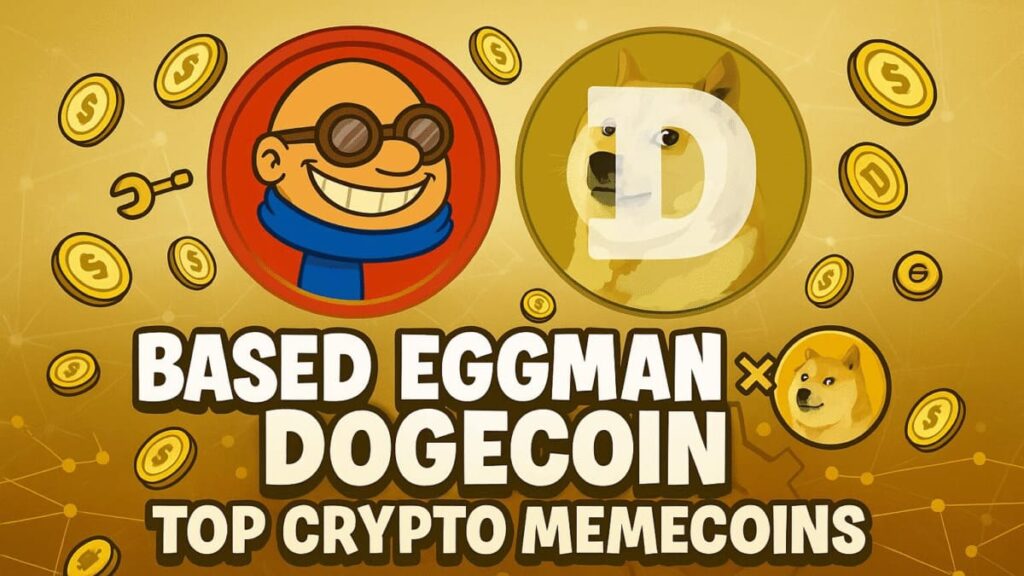
The crypto market in 2025 shows a blend of new token-sale projects and established meme coins. While early-stage token sales can attract attention from market participants, legacy tokens like Dogecoin continue to hold market share.
In this context, Based Eggman $GGs is described by the project as a gaming-focused ecosystem built on Base, Coinbase’s Layer 2 blockchain. Dogecoin, meanwhile, remains one of the oldest meme coins and continues to rank highly by market capitalization.
This comparison looks at how early-stage tokens can differ from established assets such as DOGE and what this may mean for readers assessing higher-risk altcoins.
Based Eggman ($GGs): Project Overview
Based Eggman $GGs is conducting an early-stage token sale. According to its public materials, it is built on Base and aims to use a Layer 2 network to reduce transaction costs and improve speed relative to some on-chain activity on Layer 1 networks.
The project states that $GGs has a maximum supply of 389 million tokens. As with any token supply figure, how it affects liquidity and pricing depends on multiple factors, including distribution, demand, and market conditions.
Based on the project’s description, $GGs is intended to connect to Web3 gaming and community features, including on-chain games, streaming, leaderboards, and interactive events.
The project also references a social layer and community presence on platforms such as Telegram, Discord, and X. These features and integrations are project-reported and may change over time.
Dogecoin (DOGE): Technical Overview and Market Behavior
Dogecoin remains one of the most recognized meme coins. Some chart-based indicators cited by market analysts show a mix of trends across timeframes. For example, on a 4-hour chart, DOGE’s 50-day moving average may slope upward at times, while daily and weekly moving averages can slope downward, which some interpret as weaker longer-term momentum.
The Relative Strength Index (RSI) is sometimes referenced as being in a neutral range between 30 and 70, which is commonly read as balanced momentum. Analysts also sometimes describe patterns such as symmetrical triangles as consolidation structures; interpretations and outcomes vary, and pattern-based analysis is not predictive.
Support and resistance levels are often mapped by traders based on recent price action (for example, around $0.1238 for support and $0.1263 for resistance in some snapshots), and Fibonacci retracement levels such as 0.5 can be watched as reference points. These levels can shift quickly and do not guarantee future price direction.
Based Eggman $GGs Compared With Dogecoin
Comparing Based Eggman $GGs with Dogecoin highlights the contrast between a newer project conducting an early-stage token sale and an established meme asset. Based on project materials, $GGs combines gaming-related features and community elements within its proposed ecosystem.
Dogecoin, by contrast, reflects meme-coin longevity, including broader exchange availability and higher liquidity relative to many newer tokens. It can also experience significant volatility, and technical interpretations vary by analyst and timeframe.
Together, they illustrate two different profiles in today’s crypto market: newer tokens that are still developing their ecosystems and older assets that trade with deeper liquidity and a longer history.
Final Words: The Early-Stage Token Sale Landscape
The comparison between Based Eggman $GGs and Dogecoin underscores how early-stage token sales and established cryptocurrencies can differ in maturity, liquidity, and risk.
According to its own materials, $GGs aims to combine culture, gaming, and decentralized finance features. Dogecoin, on the other hand, continues to reflect the influence of meme coins, supported by its community and market presence.
Readers evaluating early-stage tokens typically consider factors such as disclosures, token distribution, technical risks, and liquidity constraints, alongside broader market conditions. Established tokens can still be volatile, but often trade in more liquid markets than newer offerings.
Project links (for reference):
Website: https://basedeggman.com/
X (Twitter): https://x.com/Based_Eggman
This article is for informational purposes only and does not constitute financial or investment advice. This outlet is not affiliated with the project mentioned.

