TL;DR:
- An attacker drained approximately $234,000 from a legacy Balancer V1 liquidity pool on August 31, 2026.
- The vulnerability allowed the minting of 4,408.8 BPT tokens by depositing just a single satoshi after compressing WBTC reserves.
- The attack utilized nested flash loans from platforms such as Aave, Spark, Morpho, and Uniswap V3.
The week kicks off with Balancer V1 losing $234,000 after being breached through a mathematical calculation flaw. The anomaly in the smart contract’s deposit function was identified by security firm SlowMist.
🚨SlowMist TI Alert🚨
💸 @Balancer Loss: ~234k USD
🔍 Root Cause: Balancer V1 BPool `joinswapPoolAmountOut` lets caller specify BPT output while `calcSingleInGivenPoolOut` reverse-computes input via 18-decimal fixed-point math. After attacker compressed WBTC reserves to dust…
— SlowMist (@SlowMist_Team) August 31, 2026
The affected pool held reserves denominated in DeFi Pulse Index (DPI), USD Coin (USDC), Wrapped Ethereum (WETH), and Wrapped Bitcoin (WBTC).
During the early hours of this Monday, August 31, the attacker executed a series of public transactions to suppress WBTC liquidity in the contract to minimal levels. Once the balance was compressed, the 18-decimal fixed-point algorithm miscalculated the collateral required to enter the position.
By depositing a single satoshi (0.00000001 WBTC), the malicious actor managed to mint 4,408.8 liquidity tokens (BPT). SlowMist’s technical report indicates that this mathematical disproportion facilitated the extraction of the remaining assets in the contract.
To fund the exploit without risking prior capital of their own, the attacker relied on flash loans coordinated across Aave, Spark, Morpho, and Uniswap V3.
Rounding Error Mechanics and Lack of Validations
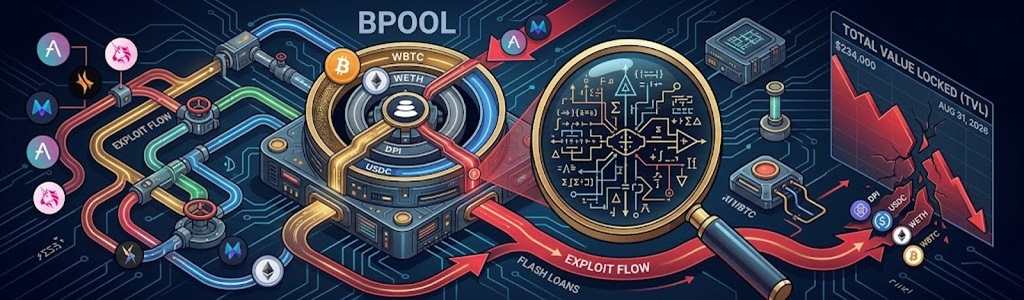
The attack vector targeted the joinswapPoolAmountOut function of the original Balancer V1 contract. This function allowed users to manually define the desired amount of BPT output, leaving the calcSingleInGivenPoolOut subroutine to determine the required input amount.
By truncating extremely small numbers toward zero via integer division, the contract failed to enforce a real deposit equivalent to the value being withdrawn.
SlowMist noted in its preliminary audit that the code lacked three critical safeguards: an enforceable minimum deposit, a minimum operational reserve balance, and a relative error check. Technical documentation for Balancer V1 shows that the MIN_BALANCE parameter was only applied during the initial asset deployment and not in everyday swap transactions.
The corporate entity Balancer Labs announced its dissolution in March 2026. This decision followed the November 2025 security incident, where a similar rounding error in V2 contracts led to losses exceeding $116 million.
Smart contracts deployed under Version 1 remain immutable on the blockchain and do not support centralized administrative pauses.
According to statements released by developers via official channels, users who still hold residual liquidity in legacy Balancer V1 pools must manually withdraw their funds. The technical team confirmed that the latest active versions of the protocol do not share this obsolete mathematical structure.