

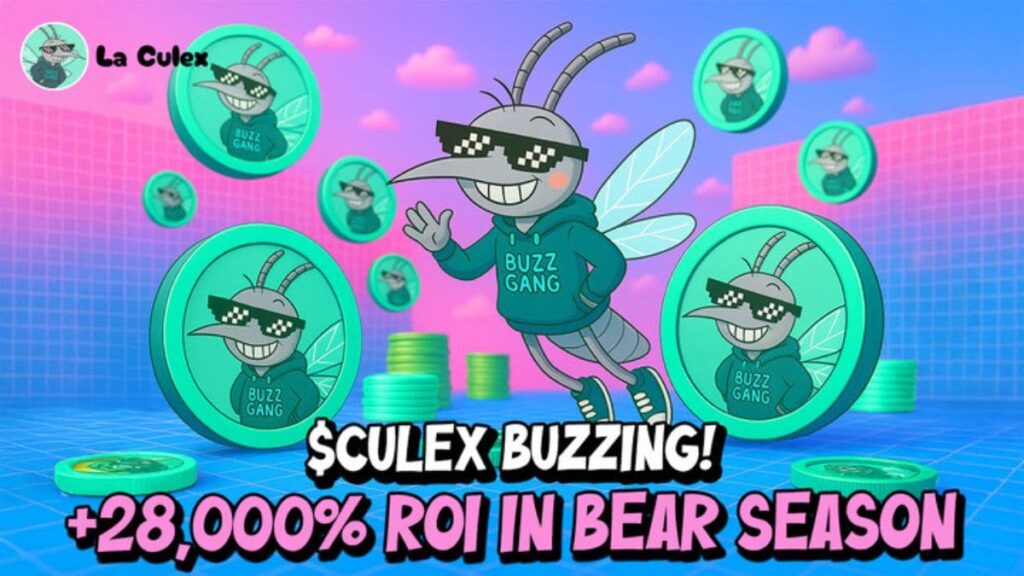
Crypto markets often move quickly, and online attention can shift just as fast. In that context, a meme token called La Culex ($CULEX) has been circulating across social media and crypto forums. Some community posts frame it as a high-upside idea, but such claims are not verifiable and should be treated as speculative.
Online discussions around early-stage tokens sometimes include hypothetical return scenarios. These examples are marketing-style illustrations rather than evidence of future performance, and outcomes can vary widely depending on liquidity, exchange listings, market conditions, and execution.
Below is a look at La Culex ($CULEX), TRON (TRX), and Hedera (HBAR) as they are discussed in November 2025. The projects differ substantially in maturity and risk profile: La Culex is described as an early-stage meme token, while TRON and Hedera are established networks with broader market history.
La Culex ($CULEX): Meme Token and Project-Reported Token-Sale Details
La Culex is described in project materials as an Ethereum-based meme token branded as crypto’s “mosquito.” The project says it aims to grow its community through referrals, offer a staking feature for holders, and reduce supply through token burns. These mechanisms and any resulting impact depend on implementation and market participation.

As of November 3, 2025, the project’s website describes a staged La Culex token sale and lists a per-token price and participation figures. These figures are project-reported and were not independently verified for this article. Any references to potential returns, “ROI,” or prospective listing prices should be treated as speculative.
The project also describes a staking feature, a referral program, and a burn mechanism. Readers assessing early-stage token sales typically look for clarity on token distribution, smart-contract audits, liquidity arrangements, and governance, but the presence of such items does not eliminate risk.
Early-stage token sales can involve significant risks, including smart-contract vulnerabilities, liquidity constraints, execution risk, and limited disclosure. Independent verification (where possible) and careful review of primary documentation are commonly recommended before any participation.
TRON (TRX): Network Activity and Market Context
While newer tokens often rely on social-media visibility, TRON is an established Layer-1 network founded in 2017, supporting DeFi applications, NFTs, and stablecoin activity.
As of early November 2025, TRON (TRX) is cited at $0.2836, with a reported 4.97% weekly change amid broader market volatility, based on widely cited market data at the time of writing. The text also cites a market cap of $26.85 billion (#8) and $1.74 billion in 24-hour trading volume. Prices, rankings, and volumes can change quickly and may differ across data providers.
The network is often discussed in connection with its low-fee transactions and throughput, and with USDT usage for stablecoin transfers. The article also references reports that TRON froze $300 million in illicit assets; readers should consult primary sources and reputable reporting for details and context around enforcement actions and methodology.
For market observers, TRON’s relevance is typically evaluated through metrics such as on-chain activity, developer support, application usage, and regulatory considerations rather than short-term price movement.
Hedera (HBAR): Hashgraph Design and Governance Model
Hedera is a distributed ledger network that uses a Directed Acyclic Graph (DAG) approach described as Hashgraph consensus. The project states this design supports high throughput and low fees, although real-world performance depends on usage and network conditions.
As of November 2025, Hedera (HBAR) is cited at $0.1780, with a reported 6.08% daily decline and 8.66% weekly increase, based on widely cited market data at the time of writing. The text cites a market capitalization of about $7.56 billion (#18) and $437 million in daily trading volume, along with 42.47 billion HBAR in circulation out of a maximum 50 billion. These market figures are subject to change and may vary by source.
The article references an SEC decision timeline connected to a Grayscale HBAR ETF expected on November 12. Regulatory decisions are uncertain, and timelines can shift; readers should rely on official filings and regulator communications for confirmation.
Hedera’s governance structure includes a council model that the project says is intended to provide stability and predictability. According to Hedera’s whitepaper, this approach is positioned as enterprise-friendly; however, governance models can involve trade-offs that different stakeholders may evaluate differently.
Final Thoughts: Key Differences and Risk Considerations
La Culex ($CULEX), TRON (TRX), and Hedera (HBAR) represent very different parts of the market. La Culex is presented as an early-stage meme token with project-described staking, referral, and burn mechanics. TRON and Hedera are established networks typically assessed through activity, ecosystem development, and governance structure.
Readers evaluating any crypto asset generally consider volatility, liquidity, security, and regulatory uncertainty as key factors. Comparisons across early-stage tokens and long-running networks can be misleading without careful context.

For More Information:
Project website (for reference): La Culex official website
Social (for reference): La Culex on X
Frequently Asked Questions About La Culex Token Sale
Is La Culex considered a top crypto investment in November?
Assessments like “best” or “top” are subjective and depend on an individual’s risk tolerance and objectives. La Culex is described by the project as an early-stage meme token, which typically implies higher uncertainty than more established networks.
How accurate are listing-price projections?
Any listing-price projection is speculative and not guaranteed. Outcomes depend on factors such as exchange listings, liquidity conditions, and market demand after launch.
Why is TRON still relevant in 2025?
TRON’s activity is commonly linked to low fees, throughput, and stablecoin transfer usage. Market relevance can be assessed through on-chain data, ecosystem adoption, and broader regulatory and compliance developments.
What makes Hedera different from other blockchains?
Hedera is positioned as a hashgraph-based distributed ledger with a council governance model. Its design differs from many proof-of-work or proof-of-stake blockchains, which may affect performance characteristics and governance trade-offs.
Should I diversify between meme coins and established projects?
Diversification is often discussed as a risk-management concept, but whether it is appropriate depends on the individual and the assets involved. Early-stage tokens can carry higher risks, including low liquidity and limited disclosure.
Glossary of Key Terms
Tokenomics: The economics of a cryptocurrency: supply, distribution, and incentives.
Token sale: A fundraising event in which tokens are offered to buyers, sometimes before broader exchange availability.
Staking: Locking tokens in a protocol that may distribute rewards, depending on the project’s rules and risks.
Burn Mechanism: Permanently removing tokens from supply to increase scarcity.
Hashgraph: A DAG-based consensus model used by Hedera for transaction ordering and validation.
Liquidity Lock: A mechanism intended to restrict access to liquidity for a defined period; terms vary and may not eliminate risk.
ROI: Return on Investment, a ratio comparing gains or losses to the original amount invested.
Summary
This piece reviews November 2025 discussion around La Culex ($CULEX), TRON (TRX), and Hedera (HBAR). It summarizes project-reported claims about La Culex’s token-sale structure and features, and provides market-context descriptions for TRON and Hedera, including their network positioning and cited market metrics. References to future pricing or returns are speculative and uncertain.
This article is for informational purposes only and does not constitute financial or investment advice. This outlet is not affiliated with the project mentioned. This article contains information about a cryptocurrency token sale; as with any initiative within the crypto ecosystem, readers should do their own research and carefully consider risks.

