
Bitcoin Tumbles to $71K as Jensen Huang Exit Triggers Nvidia Sell-Off

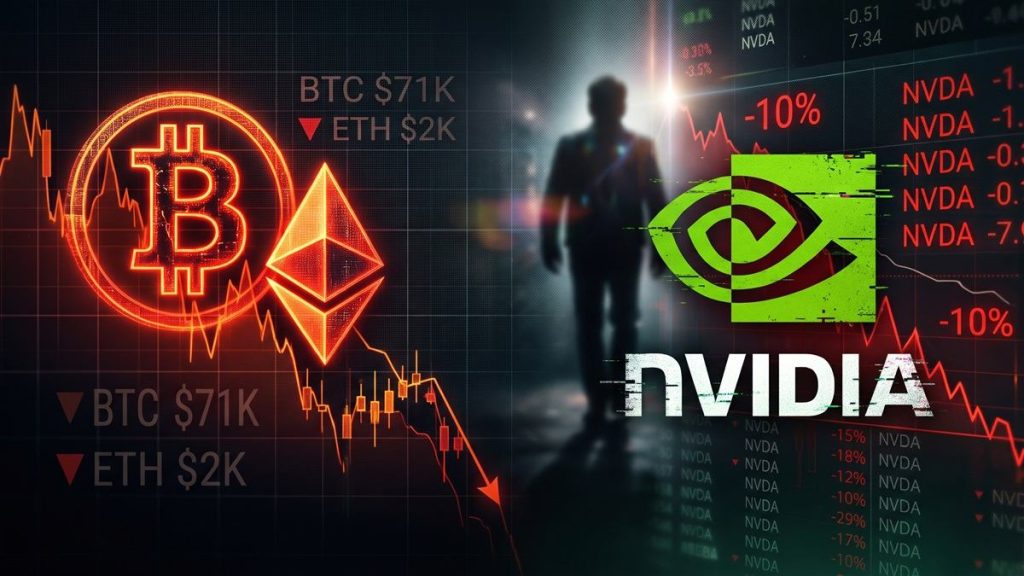
Table of Contents
TL;DR:
- Nvidia announced on November 12 the immediate resignation of Jensen Huang after 33 years of leadership; its shares fell up to 10% in premarket trading, bringing its valuation close to $3.8 trillion.
- Bitcoin dropped below $71,500 and Ethereum slipped under $1,990, marking their lowest levels since last August.
- An October study by the Bank for International Settlements (BIS) indicates that 55.2% of inbound investment in artificial intelligence firms between 2021 and 2025 came from other companies within the same sector.
Jensen Huang announced his resignation as an executive at Nvidia on Thursday, November 12, and immediately afterward, the price of Bitcoin tumbled to $71,000 while Ethereum lost the $2,000 support level. The executive’s departure intensified sell-offs in risk assets and hit the semiconductor manufacturer’s valuation.
Nvidia officially reported on November 12 that Huang stepped down from his roles as chief executive officer, president, and member of the board of directors with immediate effect. This decision concludes a 33-year tenure at the helm of the U.S. technology firm.
The company appointed Chief Financial Officer Colette Kress as interim chief executive officer while the search for a permanent replacement is underway. Additionally, Harvey Jones, a veteran board member and former Synopsys executive, took over as chairman of the board of directors.
Although the corporate statement did not specify the reasons for the resignation, previous reports circulated by financial media indicated that the board of directors had launched an independent investigation. That inquiry addressed Huang’s extramarital affairs, including one linked to a woman suspected by U.S. authorities of maintaining ties to Chinese intelligence—allegations that remain unproven.
The news triggered an immediate pullback in the chipmaker’s stock price. During premarket trading on Thursday, Nvidia shares fell by up to 10%, hovering near $156 per share.
At that trading level, the company’s implied market capitalization dropped to approximately $3.8 trillion. This figure represents a contraction of nearly $2 trillion compared to the all-time high recorded by the company in October 2026, when it reached a valuation of around $5.8 trillion.
Commenting on the tech giant’s stock performance, CryptoQuant CEO Ki Young Ju noted via his official channels that analyst sentiment toward Nvidia shares reached a standard deviation of -2.6σ, the most bearish reading documented to date for the stock.
The day’s impact spread to other artificial intelligence infrastructure firms backed by Nvidia. In the same premarket period, CoreWeave shares retreated by more than 13%, while Nebius stock plunged nearly 20% amid doubts over its growth prospects.
In parallel, risk aversion spilled over into the digital asset market. Market data reveals that Bitcoin fell below $71,500 during the November 12 session, trading around $71,339 with a 2.90% decline over the past 24 hours.
Meanwhile, Ethereum lost the psychological $2,000 mark as it slipped below $1,990, recording a daily drop of 2.56% to settle near $1,998. Both cryptocurrencies reached their lowest prices since last August.

The circular financing model in the artificial intelligence sector
According to the market report, the market reaction stems from the central role Huang played in both supplying advanced processors and structuring financial agreements for purchasing companies. The leadership transition has reopened the debate over the sustainability of cross-investment schemes within the technology sector.
Nic Puckrin, CEO of Coin Bureau, warned in statements picked up by the outlet that Huang’s exit could affect the artificial intelligence ecosystem due to his direct involvement in negotiating these contracts. Puckrin raised doubts about a successor’s ability to replicate such agreements and about the stability of confidence in the current investment model.
This scrutiny aligns with the findings of a study released in October by the Bank for International Settlements (BIS). The document indicates that 55.2% of the capital invested in artificial intelligence companies between 2021 and 2025 originated from other companies belonging to the same industry.
Of the total internal sector investments, 46.4% came from firms that simultaneously maintained commercial relationships with the companies receiving the funds, accounting for approximately 25.6% of all inbound investment analyzed by the institution.
Nvidia ranks among the active participants in this financial dynamic. In January 2026, the company made a $2 billion investment in CoreWeave, a cloud infrastructure provider that purchases its processors.
That capital injection was part of an agreement aimed at accelerating CoreWeave’s development of artificial intelligence data centers, tightening financial ties between the hardware manufacturer and one of its main customers. Analysts compare this structure to the telecommunications boom of the late 1990s, a period in which manufacturers financed the purchases of network operators.
Although Huang’s resignation does not alter Nvidia’s existing contracts, the new management will inherit a network of financial commitments whose continuity depends on future demand for computing capacity. The next key milestone to evaluate the transition will take place on November 17, 2026, the date scheduled for Nvidia’s quarterly earnings call with investors.

Charles Hoskinson Names a Stock to Watch as Nvidia Shake-Up Hits Neoclouds
TL;DR Cardano founder Charles Hoskinson pointed to AMD stock following Jensen Huang’s sudden resignation as Nvidia CEO. Nebius and CoreWeave shares came under pressure as

Glassnode: Bitcoin Faces Capital Outflows as Market Momentum Weakens
In its latest report, Glassnode warned that Bitcoin is experiencing a sustained loss of momentum. The pioneer cryptocurrency’s price fell below the short-term holder cost

ARK Invest Trims Block and ARKB, Adds Nvidia and SoFi
ARK Invest reduced positions in Block and its ARK 21Shares Bitcoin ETF (ARKB) on November 9 while adding Nvidia and SoFi Technologies across its actively

Bitcoin Falls Below $76K, Wiping $140 Billion Off Crypto Market
TL;DR: The total market capitalization of the crypto sector lost approximately $140 billion in four hours. Derivative platforms recorded the liquidation of $1.053 billion in

Bitcoin Breaks $80K Following US Midterm Results, Triggering Massive Crypto Liquidations
TL;DR: Bitcoin broke the $80,000 barrier during the session, printing an intraday high of $81,000 before settling around $78,297. Liquidations across the global crypto derivatives

Nvidia, Nike Join 50 Issuers Objecting to OKX-ICE Plan
OKXICE TSV has disclosed that 50 public companies have submitted Notices of Issuer Objection to its planned tokenized stock venue, including Nvidia, Nike, Costco, Microsoft,