TL;DR
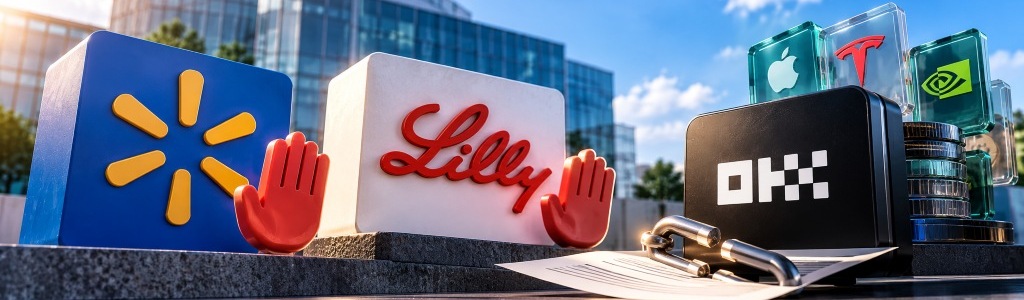
- Walmart and Eli Lilly joined the companies objecting to tokenized versions of their shares trading on OKXICE, taking disclosed issuer objections to 38.
- Carnival, Arcos Dorados and Cigna also appeared in the October 28 update. The objections narrow the venue’s potential stock roster without cancelling the project.
- OKXICE plans permissioned, one-for-one share-backed token trading on XLayer, with identity, AML and wallet screening required before participants can trade under its framework.
Walmart and Eli Lilly have formally objected to having tokenized versions of their shares traded on the OKXICE Tokenized Securities Venue, joining a growing list of issuers opting out of the proposed platform. The October 28 public notice lists 38 issuer objections in total. The development highlights consent as a practical constraint for real-world asset tokenization, but the objections apply specifically to OKXICE rather than blocking tokenization of those companies’ shares across every possible venue.
Issuer Objections Continue to Narrow OKXICE’s Planned Stock Roster
Walmart and Eli Lilly were joined by Carnival, Arcos Dorados and Cigna in the latest update. The five additions extend a sequence of issuer objections that has progressively narrowed OKXICE’s planned stock roster. Earlier waves included CoreWeave and Broadcom, followed by companies such as Goldman Sachs, Microsoft, Qualcomm, Caterpillar, McDonald’s, Western Digital and Alphabet. The latest notice does not explain why Walmart, Eli Lilly or the other newly listed issuers objected.
OKXICE is a 50-50 joint venture between Intercontinental Exchange Holdings and OKC USA Holding. Its proposed venue would offer secondary trading of tokenized NMS stocks through permissioned Uniswap v4 liquidity pools on XLayer. Participants must complete identity, AML, sanctions and wallet screening before receiving permission to trade. The model pairs tokenized shares with supported payment stablecoins and does not involve OKXICE conducting primary securities offerings or directly issuing the tokenized stocks.
For third-party tokenization, the structure requires the underlying shares to be held one-for-one through a registered broker-dealer. The tokenized securities are designed to pass through rights equivalent to the underlying shares, including dividends, voting rights and residual claims upon liquidation. The expanding objection list follows earlier issuer resistance and underscores that technical and regulatory architecture does not automatically secure corporate participation.
The objections also sharpen a broader debate over issuer control. Robinhood CEO Vlad Tenev has separately argued that companies should not automatically be able to veto tokenized stock products when those structures do not alter corporate obligations or official shareholder records. OKXICE operates under a framework that explicitly gives issuers an objection mechanism, making participation dependent partly on company-level decisions. That contrasts with arguments against broad issuer veto power over tokenized stocks. For OKXICE, the immediate consequence is a smaller potential asset roster, not termination of the venue itself. The distinction matters as tokenized equity models continue expanding under U.S. regulatory exemptions.