
The disclosure of an entropy flaw in Coldcard devices reopened a recurring debate in the sector: whether hardware wallets constitute a point of failure within self-custody.
An implementation error in seed generation does not invalidate the model of private key isolation. The event exposes a different fact: security in self-custody rests on a sequence of processes, and the most probable failure points concentrate in entropy generation, transaction signing, supply chain integrity, and operator behavior. Assigning the problem to hardware diverts attention from controls which reduce risk in measurable terms.
The Coldcard Incident: Process Failure, Not Architecture Failure
The Coldcard incident involved firmware from version 4.0.1, in which a software-based random number generator replaced the hardware RNG in specific seed creation flows. The result was the production of predictable seed phrases, reconstructible by a third party with access to the generator logic. Cumulative losses exceeded USD 100 million in bitcoin.
Correct analysis separates two layers: the isolation architecture of the device, which was not compromised, and the initialization process, which was. The distinction matters because it defines where investment in controls should be allocated and where it should not.
Entropy as the Root of Trust
Entropy is the root of trust for any custody scheme. A private key derived from a predictable source reduces the search space to an enumerable set, independent of the robustness of the secure element which stores the key afterward.
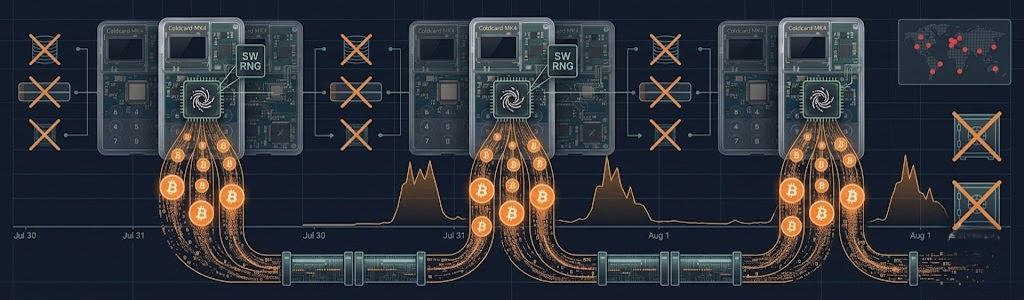
The correction applied by Coldcard requires external entropy input: 65 key presses, 50 die rolls, or 128 coin flips. The operational lesson: verification of the randomness source must form part of the configuration procedure, not remain delegated to trust in the manufacturer.
A device with a certified secure element and a seed generated with deficient entropy offers less security than a device without certification and entropy verified by the user.
Transaction Signing as an Attack Surface
The second failure point is transaction signing. Unauthorized withdrawals of major magnitude in recent cycles do not originate from broken cryptography but from valid signatures obtained through deception. The Bybit case, with approximately USD 1.5 billion drained, illustrated a pattern: the signer authorized operations whose actual semantics were not visible on the device interface.
The limitation is not the key but the display capacity of the hardware. Firmware which cannot render the destination, amount, contract, and effect of a signature leaves the operator in a position of blind signing.
Mitigation requires interfaces which expose the complete payload and workflows which reject unverifiable operations. Hardware protects the key; hardware does not protect the operator decision when the operator cannot evaluate what is signed.
Supply Chain, Firmware, and Limits of Air-Gap
Supply chain and firmware integration add attack surface. The Ledger Connect Kit incident demonstrated malicious software can reach the stage immediately before final approval on the device.
The Dark Skippy technique showed seed information can be encoded within transaction signatures with normal appearance, which limits the value of air-gap as a single control.
The conclusion is not to discard physical isolation but to combine isolation with firmware verification, reproducible builds when available, and vendor separation. Supply chain security is a verification problem, not a problem of trust in a brand.
Threat Model Definition and Resource Allocation
A custody system requires an explicit threat model. The relevant adversaries include remote attackers, malicious firmware, supply chain interception, physical seizure, coerced disclosure, and inheritance failure. Each adversary maps to different controls.
Remote attackers require offline key storage and transaction verification. Malicious firmware requires reproducible builds and independent verification.

Physical seizure requires geographic distribution and passphrase separation. Inheritance failure requires documented procedures and legal arrangements.
Resource allocation without a threat model produces controls which address low-probability events while leaving high-probability events unmitigated. The Coldcard entropy flaw and the Bybit signing failure both fall into categories which a defined threat model would prioritize.
Retail and Institutional Differences
Retail holders and institutional holders face different constraints. A retail holder with a single device and a paper backup manages a limited attack surface.
An institutional holder with multiple signers, operational staff, and regulatory obligations requires multisignature quorums, policy engines, and separation of duties. Applying retail procedures to institutional holdings produces operational fragility.
Applying institutional procedures to retail holdings produces unnecessary complexity and new failure modes. The correct design depends on the value at risk, the number of operators, and the legal jurisdiction. Hardware wallets serve both contexts, but hardware wallets alone do not constitute a complete custody system.
Open Source, Reproducibility, and Verification
Open source firmware enables independent review, but open source without reproducible builds leaves a gap between source code and deployed binary.
Reproducible builds allow a user or a third party to compile the firmware and compare the output against the manufacturer binary. When reproducible builds are unavailable, verification depends on trust in the manufacturer supply chain.

The Coldcard incident involved a flaw in a software RNG which source review could have identified. The lesson is not open source is sufficient, but open source combined with reproducibility and independent audit reduces the probability of undetected implementation errors.
Backup, Inheritance, and Legal Continuity
Seed backups require durability, redundancy, and confidentiality. A single paper backup in one location creates a single point of failure. A metal backup in one location improves durability but does not address geographic risk.
Geographic distribution with encryption or passphrase separation addresses multiple failure modes. Inheritance planning requires instructions which heirs can execute without the original holder.
Legal continuity requires consideration of jurisdiction, probate, and fiduciary access. A custody system which functions correctly for the holder but fails at inheritance produces permanent loss. Hardware wallets do not solve inheritance; procedures and legal instruments solve inheritance.
The Underlying Argument: Eliminating the Counterparty
The argument for self-custody does not depend on hardware being infallible. It depends on eliminating the counterparty. The FTX insolvency showed exchange balances are contractual obligations recorded in a database, not keys under user control.
When the platform suspended withdrawals, holders could not exercise disposal over assets recorded as owned. Self-custody does not eliminate operational risk, but it transfers control to a set of procedures which the holder can audit, replicate, and modify without third-party authorization.
Independent Recovery Path
Self-custody retains value because it maintains an independent recovery path. As long as a valid key or readable backup exists, the holder can reconstruct access through compatible tools even if the manufacturer discontinues the product or service.
Standard portability through BIP-39 and BIP-32 allows migration across implementations without dependence on provider continuity. The ability to transfer assets without waiting for a platform to open withdrawals is an operational property, not an ideological preference. Delegated custody reintroduces a control point which can deny access at the moment of greatest need.
Diversification of Dependencies
The proportional response to risk is not to abandon hardware but to diversify dependencies. For reduced holdings, a correctly initialized and backed-up device may be sufficient. For larger holdings, concentration in one manufacturer, one firmware, or one backup procedure introduces single-point risk.
Distribution across devices from different vendors, with an additional passphrase and backups in separate locations, reduces the probability of total loss from an individual failure. Diversification does not eliminate risk; it distributes risk across components with uncorrelated failure modes.
Verifiable Operational Controls
Practices which reduce risk in measurable terms include: generating entropy with dice or coins instead of accepting default generation; verifying address, amount, and contract on the device screen and not on the host interface; keeping firmware updated with signature verification; storing backups offline with geographic redundancy; and documenting an inheritance plan with verifiable instructions. None of the described measures depends on the manufacturer or on service continuity. All are executable by the holder with accessible resources.
Regulatory and Jurisdictional Considerations
Regulatory treatment of self-custody varies by jurisdiction. Some jurisdictions impose reporting obligations on holdings above thresholds. Some jurisdictions restrict certain privacy tools. Some jurisdictions recognize self-custody as a property right.

A custody system must account for applicable law without delegating key control to a regulated intermediary. Jurisdictional diversification can reduce legal single-point risk. Legal counsel familiar with digital assets is a component of custody planning, not a substitute for technical controls.
Hardware Wallet Limitations
Hardware wallets do not provide transaction semantics verification beyond the data which firmware can parse. Hardware wallets do not provide social recovery. Hardware wallets do not provide inheritance execution. Hardware wallets do not provide legal identity.
Hardware wallets provide key isolation and signing authorization. Understanding the boundary of hardware wallet capability prevents overreliance and clarifies where complementary controls are required.