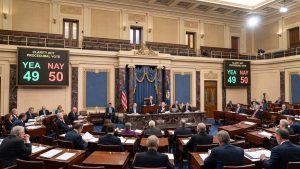
After months of negotiations, the long-awaited CLARITY Act failed to clear the U.S. Senate. The bill was blocked on September 15 after a procedural vote ended 49-50, well short of the 60 votes required to move forward. The outcome represented another setback for the digital asset industry, which has spent years pushing for clearer rules defining the respective roles of the SEC and CFTC.
However, the legislative setback coincided with a regulatory development that could prove even more significant for certain areas of the market. On September 17, the SEC announced a temporary “Innovation Exemption” designed to facilitate onchain trading of certain tokenized U.S. stocks. The measure allows qualifying specialized venues to operate under specific conditions while the Commission considers longer-term regulatory changes.
The contrast was highlighted during a conversation hosted by Scott Melker, widely known as The Wolf of All Streets, on his The Daily Wolf program for Yahoo Finance, where Coinbase CEO Brian Armstrong discussed the latest developments in Washington. Armstrong’s analysis helps explain why the failure of the legislation does not necessarily mean a pause for crypto innovation in the United States.
The Political Dispute That Stopped the CLARITY Act
During the final weeks of negotiations, the bill underwent numerous changes designed to attract bipartisan support. Among them were new provisions concerning ethics, conflicts of interest, and elected officials’ involvement in certain digital-asset activities. Reuters reported that disagreements over these provisions contributed to the legislation being blocked in the Senate.
Speaking with Scott Melker, Armstrong argued that, in simplified terms, the ethics provisions played a decisive role in killing the bill. His interpretation represents the assessment of one of the industry’s most prominent executives rather than an official explanation for the entire Senate vote. What is documented is that lawmakers failed to reach the threshold required to continue the legislation.
The immediate consequence was the preservation of the existing regulatory framework. At the same time, however, the setback leaves greater room for federal agencies to use their existing statutory authority. That distinction is crucial because the regulatory process can move on a different timetable from Congress.
The SEC Opens a Door for Tokenized Stocks
The SEC’s September 17 decision represents one of the most important recent regulatory developments for tokenized financial assets in the United States. The Commission granted temporary, conditional exemptive relief to certain Tokenized Securities Venues (TSVs), allowing them to trade tokenized National Market System stocks through structures involving automated market makers and liquidity pools.
The so-called Innovation Exemption is not a blanket authorization for tokenizing any stock. Participating venues must comply with conditions covering trading limits, transparency, smart-contract requirements and investor protections. The SEC also requires tokenized NMS stocks to provide holders with the same rights and privileges as equivalent traditional shares, including applicable shareholder rights.
The exemption will remain in place for five years and is accompanied by a public-comment process. SEC Chairman Paul S. Atkins described the initiative as an initial step toward bringing U.S. capital markets into the digital age while the Commission evaluates whether additional regulatory action is necessary.
That changes a central assumption behind the original article. Tokenized stock trading no longer depends exclusively on Congress passing comprehensive new legislation. The SEC has now established a concrete, although temporary and conditional, regulatory pathway for certain onchain securities markets in the United States.

Base Builds the Infrastructure for an Onchain Economy
The evolution of Base, Coinbase’s Ethereum Layer-2 network, illustrates where this transformation could lead. According to L2BEAT, Base currently exceeds $14 billion in Total Value Secured, placing it among the largest Layer-2 networks in the Ethereum ecosystem.
Base’s own 2026 strategy focuses on global markets, payments, stablecoins and developer infrastructure. Its roadmap envisions expanding blockchain-based access to stocks, commodities, prediction markets and other asset classes while developing infrastructure capable of supporting financial activity on a continuous basis.
The strategy also extends into Agentic Finance, where artificial-intelligence agents interact with digital services and make payments autonomously. Coinbase and Base are developing infrastructure for this emerging economy, including x402, a protocol designed to allow agents to pay for APIs, content and other digital resources using blockchain-based transactions. Coinbase has also announced an AWS integration aimed at helping websites and API providers accept AI agents as customers.
Base’s importance therefore goes beyond its liquidity metrics. Its connection with Coinbase provides a built-in distribution channel as tokenized securities, stablecoin payments and automated financial services develop. The network’s role could become increasingly relevant if traditional financial products begin moving onto blockchain rails at scale.

Regulation Moves Ahead While Congress Debates
The monetary backdrop also remains important for digital assets. On September 16, the Federal Reserve set the federal funds target range at 3.75%-4.00%, keeping financial conditions considerably tighter than during the near-zero-rate era.
For Bitcoin and other risk assets, interest rates remain a major market variable. Yet while monetary policy influences the cost of capital, regulatory policy increasingly determines what types of blockchain-based financial infrastructure can operate within the United States.
The broader reflection is that the CLARITY Act’s failure does not mean U.S. crypto regulation has simply stopped moving. Congress remains central to establishing durable statutory rules, but the SEC’s latest action demonstrates that federal agencies can use existing authority to create targeted opportunities for innovation. Tokenized stocks, stablecoin payments and agent-driven finance are therefore progressing through multiple regulatory and technological channels rather than relying on a single piece of legislation. While Washington continues debating the permanent framework, onchain financial infrastructure is already moving forward, with Base and other blockchain networks positioning themselves to support the next generation of digital markets.
Disclaimer: This article has been written for informational purposes only. It should not be taken as investment advice under any circumstances. Before making any investment in the crypto market, do your own research.