


The announcement of two large‑scale stablecoin initiatives—a consortium of 21 financial institutions planning a launch in H1 2027 and Open USD (OUSD), supported by over 140 firms including Visa, Mastercard, Stripe, BlackRock, and Coinbase—has prompted debate regarding the potential erosion of the duopoly held by Tether (USDT) and Circle (USDC). As of August 2026, the aggregate stablecoin market stands at $316.4 billion, with USDT representing 59% ($187B) and USDC 24% ($75B) . The remaining 17% is distributed among DAI, FDUSD, USDP, and others. This concentration constitutes the structural baseline against which any new entrant must compete.
Distribution as the Primary Variable
The issuance of a compliant stablecoin no longer constitutes a competitive advantage. Technology stacks are standardized, reserve structures are transparent, and regulatory frameworks such as the U.S. GENIUS Act and EU MiCA define clear operational requirements. The marginal cost of launching a regulated stablecoin has converged to the point where differentiation resides exclusively in distribution channels and user acquisition.
OUSD proposes a model that redirects the economic incentive: distributing the majority of reserve‑generated yield to partner platforms that facilitate minting, redemption, and settlement. This structure eliminates minting/redemption fees and imposes no volume caps. The intended effect is to align the financial interest of distribution partners (exchanges, payment processors, wallets) with the adoption of the token, effectively outsourcing the go‑to‑market effort to entities that already control user relationships.
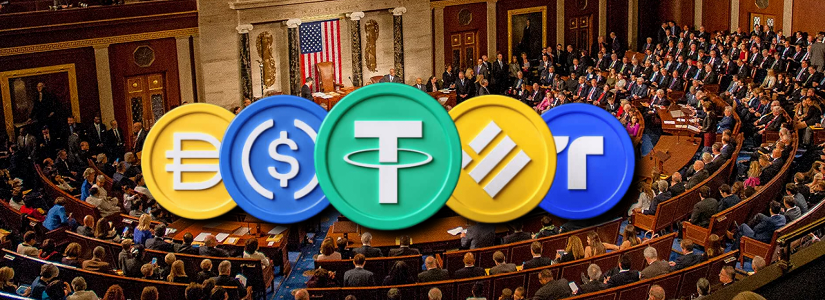
The 21‑bank consortium adopts a distinct approach: leveraging the existing correspondent banking network and corporate client base of its members (collectively serving over 50 million businesses) to offer a regulated, institution‑grade dollar token with potential expansion to other G7 currencies. This initiative complies with the GENIUS Act and MiCA, and its primary advantage lies in the pre‑existing settlement infrastructure of traditional finance, which could enable direct integration into treasury operations and commercial payments without the onboarding friction associated with crypto‑native exchanges.
Despite these distribution strategies, the network effect accumulated by USDT and USDC over multiple market cycles constitutes the principal entry barrier. ARK Invest has quantified that stablecoin competitiveness derives from liquidity depth, integration density, and settlement velocity, all of which require sustained accumulation over years. New entrants cannot shortcut this process through partnership lists.
Data from 2026 indicate that USDT maintains deep liquidity pairs on Binance, OKX, and Bybit, representing over 70% of stablecoin trading volume on those platforms. USDC, conversely, accounts for approximately 79% of the $38 trillion adjusted on‑chain transfer volume recorded in multiple quarters, driven by its integration into Circle’s Cross‑Chain Transfer Protocol (CCTP) and institutional custody APIs.
This asymmetry reflects a functional division: USDT dominates offshore exchange liquidity and settlement in jurisdictions with limited dollar access, while USDC captures regulated on‑ramps, institutional payment flows, and DeFi lending protocols where audited reserves and compliance are prerequisites.
Any new entrant must replicate not only the technical integrations (smart contract deployments across Ethereum, Solana, Avalanche, Arbitrum, etc.) but also the operational redundancy (24/7 reserve monitoring, real‑time sanctions screening, multi‑bank settlement rails) that existing issuers have refined over a decade. The cost of replicating this infrastructure is estimated in the hundreds of millions annually, a figure that must be sustained before meaningful adoption materializes.
Economic Sustainability of the Open USD Model
Jeremy Allaire, CEO of Circle, has questioned the sustainability of permanent zero‑fee minting/redemption combined with near‑total yield distribution to partners. Operating a stablecoin requires expenditure on security audits, insurance coverage, compliance staffing, and node infrastructure. These costs scale with transaction volume. Under the OUSD model, the issuer retains only a residual spread (the difference between reserve yield and the amount passed to partners), which may prove insufficient to fund operational resilience as volume grows.
Circle’s fiscal year 2025 financials show that 96% of its $2.7 billion revenue originated from interest income on reserve assets. Its cost structure includes approximately $450 million annually in compliance, legal, engineering, and banking relationship management. Any issuer operating on a narrower margin would have reduced capacity to absorb regulatory fines, custody disruptions, or technical failures.
Talos has noted that OUSD represents a pressure on Circle’s margin rather than an immediate supply displacement, given that the total addressable yield pool is fixed relative to the reserve base. A redistribution of that yield to partners does not increase the aggregate value; it merely shifts the beneficiary, potentially starving the issuer of the capital required for infrastructure reinvestment.
The efficacy of a 140‑company alliance is constrained by the divergent commercial interests of its members. ARK Invest has pointed out that many participating firms (e.g., Visa, Stripe, Coinbase) already derive value from the existing stablecoin ecosystem and have established settlement processes using USDC or USDT.
Switching to a new token entails integration costs, retraining of treasury systems, and potential friction with clients who prefer the incumbent for its deeper liquidity. The alliance structure does not guarantee exclusivity; partners may continue to support multiple stablecoins, reducing the incentive to actively promote OUSD over alternatives.
The bank consortium faces governance overhead: achieving consensus among 21 separate legal entities on redemption policies, blocklisting procedures, dispute resolution, and reserve management introduces latency in decision‑making.
The announcement did not specify the legal entity, blockchain selection, custodian, or reserve manager—details that are prerequisites for institutional adoption. Until these variables are resolved, the consortium remains at a pre‑operational stage, whereas USDT and USDC have fully functional settlement rails across 15+ blockchains.
Regulatory Constraints Under the GENIUS Act
The GENIUS Act requires a 1:1 reserve ratio, monthly attestations by registered public accountants, and a prohibition on algorithmic stabilization. Both initiatives comply with these provisions. However, the Act explicitly prohibits stablecoin issuers from paying interest directly to end holders. OUSD’s model does not pay holders directly; it distributes yield to intermediary platforms (exchanges, wallets), which may then pass incentives to users through separate mechanisms (e.g., staking rewards).
The bank consortium, by contrast, operates under existing banking regulations and can offer deposit‑like products that may include interest, but those would be subject to different banking charters and Federal Reserve oversight. The regulatory arbitrage available to OUSD is narrower than advertised, as the yield distribution to partners does not automatically convert into a competitive advantage for the end user.

The most probable outcome is that these initiatives expand the total addressable market rather than displace USDT or USDC. The current $316 billion supply represents less than 0.5% of global M2 money supply (estimated at $80 trillion).
New entrants will likely capture incremental demand from corporate treasury settlement, B2B cross‑border payments, and tokenized collateral for securities trading—segments where the duopoly has limited penetration due to either regulatory ambiguity or insufficient banking integration. The bank consortium is positioned for the corporate treasury use case, while OUSD targets the retail and payment processor segment.
However, the core liquidity layers—USDT on offshore exchanges and USDC on institutional settlement rails—are protected by entrenched switching costs. A trader cannot replace USDT without re‑establishing OTC relationships, re‑calibrating risk models, and convincing counterparties to accept the new token.
A corporate treasurer cannot replace USDC without re‑integrating with Circle’s CCTP and obtaining approval from their compliance committee. These switching costs, combined with the compounding nature of network effects, imply that the duopoly’s market share will remain above 75% over a 3‑year horizon, even under optimistic adoption scenarios for the new entrants.

