The surging rise of artificial intelligence has unleashed a cutthroat race for global energy infrastructure. Massive high-performance facilities demanding uninterrupted gigawatts and immediate grid access have strained available electrical capacity. Faced with this looming power crunch, Bitcoin miners find themselves torn between defending their baseline profitability and retrofitting their sites to ride the AI computing wave.
Market Context: Squeezed Margins and the Corporate Pivot
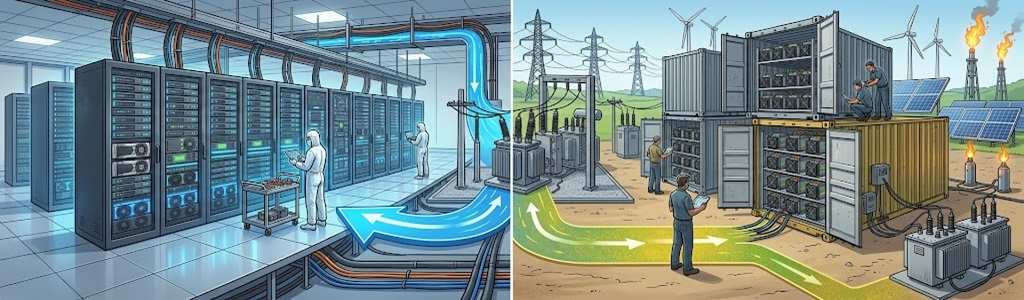
The mining ecosystem is navigating an operational reset marked by periodic drops in network difficulty and compressed profit margins. In this environment, publicly traded corporate giants have begun monetizing their power contracts by leasing space to AI. Companies such as Core Scientific and TeraWulf are generating substantial revenue by leasing power and interconnection capacity to tech firms—a far more lucrative alternative than direct mining under current cost structures.
Hardware itself offers no leverage here, as AI GPUs and Bitcoin ASICs are strictly non-interchangeable. The real battle is fought over access to permitted electrical substations, low-latency fiber optics, and secured transmission rights. Because building new high-voltage infrastructure takes years, operational mining sites already connected to the main grid have turned into prime digital real estate for tech conglomerates.
Technological Impact: AI Inflexibility vs. Crypto Agility
The core divergence between both industries lies in their energy consumption profiles. Training AI models demands continuous, redundant, and highly stable power to prevent catastrophic computational failures. If a deep learning data center loses power, complex training workloads crash, creating an absolute reliance on heavily backed, Tier-1 energy sources.
Conversely, Bitcoin mining operates with intrinsic flexibility and intermittency, enabling it to function as a grid shock absorber. Miners can power up or curtail hardware based on real-time electricity availability, monetizing surplus solar, wind, or flared natural gas that would otherwise be wasted. This technical versatility allows mining to thrive in remote or off-grid regions where AI simply cannot operate viably.
Future Outlook: An Inevitable Energy Bifurcation
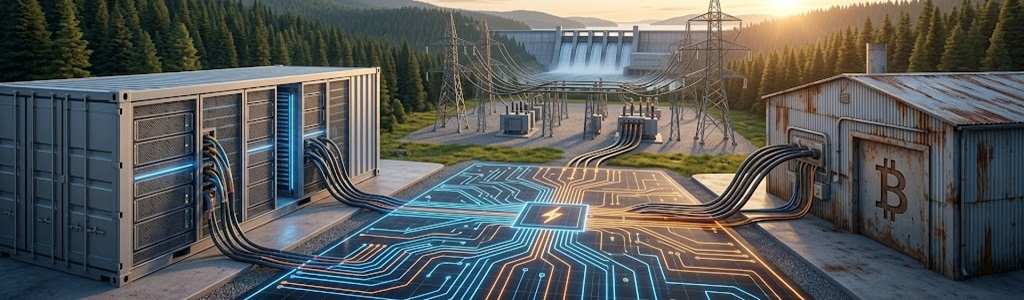
Far from extinguishing digital mining, the AI boom is redrawing the industry’s structural and geographic footprint. Large-scale operators controlling premium grid interconnections will continue shifting toward high-performance computing hosting. Simultaneously, displaced hashrate will migrate toward private operators and stranded-energy initiatives, where low kilowatt-hour costs preserve margins without directly competing against Big Tech.
Bitcoin’s native difficulty adjustment mechanism guarantees the network’s economic resilience during hashrate migrations. As computational power drops, the protocol lowers the cost of block validation, allowing previous-generation hardware to remain profitable in regions with ultra-cheap surplus energy. The energy sector will not pick a single winner; it will bifurcate the market—AI will capture stable urban capacity, while Bitcoin absorbs marginal, unmonetized power.
The battle for power will not wipe Bitcoin mining off the map, but its operational boundaries are shifting permanently. While artificial intelligence secures top-tier grid nodes and premium infrastructure, crypto mining is cementing its status as the buyer of last resort for remote renewables and stranded energy assets. Amid this industrial restructuring, the future of the network hangs between becoming a vital financial ally for the energy transition or being pushed entirely to the fringes of the global power grid.