TL;DR:
- The Solana network recorded over $4.7 trillion in stablecoin transaction volume over the past year.
- Financial institutions such as Visa, PayPal, MoneyGram, and Western Union integrated settlements and asset issuance onto this Layer 1 infrastructure.
- Major global exchanges, including the New York Stock Exchange (NYSE), the DTCC, and the London Stock Exchange, are evaluating on-chain equity trading models.
Lily Liu, President of the Solana Foundation, delivered a comprehensive presentation on Wednesday, September 2, analyzing the token supercycle. The executive provided insights into the structural transition of capital toward internet-native infrastructures operating 24/7 without interruption.
In her analysis, Liu argues that tokenization goes far beyond the initial digitalization of finance by altering the very nature of the underlying asset. Official data indicates that continuous issuance, custody, and trading on distributed ledgers are replacing operational frameworks historically constrained by banking hours and geographic borders.
Convergence of Institutional Capital and Programmable Rails
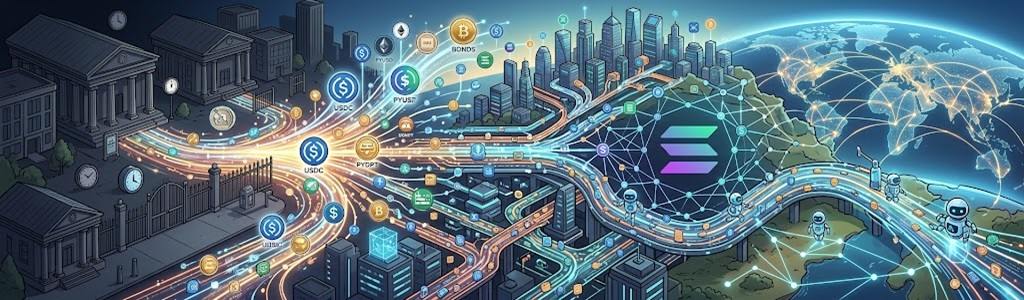
The publication highlights that the transaction volume of real-world assets (RWAs) on Solana reached hundreds of billions of dollars over the last twelve months. These flows included U.S. Treasuries, equity securities, and private credit facilities.
Global payments giants have actively deployed technical infrastructure on the network. Visa enabled merchant transaction settlements using USD Coin (USDC), while PayPal expanded direct PYUSD payments into the ecosystem. Furthermore, Western Union structured the launch of its regulated digital asset, USDPT, within this technical environment.
According to the analysis published by Liu, this mass-distribution framework could narrow geographic liquidity gaps much like American Depositary Receipts (ADRs) did. Projections outlined in the text suggest that an expanded base of both retail and institutional investors tends to optimize price discovery for identical cash flows.
Integrating consumer applications also streamlines access to capital markets. Rather than building interfaces across multiple clearing intermediaries, mobile environments can directly connect to monetary rails through Application Programming Interface (API) calls.
The interaction between artificial intelligence agents and decentralized networks represents another central pillar of the report. These software programs autonomously purchase operational compute capacity, consume energy, and contract data services.
Data from the analysis points out that the total market capitalization of tokenized assets still accounts for a modest fraction compared to traditional stock exchanges. The analysis compares the current stage of on-chain bonds to the early days of digitizing print media in the late 20th century.
On-chain equity trading pilots currently spearheaded by institutions such as the London Stock Exchange and the DTCC mark the next phases of convergence between legacy financial markets and decentralized systems.