


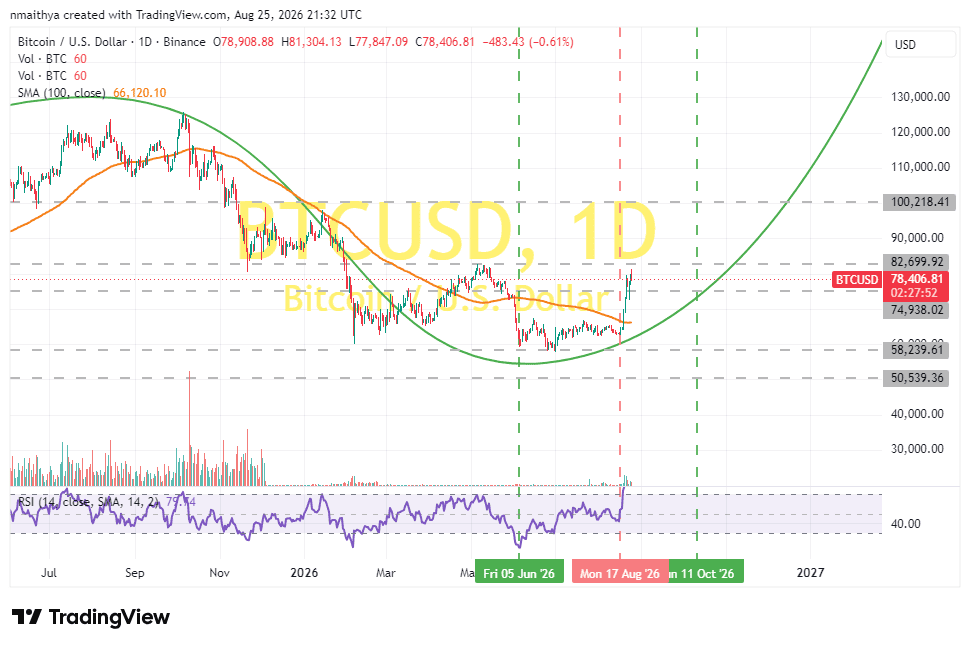
Bitcoin’s latest price rally has brought renewed attention to short-term cryptocurrency trading. In late August, Bitcoin moved to trade above $80,000 for the first time in nearly three months, breaking out after an extended period of relatively subdued price action.
The move has been accompanied by renewed trading activity and increasingly bullish positioning among some retail traders. According to retail trading sentiment on Bitcoin provided by Capital.com, more than 80% of traders on the platform were positioned as buyers in late August.
That figure should not be interpreted as a prediction of where Bitcoin is heading next. It represents positioning among clients of one trading platform rather than the cryptocurrency market as a whole, and sentiment can change quickly when prices are volatile.
For traders interested in short-term price movements rather than long-term ownership, one way of gaining exposure to Bitcoin—where regulations permit—is through contracts for difference, or CFDs. Understanding how these instruments work is particularly important after a sharp price move, because leverage and volatility can amplify both gains and losses.
Trading Bitcoin as a Contract for Difference
A contract for difference is an agreement between a trader and a broker in which the two parties exchange the difference in the value of an asset between the time a position is opened and when it is closed.
The trader does not own the underlying asset. In the case of a Bitcoin CFD, no Bitcoin is purchased or transferred to a cryptocurrency wallet. Instead, the contract tracks changes in Bitcoin’s market price.
This makes CFD trading fundamentally different from buying Bitcoin through a cryptocurrency exchange.
Someone purchasing Bitcoin directly can hold the asset over the long term or transfer it between compatible wallets. A CFD trader is instead speculating on price movements and can generally take either a long position if they expect the price to rise or a short position if they expect it to fall.
CFD platforms may also provide access to other markets, including currencies, commodities, indices and equities, allowing traders to manage different types of market exposure through the same account.
However, this convenience comes with additional considerations. CFDs can involve leverage, spreads, financing charges and margin requirements, making their risk profile different from simply owning Bitcoin.
Factors to Consider When Using CFDs to Trade Bitcoin
Bitcoin is already a highly volatile asset. Combining that volatility with a leveraged derivative means traders need to understand not only where the market might move, but also how the structure of the trade affects their exposure.
Leverage
Leverage allows a trader to control a position larger than the amount of capital provided as margin.
For example, with 2:1 leverage, $500 of margin could provide exposure to a $1,000 position. If Bitcoin moves 5%, the position would change in value by approximately $50 before fees and other trading costs.
Relative to the $500 used as margin, that represents a 10% change.
The same mechanism works in the opposite direction. Leverage can magnify losses relative to the capital committed to a position, which is why position size and risk management become especially important.
Available leverage varies according to the jurisdiction, provider and classification of the trader. Regulatory authorities in some markets place strict limits on cryptocurrency CFDs for retail clients, while in other jurisdictions these products may be restricted or unavailable altogether.
Traders should therefore check the rules and protections that apply to their location rather than assuming the same leverage conditions are available everywhere.
Slippage and Volatility
Slippage occurs when a trade is executed at a different price from the one expected when the order was submitted.
It can become particularly relevant during periods of high volatility, and cryptocurrency markets are capable of moving rapidly over short periods.
Volatility itself is not necessarily positive or negative for a trader. Price movement creates trading opportunities, but sudden changes can also produce losses faster than expected, particularly when leverage is involved.
Major economic announcements, changes in interest-rate expectations, regulatory developments and geopolitical events can all contribute to abrupt shifts in market sentiment.
Bitcoin has also become increasingly sensitive to broader liquidity and macroeconomic conditions. Its latest move above $80,000 coincided with news that the US Treasury planned to double its long-dated bond buyback operations from $2 billion to $4 billion per session.
That timing does not establish that Treasury policy alone caused Bitcoin’s rally. Cryptocurrency prices respond to multiple factors simultaneously, and assigning a major market move to a single event can oversimplify what is happening.
For CFD traders, the practical issue is that rapid market movements can affect execution. Even risk-management tools such as stop-loss orders may be executed at a different price than expected during exceptionally volatile conditions.
Spreads and Overnight Costs
Trading costs are another factor that can be overlooked when focusing primarily on Bitcoin’s price.
CFD providers typically quote separate bid and ask prices, with the difference between them known as the spread. Depending on the broker and account structure, additional fees or commissions may also apply.
Positions that remain open overnight can also attract financing charges. Because CFDs often provide leveraged market exposure, brokers may charge financing costs for maintaining a position beyond the trading day.
These costs may appear relatively small over a short period but can accumulate if a position remains open for several days or weeks.
This is one reason CFDs are generally approached differently from directly holding Bitcoin. Someone who owns BTC does not pay CFD overnight financing charges simply for continuing to hold the asset, although direct cryptocurrency ownership introduces its own costs and risks, including exchange fees and custody considerations.
Understanding the Trade Before Following the Rally
Bitcoin’s latest rally may make short-term trading more attractive, but a rising price does not eliminate the risks associated with leveraged products.
CFDs provide a way to speculate on Bitcoin’s price without owning the cryptocurrency and can offer both long and short exposure. At the same time, leverage, slippage, spreads and financing costs can materially affect the outcome of a trade.
The distinction between buying Bitcoin and trading a Bitcoin CFD is therefore more important than deciding which method is universally “better.” They are different instruments designed for different approaches to market exposure.
After a sharp rally, traders should pay particular attention to position size, leverage and the possibility of rapid reversals rather than assuming that recent momentum will continue.
In a market as volatile as Bitcoin, understanding how a position can lose money is just as important as identifying how it might profit.

