Manual crypto trading has an operational ceiling. Markets run 24/7, positions need constant monitoring, and a single delayed decision can cost a trade. If you’re still placing orders by hand, you’re competing at a structural disadvantage against bots that execute in milliseconds.
Moving from manual execution to algo trading used to require deep programming knowledge. However, modern infrastructure platforms are shifting this paradigm. Platforms like Delta Exchange address this barrier directly—not just by offering an API, but by building an ecosystem that makes automated execution accessible at every skill level.
Here is a practical look at how this premier bitcoin trading exchange makes automated strategies easy for everyone, and how AI integrations are lowering the entry barrier for everyday traders.
Key Takeaways
-
Seamless Automation: Professional-grade REST/WebSocket APIs are now enhanced by AI-assisted code generation.
-
The Human Factor: AI tools remove the coding barrier but don’t replace strategic judgment; strategy validation remains a human responsibility.
-
Low Risk Entry: Demo accounts, micro contract sizes, and third-party integrations allow traders to test workflows before risking live capital.
Why Automate Crypto Derivatives Trading?
In the highly volatile derivatives market, automation is primarily a risk management tool. Emotional bias, execution lag, and simple fatigue degrade manual trading performance over time.
When trading crypto derivatives, a bot doesn’t hesitate, doesn’t revenge trade, and doesn’t miss a 3 AM signal because the trader was asleep. By removing the human element from execution, your strategy runs exactly as coded, every time, whether you’re watching the charts or not.
The Tech Stack Behind Automated Infrastructure
To successfully transition to automated crypto derivatives trading, an exchange needs a framework built for machine communication from the ground up. The infrastructure must rely on three core pillars:
-
The Data Layer: Robust REST and WebSocket APIs that deliver real-time market data and instantaneous order execution.
-
The Integration Layer: Native compatibility with popular third-party platforms like TradingView, TradeTron, AlgoTest, and NextLevelBot to hook existing workflows straight into the execution engine.
-
The Hub: A dedicated section designed specifically for secure API key management and deployment.
API Copilot: Bridging the Coding Gap
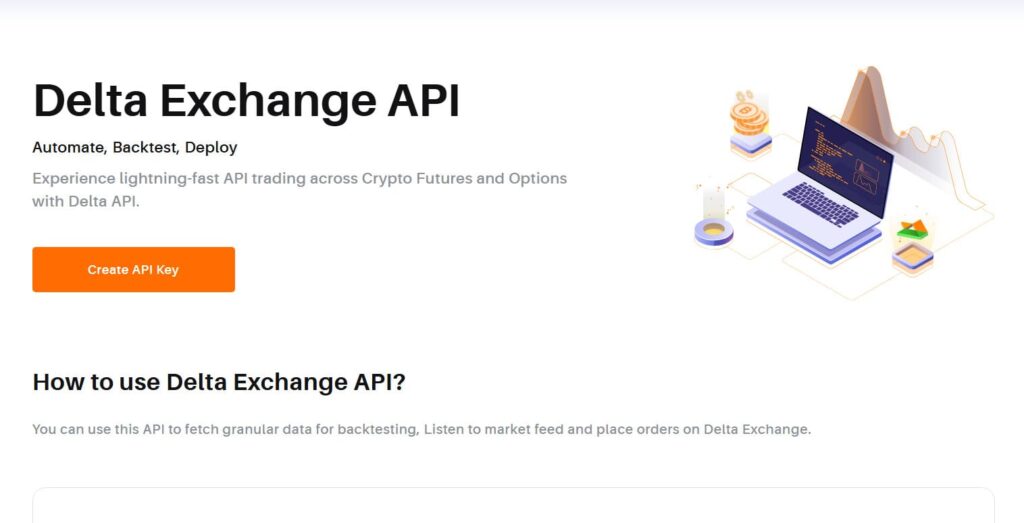
Most traders stall at the exact same wall: “I have a profitable strategy, but I don’t know how to code it.”
To solve this, the integration of AI assistants inside trading terminals has changed the game. The built-in API Copilot acts as an AI chatbot embedded directly into the platform to handle the technical heavy lifting:
-
Code Generation: You can describe a strategy in plain English (e.g., “a Python bot that buys BTC calls when RSI drops below 30”) and the AI generates the script.
-
Error Debugging: Paste a broken snippet of code and receive a corrected version with a clear explanation of the bug.
-
Concept Guidance: It functions as a technical knowledge base for structuring multi-leg options bots or managing complex WebSocket connections.
Note: While this dramatically lowers the barrier to entry, it does not replace the necessity of understanding the logic of your own code before deployment.
Step-by-Step: Moving from Logic to Execution
If you want to move your strategy away from manual clicking and into an automated workflow, follow this roadmap:
-
Set Up the Environment: Log into your trading interface and navigate to the automated trading dashboard.
-
Generate Credentials: Create your API keys, ensuring you follow strict security and permission protocols.
-
Leverage the AI Assistant: Use the AI platform tool to write, translate, or refine your strategy’s script into your preferred programming language.
-
Sandbox Testing: Never deploy unverified code. Run the script on a free demo account utilizing real-time market conditions to watch for execution bugs.
-
Go Live and Monitor: Deploy the script with live capital, keeping in mind that while automation handles execution, strategy oversight remains your job.
Tailoring the Strategy by Experience Level
For New Algo Traders
-
Keep it Simple: Start with single-leg strategies before diving into complex derivatives.
-
Manage Exposure: Utilize Bitcoin (BTC) and Ethereum (ETH) micro-contracts to keep initial risk manageable.
-
Treat AI as a Teacher: Don’t just copy-paste. Use the generated scripts to learn how code interacts with market orders.
For Experienced Quantitative Traders
-
Rapid Prototyping: Use the AI assistant to instantly generate boilerplate code for complex structures like iron condors, strangles, or calendar spreads.
-
Event-Driven Execution: Connect external analytics directly to the API (e.g., sending TradingView webhook signals directly to the execution layer) for low-latency trading.
The Bottom Line
The true barrier to automated trading was never really technical; it was psychological. Most traders either didn’t believe they could build a system, or felt the tools were reserved for institutional firms.
With the emergence of integrated AI assistants and robust APIs, that gap has effectively closed. Want to explore automated crypto derivatives trading? Visit the website at www.delta.exchange or join their community on X. In a 24/7 market where structural advantages are measured in milliseconds, closing that gap is everything.
Frequently Asked Questions (FAQs)
Do I need coding experience to use an API Copilot?
No, you can prompt the AI using conversational language. However, learning to read and understand the generated code is highly recommended before risking live funds.
Does the AI assistant execute trades automatically?
No. The AI only generates and refines the code blocks. True execution happens securely through your own deployed scripts via the exchange’s API keys.
Can I test automated strategies without risking money?
Yes. You can utilize a free demo account that mimics real-time market conditions to paper-trade your algorithms safely.
Which automated platforms easily integrate with the exchange?
The platform natively supports workflows from TradingView, TradeTron, AlgoTest, and NextLevelBot.