Imagine a world where, at two in the morning on a Sunday, you buy a fraction of Apple directly from your self-custody wallet, using profits from a Solana token trade. No banks, no brokers, no trading hours. Such a world already operates, and what it puts on the table goes far beyond a tech curiosity. It opens the first real crack in the wall separating traditional finance from the crypto universe. But nobody should mistake the surface shine for safety.
Beneath the new product wrapper lurk risks that very few investors have prepared for. My opinion, after watching this phenomenon from its earliest days, stands clear: tokenized stocks represent the most important convergence opportunity of the decade, but also a legal and technical minefield that demands a new maturity from every crypto investor.
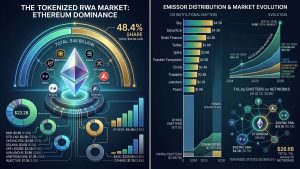
I do not talk about a distant promise. By this final quarter of 2025, the market for tokenized stocks already touches $476 million in capitalization. That figure looks like pocket change next to the trillions moving through stock exchanges, but it marks a beachhead that keeps growing, pushed by a much wider wave: the tokenization of real-world assets. In just one year, on-chain tokenized real-world assets tripled, crossing $18.6 billion.
When BlackRock launched its BUIDL fund on-chain and giants like Kraken, Robinhood, and eToro started offering synthetic or asset-backed stock exposures, the signal became impossible to ignore. The fusion of traditional finance and DeFi has begun.
Yet the first thing any crypto investor must understand is that not all tokenized stocks share the same DNA. Two models exist, and they differ as much as buying a house differs from betting on its price.
On one side sit asset-backed tokenized stocks, the only ones that, in my view, deserve the name. A regulated issuer buys real shares of Tesla or Nvidia, deposits them with a qualified custodian, and issues tokens that represent a proportional claim on those shares. If the custodian fails, the token loses value. But at least the holder keeps an anchor in the real world: potential dividends and an indirect legal claim on the underlying asset. It works as a digital custody receipt, with all its virtues and burdens.

On the other side sit synthetic tokens, pure DeFi engineering. No real share sits in any vault. An oracle reads the price of Apple on the Nasdaq, and a smart contract adjusts the token’s value. To mint the token, a trader locks crypto assets as collateral. This arrangement offers no ownership; it creates a derivative.
The trader bets on price direction while facing exposure to protocol solvency, code bugs, and the oracle nightmare that strikes every weekend. Calling that a “tokenized stock“ amounts, in the end, to dangerous marketing.
The promise that pulls crypto investors toward these instruments rides on three clear benefits. Trading runs 24/7, freeing capital from the tyranny of the closing bell. Fractional ownership lets anyone buy a sliver of a $2,000 share with just a few dollars. And, above all, DeFi composability enables the use of a tokenized stock as collateral for a USDC loan or as a building block inside automated yield strategies — all from a permissionless wallet, with instant settlement. Picture the flow: a trader converts memecoin gains into a fraction of Apple, then deposits that token into a lending protocol to extract liquidity and jump into the next opportunity. That fluidity feels genuinely powerful and unprecedented.
But here my opinion turns harsher and more urgent. The other side of the mirror shows a catalog of risks that the crypto investor, accustomed to living without a safety net, tends to underestimate.
Legal risk occupies the first spot. In the United States, the SEC keeps debating how to classify these tokens. The agency authorized a pilot program for tokenized large-cap securities, a step forward, but one wrapped in strict conditions and tight limits. Investor protections remain minimal.
In most structures, the token holder lacks voting rights, cannot attend shareholder meetings, and faces a tangled cross-border legal maze if fraud occurs. Buying a synthetic token through an unregulated exchange can leave a person as exposed as someone gambling in an unlicensed casino.
Technical risk packs equal severity. I speak of the oracle problem. Most oracles that feed synthetic tokens freeze the stock price on Friday night and do not update it until Monday morning. If a company suffers a catastrophe on Saturday, the token continues trading on a phantom price while professional arbitrageurs feast on the mispricing, often at the expense of retail participants.
On top of this sits the glaring absence of a basic safety mechanism: the circuit breaker. A piece of explosive news on a Sunday can trigger a freefall in the tokenized stock with no emergency stop to pause trading and let cooler heads intervene. Flash crashes do not represent a remote possibility; they come as a built-in feature of a market without an off switch.
Liquidity presents another mirage. Weekend trading volumes can collapse to 30 percent or less of weekday levels, producing stark premiums or discounts against the price of the underlying stock on the real exchange. An unwary investor buying a tokenized share on Saturday may believe they pay a fair price while actually swallowing a brutal markup born from thin market depth. And when we turn to asset-backed tokens, we add counterparty risk.

The investor does not bet on Apple alone; they bet on Apple plus the financial health of the custodian and the legal soundness of the issuer. A custodian insolvency can push the token to zero even if the underlying shares remain perfectly intact. That dual — sometimes triple — layer of risk rarely appears in the marketing brochures.
The competitive field in 2025 tells the story with perfect clarity. Crypto-native exchanges like Kraken, with their xStocks backed by Swiss-regulated Backed Finance, commit to the regulated custody model, though they remain unavailable inside the United States. Robinhood launched its tokenized stock offering for European customers. Traditional fintech firms move cautiously, while pure DeFi protocols such as Ondo Finance and Edel Finance build lending and borrowing markets around tokenized equities in much less regulated settings.
The market fragments across Solana, Ethereum, and TON, each chain offering its own trade-offs between speed, cost, and regulatory compliance. My conviction stands firm: long-term winners will be those that manage to deliver DeFi programmability inside a transparent legal wrapper and with first-class custodians. Synthetic tokens without asset backing face a short lifespan once regulators sharpen their aim.
The intelligent crypto investor should read this moment as a wake-up call. For years, the mantra has been “Don’t Trust, Verify,” applied strictly to code. Now the same discipline must extend to the legal wrapper. Verify who custodies the shares, what rights the token grants, in which jurisdiction the issuer operates, and whether the oracle updates the price in real time or only when it feels like it.
This new reality demands reading prospectuses, an activity that most crypto natives treat as an allergy. Without that legal and technical literacy, buying a tokenized stock becomes a leap into a pool without checking for water.
Where do we head from here? Analysts project the market for tokenized real-world assets could swell to between $2 trillion and $4 trillion by 2030. I do not believe we will witness a replacement of traditional stock exchanges. Instead, I see the birth of a hybrid on-chain and off-chain financial system.
Traditional exchanges like the NYSE will develop their own regulated tokenized securities platforms, coexisting with DeFi protocols that must submit to clearer regulatory frameworks to survive. The promise of a global, instantaneous, programmable market carries too much weight to ignore. But the path will not trace a smooth victory march.