April 2026. While the crypto market attention swings between Layer 2 wars, AI memes, and promises of spot ETFs, there is one piece of data that should stop us dead in our tracks: Chainlink’s Cross-Chain Interoperability Protocol (CCIP) is processing $18 billion in monthly volume. This is not a projection. It is not a whitepaper promise. It is real, liquid, institutional, and above all, autonomous traffic.
For years, the narrative surrounding Chainlink (LINK) has been that of a boring but necessary utility: “It’s the oracle that brings prices to DeFi.” That phrase, while accurate in 2021, is today a dangerous anachronism that obscures a much more ambitious reality and, in my opinion, one of the greatest asymmetric value opportunities in the current blockchain ecosystem. The hidden value of LINK does not lie in feeding Aave or Compound (which it already does masterfully, securing over $60 billion). It lies in its metamorphosis into the verifiable trust layer for autonomous Artificial Intelligence.
The Great Discrepancy: Securing 10 Times Your Own Value
Let’s start with the most evident yet most ignored financial anomaly. Chainlink dominates approximately 65% of the oracle market and has facilitated a cumulative transaction volume of nearly $29 trillion throughout its history. These are figures befitting a financial giant on the scale of SWIFT or major traditional clearinghouses.
Yet, its current market capitalization hovers around $6.3 billion. This means the value the network secures and the value the market assigns to the LINK token exist in parallel dimensions. We are talking about critical infrastructure that secures a value nearly 10 times greater than its own total circulating valuation.

In traditional markets, when a company secures assets at a multiple that high relative to its own value, analysts speak of an undervalued “moat.” In Chainlink’s case, the market seems anchored to the speculative volatility of LINK as a cryptocurrency, ignoring the massive and growing utility of the network as infrastructure. This gap between secured value and market capitalization is the smoke signal indicating that the “hidden value” we allude to is real and quantifiable.
CCIP: It’s Not a Bridge, It’s the Hive Mind’s Highway
The second pillar of this thesis, and perhaps the most misunderstood by the retail investor, is CCIP. The word “bridge” is cursed in crypto due to multi-million dollar hacks of the past. But CCIP is not a typical bridge; it is a universal and secure messaging standard.
Decentralized AI (DeAI) faces an existential problem: liquidity fragmentation and the inability to act across digital borders. An AI agent designed on Ethereum cannot, by default, pay for verified computing services on Solana or move collateral to a private bank chain. CCIP solves this with a level of security backed by the same Decentralized Oracle Networks (DONs) that have proven their resilience for years.
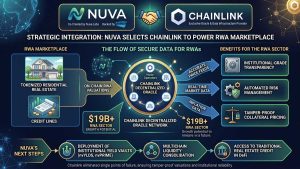
The backing of Lido adopting CCIP as the official infrastructure for wstETH and the connection to Solana channeling over $19 billion in liquidity are not mere technical integrations. They are statements of intent. They are building the rails upon which not humans, but software agents with purchasing power and decision-making capacity will travel. In this scenario, LINK ceases to be a subscription to weather data and becomes the fuel and toll for the autonomous economy.

The Proof of Truth: The Differentiating Factor for Trustworthy AI
Here lies the philosophical and economic core of this revolution. Generative AI is brilliant at creating text and images, but it is terrible at distinguishing truth in adversarial environments. In decentralized finance, “Garbage In, Garbage Out” is the difference between profitability and instant ruin.
How can an AI agent, programmed to maximize yield, know if the proof-of-reserves report it is reading on Blockchain X is legitimate or a mirage created by an attacker? The answer lies not in a more powerful LLM, but in cryptographically verifiable data. Chainlink is closing this loop with tools that go beyond price:
On-Chain Reputation for Agents: In this very month of April 2026, a system has materialized where CCIP publishes the “credit score” of AI agents. This means a smart contract can reject a transaction not because the agent lacks funds, but because its behavioral history is suspicious. This is the creation of the credit history of machines.
Real-World Verification: The alliance with Validation Cloud points to a future where an agent can visually verify an external event (e.g., “Has the insured ship sailed?”) before releasing a payment on the blockchain.
This “Proof of Truth” layer is the secret ingredient that generative AI models like GPT need to act in the real financial world. Without Chainlink as a verifying intermediary, AI on blockchain is limited to trading chatbots. With Chainlink, it becomes an infallible autonomous banker.
The Filter of Time and the Institutional Catalyst
I am aware of the skepticism. “LINK has been promising for years and the price doesn’t reflect the fundamentals.” It’s a valid criticism I have shared myself during bear cycles. However, we must apply an appropriate time filter. Institutional-grade infrastructure is not built in 4-month hype cycles; it is built in regulatory and banking integration cycles of 4 to 5 years.
The fundamentals have changed radically in 2026. We have LINK ETFs in the approval process (with Bitwise leading the charge), opening a floodgate of passive capital that is currently non-existent for the token. We have projections from banks like Standard Chartered pointing to a price of $15 by year-end, not as a chimera, but as a logical revaluation of a utility with a natural monopoly in its niche.
If the AI agent economy takes off (and everything points to this being the dominant narrative of the second half of this decade), the most optimistic models placing LINK in the $25 to $35 range do not seem far-fetched. Not because it is the “next meme coin,” but because it will be the operational reserve currency for a new class of digital workers who never sleep.
Patience as a Competitive Advantage
The cryptocurrency market is designed to reward immediate narrative and punish silent building. Chainlink has been the quintessential silent builder. While other projects were selling dreams of 10,000 transactions per second, Chainlink was laying the wiring that now transports $18 billion a month without making a sound.
The hidden value of LINK is precisely that: the noise has not yet reached the ears of the general retail public. The “price oracle” narrative is a smokescreen hiding the reality of computable trust infrastructure for AI.
Thinking LINK is expensive today, looking at its $6 billion market cap versus the $60 billion it secures, is like thinking the power grid was overvalued just before the invention of the assembly line. Autonomous AI agents will be the largest consumers of “verifiable trust” the world has ever seen. And Chainlink, with CCIP and its verifiable data, is the only power provider that has proven capable of keeping the lights on in the middle of the crypto storm.
It’s not about whether AI will define the future of blockchain; it’s about who will provide it with the map and the compass. And that answer, silent but overwhelmingly evident in the data, is Chainlink.