TLDR:
- Mubadala Investment Company increased its position in the iShares Bitcoin Trust (IBIT) to reach 12.7 million shares.
- Al Warda Investments also raised its stake, bringing the combined investment of both funds to over $1 billion.
- The purchases were strategically executed during market dips, reinforcing the thesis of long-term institutional accumulation.
It was revealed on Tuesday that Abu Dhabi funds surpassed $1 billion in Bitcoin exposure through regulated U.S. vehicles. According to recent 13F filings with the SEC, firms such as Mubadala Investment Company and Al Warda Investments took advantage of the volatility in the fourth quarter of 2025 to accumulate millions of shares in BlackRock’s ETF, IBIT.
This financial maneuver demonstrates that temporary price pullbacks do not intimidate large state-owned capital. On the contrary, the steadfastness of these United Arab Emirates government entities underscores a diversification strategy into digital assets aimed at stability and growth over a multi-year horizon.
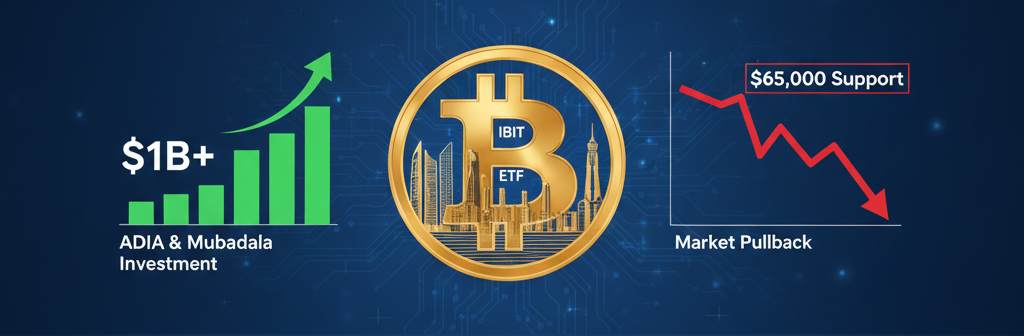
Strategic accumulation and institutional resilience in 2026
Although the value of these holdings fluctuated at the beginning of 2026 due to recent market corrections, the commitment of these sovereign wealth funds remains unchanged. Consequently, the interest in liquid and regulated products continues to displace direct investment in traditional exchanges, offering governments an essential layer of security and regulatory compliance for managing assets of this magnitude.
Robert Mitchnick, Head of Digital Assets at BlackRock, explained that the perception of hedge funds being responsible for selling pressure is erroneous. Instead, the firm’s data suggests that large IBIT holders maintain a “buy and hold” outlook, acting as a fundamental support for the cryptocurrency market structure.
In summary, the news that Abu Dhabi funds have consolidated such a level of exposure is a milestone in the validation of Bitcoin as a legitimate store of value for nation-states. Global analysts remain focused on how this flow of sovereign capital will influence other funds in the region, potentially driving a new wave of massive institutional adoption in the coming months.